
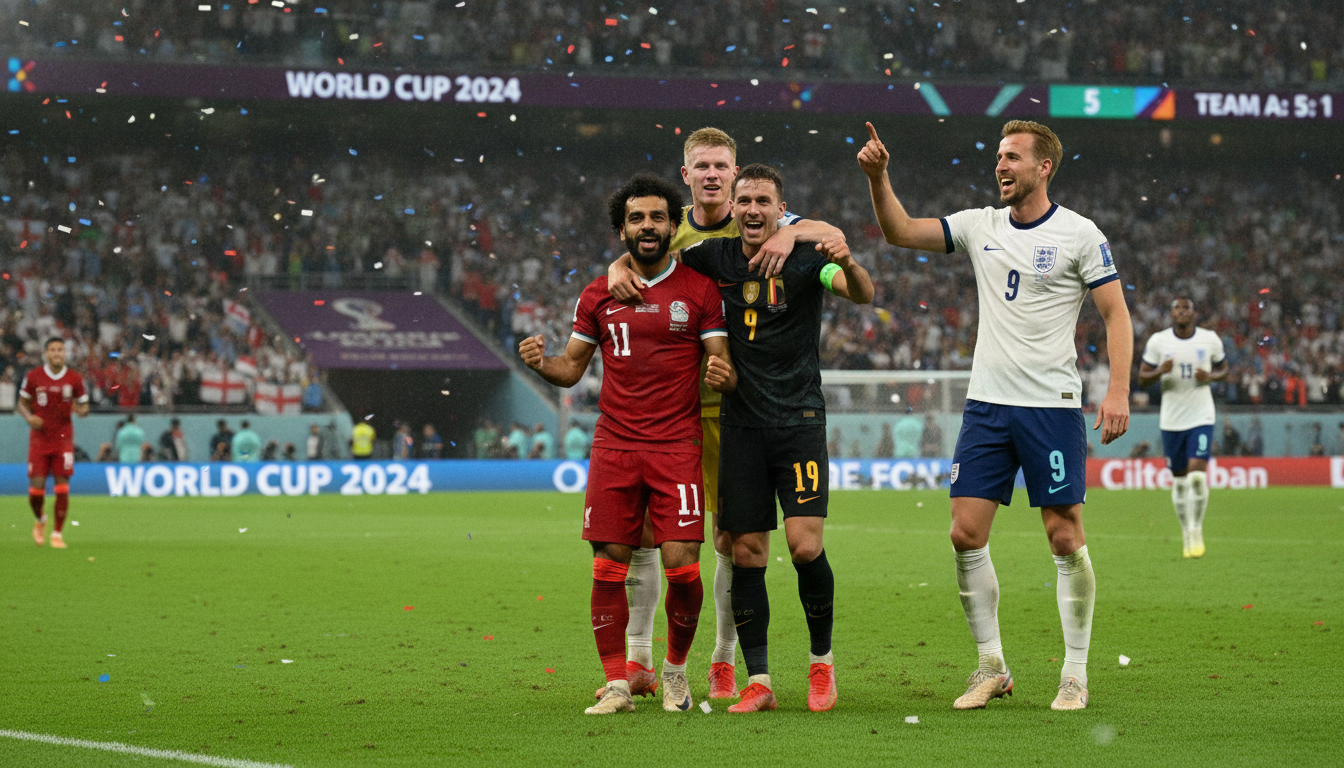
World Cup goals surge: 121 in 40 matches as ball design, stoppage time and club talent drive scoring spike
The tournament has produced a torrent of World Cup goals early on, with 121 strikes in the first 40 matches and an average of three per game that is eclipsing recent tournaments.
Scoring spike in opening matches
The World Cup has delivered an unusually high scoring rate through its opening fixtures, producing 121 goals from 88 different players over 40 games.
That tally translates to an average of three goals per match and includes eight own goals and only three scoreless draws.
Statisticians and commentators say the pace of scoring has already put the competition on track to surpass past tallies when normalized to the tournament’s expanded match list.
Tournament organisers and team officials have pointed to several on-field factors that appear to be increasing goal opportunities and conversion rates.
Ball design flagged as a factor
FIFA introduced a new match ball for this edition, and its manufacturers describe features intended to enhance in-flight stability and grip in humid or wet conditions.
Several coaches and players have publicly commented that the ball seems to travel at higher velocities, increasing the challenge for goalkeepers on long-range strikes.
“I think today and the last couple of days, you saw if you kick the ball in the right position, it’s extremely difficult to save,” Austria coach Ralf Rangnick observed, reflecting widespread player sentiment.
Added surface grip and pronounced seams have been cited as contributors to both strike precision and unpredictable flight, particularly in fast-paced volleys and driven shots.
Match length and format widening opportunities
Newly introduced hydration breaks and the increased allowance for stoppage time have extended effective playing minutes, creating more opportunities for late goals.
Observers also note that the tournament’s expansion to 48 teams has widened the talent spread, producing matches with larger margins and more chances for prolific scorers.
Those structural changes combine with tactical trends favoring attack-minded play to elevate both the frequency and variety of scoring chances.
As a result, the early phase of the World Cup has seen a higher conversion rate on clear-cut chances than in many recent global tournaments.
Premier League players top the scoring charts
Players affiliated with England’s Premier League at the time squads were announced have been the leading source of goals, contributing 28 of the tournament’s strikes so far.
Across Europe’s top divisions, 16 goals came from the German Bundesliga, 11 from Spain’s La Liga, seven from France’s Ligue 1 and five from Italy’s Serie A.
Major League Soccer-based players accounted for eight goals, highlighted by Lionel Messi’s multi-goal performances that included a hat trick in his national team’s opener.
Those figures reflect club affiliation at the moment of official squad submission, a metric FIFA uses to attribute player representation by league.
Club-level contributions and standout names
Real Madrid-listed players have combined for six goals in the early rounds, with contributions spread among several national team stars.
Liverpool’s contingent has also been productive, contributing multiple goals from a mix of international players, while Bayern Munich players have supplied important strikes as well.
Manchester City, despite fielding the most players at the tournament on paper, have yielded comparatively few goals so far, underscoring the disperse nature of scoring across clubs and national teams.
The distribution of goal scorers underscores how elite club training environments feed into national-team performances on the global stage.
Comparison with prior tournaments and club competitions
When projected to a 64-match span for direct comparison, the current scoring pace would approach nearly 194 goals, well above the 172-goal total recorded in 2022.
Analysts caution that such comparisons are imperfect because this tournament includes more matches and different competitive dynamics than recent editions.
Beyond the World Cup, continental club competitions have also trended toward higher scoring, with recent Champions League seasons recording increases in average goals per game.
Those parallel trends suggest broader tactical shifts and perhaps changes in equipment and training that favor attacking play across levels of the sport.
The early tournament numbers—driven by ball characteristics, extended playing time, the expanded field and concentration of top-club talent—have produced a vivid and sustained scoring surge that continues to reshape expectations for the competition.
