
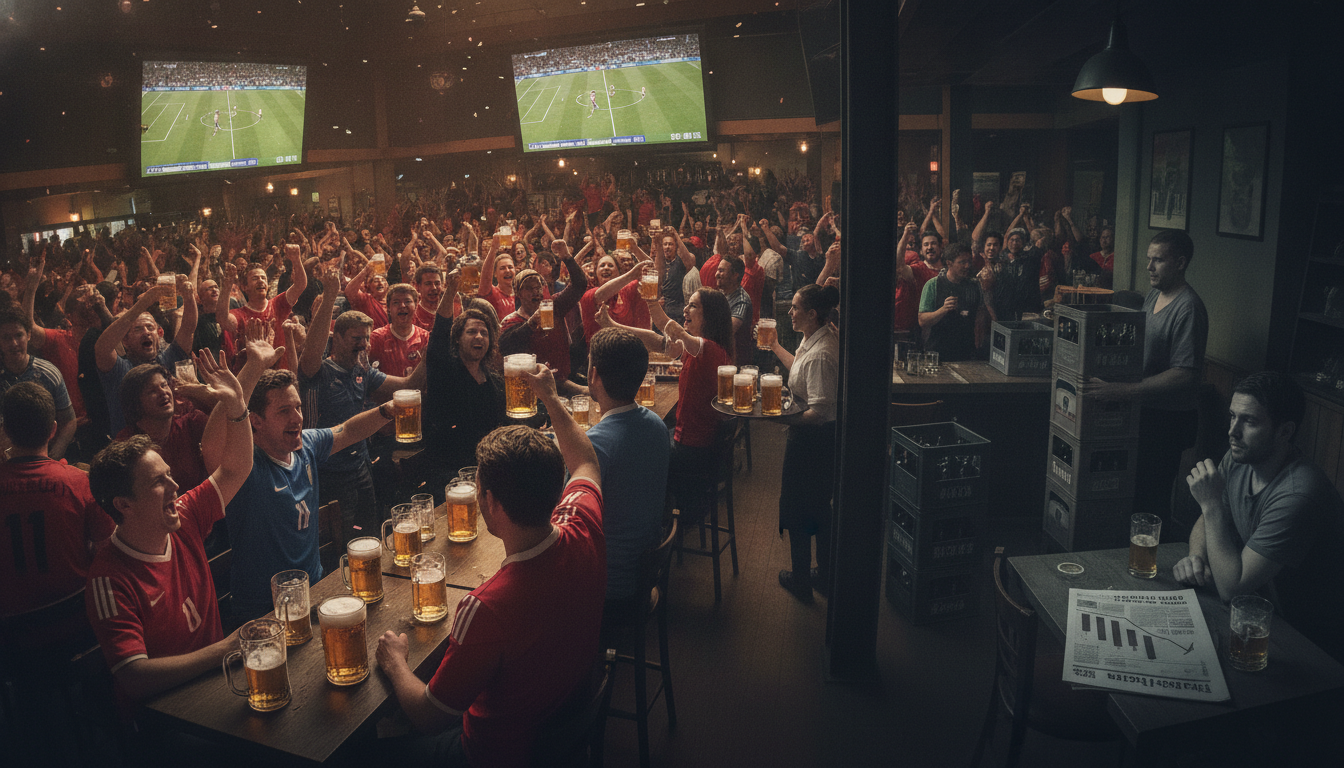
World Cup Drives Local Beer Sales but Fails to Reverse Global Downtrend
World Cup beer sales surged in host cities, yet global beer sales remain under pressure as health, economic and lifestyle shifts continue to reshape demand.
The World Cup delivered a conspicuous uptick in beer sales in match cities, but the wider beer market shows persistent weaknesses that predate the tournament. Stadiums and bars experienced packed crowds and heavy pours — including nearly 290,000 beers consumed across six Philadelphia matches — yet industry data point to a long-running decline in overall beer sales across major markets. Brewers and wholesalers say the event produced a temporary lift, not an immediate turnaround, leaving questions about long-term recovery.
World Cup Surge in Stadiums and Bars
Tournament venues and local pubs reported unusually high volumes, with some establishments requiring emergency restocking to keep taps flowing. In Boston, a flagship taproom arranged back-to-back deliveries after a wave of visiting supporters tapped kegs dry during early matches.
Organizers and brewery sponsors staged large-scale promotions and watch parties, amplifying in-person viewing and on-premise consumption. The effect was particularly visible in host cities, where bars, restaurants and stadium concessions posted double-digit percentage gains in the opening weeks compared with the prior year.
Long-term Decline in U.S., Canada and Europe
Despite the World Cup bump, beer sales trends remain negative across several key regions, driven by a decade-long slide in per-capita consumption. Industry trade groups and national statistics agencies report falling volumes in the United States, Canada and the European Union, reflecting a structural softening rather than a cyclical blip.
Craft and mainstream brewers have struggled to offset lost volume with premiumization and new brands, and share prices for some global brewers moved on match outcomes and investor sentiment during the tournament. Market watchers caution that event-driven spikes rarely change the underlying trajectory without sustained shifts in consumer behavior.
Health and Economic Forces Shaping Demand
Shifts in personal health attitudes and broader affordability concerns have eroded routine beer drinking among many consumers. Surveys indicate growing public skepticism about daily alcohol consumption, and beverage-market research firms link falling consumption to tighter household budgets and changing lifestyle priorities.
At the same time, demand has migrated toward low- and no-alcohol alternatives and other “wellness” beverages, though non-alcoholic beer still represents a small slice of total market volume. These patterns suggest that while consumers may drink more at celebratory events, they are cutting back in everyday life.
Brewers’ Marketing and Event Strategies
Global brewers leaned into the tournament with sponsorships, promotions and localized marketing to capture fandom-driven consumption. The official sponsor staged hundreds of thousands of watch parties worldwide, and competing brewers increased marketing spend and launched limited-edition products aimed at matchday crowds.
Brewers also emphasized on-premise experiences to counteract at-home viewing trends and the broader “cocooning” effect attributed by wholesalers to streaming and smartphone entertainment. Company executives say large events are an opportunity to remind consumers of beer’s social role, even as they expand portfolios with lower-alcohol options.
Regional Mood and Match Outcomes Affect Sales
The link between national team performance and consumer behavior was visible in several host cities, where local mood swings altered nightlife patterns. In markets where favored teams were eliminated, public gatherings and bar traffic notably diminished, influencing short-term sales for brands tied to those teams or regions.
Industry observers point out that emotional highs and lows around specific matches create volatility for retailers and brewers, complicating inventory planning and marketing effectiveness. This episodic nature underscores why single events, however large, rarely produce a sustained reversal in beer sales trends.
Looking Ahead: Olympics, NCAA Changes and Industry Outlook
Executives and trade groups are pinning hopes on a slate of upcoming sporting events and policy shifts to extend momentum from the World Cup. The relaxation of long-standing advertising restrictions for alcohol at major college tournaments and the promise of large-scale events such as the Los Angeles Olympics are being framed as opportunities to rebuild on-premise occasions.
Still, industry leaders stress that converting episodic spikes into long-term gains will require adapting to changing tastes, investing in lower-alcohol lines, and finding ways to attract younger and health-conscious consumers. The challenge for brewers will be balancing traditional marketing around camaraderie with new product strategies that align with evolving consumer expectations.
Consumer behavior after the World Cup will determine whether the tournament stands as a memorable short-term boom or as a modest bright spot in a longer era of subdued beer sales.
