
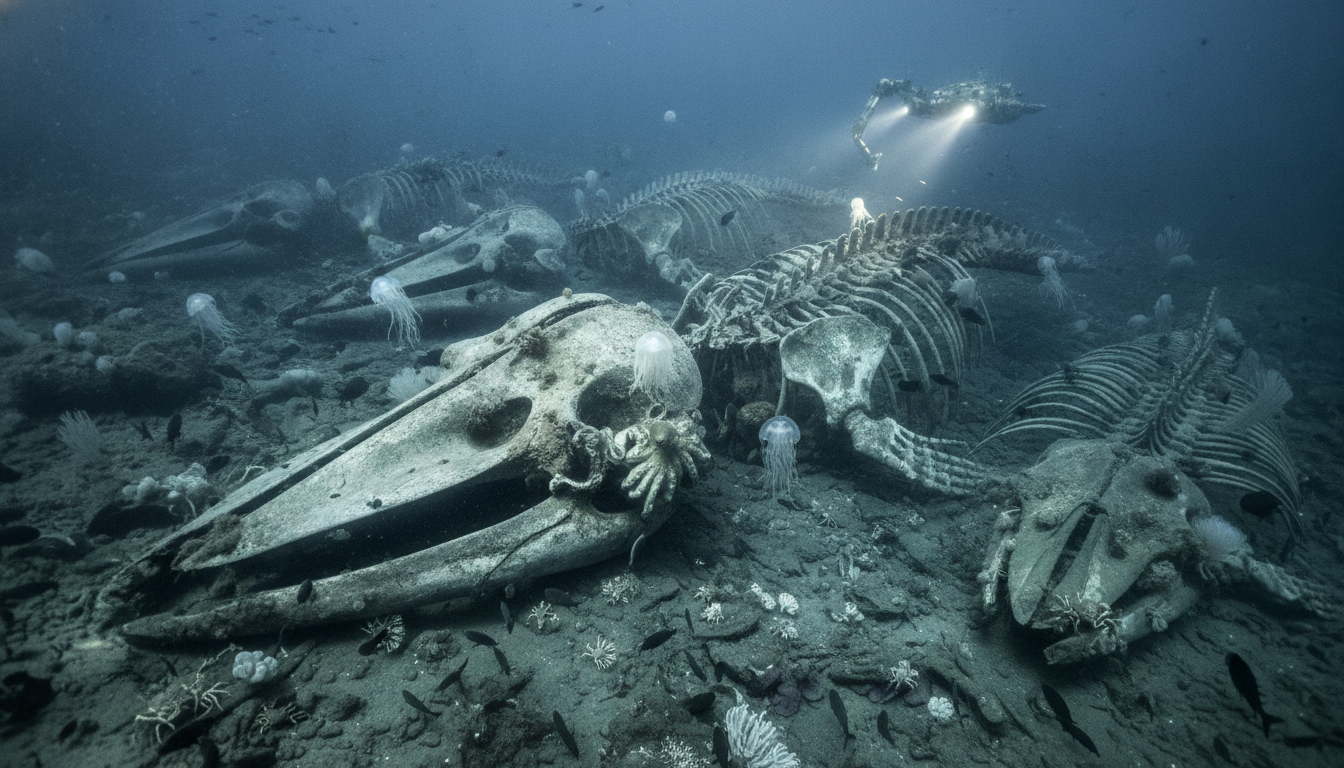
World’s largest whale cemetery discovered in southeastern Indian Ocean
Researchers discover near 500 fossil skeletons in a whale cemetery off western Australia, revealing rich deep‑sea life and long‑term carbon storage.
The world’s largest whale cemetery has been identified along a 1,200‑kilometre corridor in the southeastern Indian Ocean, according to a study published in Nature. The discovery — with nearly 500 fossil whale skeletons lying at roughly 7,000 metres depth — reveals a sprawling deep‑sea ecosystem sustained by whale carcasses and suggests a continuous accumulation of remains for millions of years.
Massive assemblage mapped west of Australia
The site stretches along the Diamantina region off western Australia and contains at least 485 documented fossil cetacean skeletons, many concentrated in a V‑shaped trench that funnels falling carcasses to the abyssal plain. Some of the bones have been dated to roughly 5.3 million years ago, and researchers say the pattern points to a long‑running sink for whale remains.
Scientists estimate that, when extrapolated across the entire corridor, more than 10 million whale skeletons could rest beneath the seabed in this area. The scale and depth of the assemblage make it by far the largest whale graveyard yet recorded.
A surprising variety of deep‑sea life
Explorations showed that whale bones on the seafloor are far from barren; they host dense communities that include jellyfish, brittle stars, bone‑boring worms and bivalves. Many of the organisms appear adapted to exploiting whale‑fall resources, and some may be previously unknown to science, the study’s authors report.
Researchers liken these concentrated food sources to hydrothermal vents in the way they sustain chemosynthetic and scavenger communities on a local scale. The bone deposits appear to connect otherwise patchy deep‑sea habitats and help maintain biodiversity in an environment that is otherwise cold and nutrient‑poor.
Exploration by deep submersible revealed the site
The findings came after 32 dives in 2023 using the Chinese manned submersible Fendouzhe, which carried up to three people and used robotic arms to collect fossil fragments. Lead and co‑authors on the paper include researchers from the Chinese Academy of Sciences, who catalogued the skeletal remains and associated fauna during the missions.
Scientists described their direct observations of the seafloor communities as unexpectedly flourishing given the extreme depth. The physical sampling allowed paleontologists to establish ages for some fossils and identify at least one previously unknown species of beaked whale among the remains.
Implications for carbon and palaeontology
Beyond ecology, the mass of tissues and lipids trapped in the corridor is substantial. Study authors estimate the whale remains contain roughly 6.7 million tonnes of CO2‑equivalent carbon in the form of preserved organic matter, highlighting an underappreciated role for whale falls in long‑term carbon sequestration on the deep seafloor.
The continuous accumulation of carcasses over at least five million years offers a rare long‑term record for researchers studying whale evolution and distribution. Paleontologists say the assemblage provides a new window into how cetacean communities changed through geological time and how deep‑sea ecosystems responded.
Broader significance and future research directions
Oceanographers not involved with the study called the discovery remarkable for its scope and for the insight it provides into deep‑sea connectivity. The authors note that similar fossil evidence recovered from commercial trawls hints that other large whale‑fall sites may exist off South Africa and the Iberian Peninsula, warranting further survey work.
The research also raises questions about how modern whale populations and human activities intersect with these deep‑sea processes. Scientists say further sampling and genetic analysis of the organisms living on the bones will be required to determine how many species are new to science and how these communities are linked to vents and cold seeps.
The discovery of this whale cemetery in the Diamantina region reframes the seafloor as an active, long‑term repository of animal life and carbon, and it opens new avenues for studying deep ocean ecosystems and the palaeobiology of whales.
