
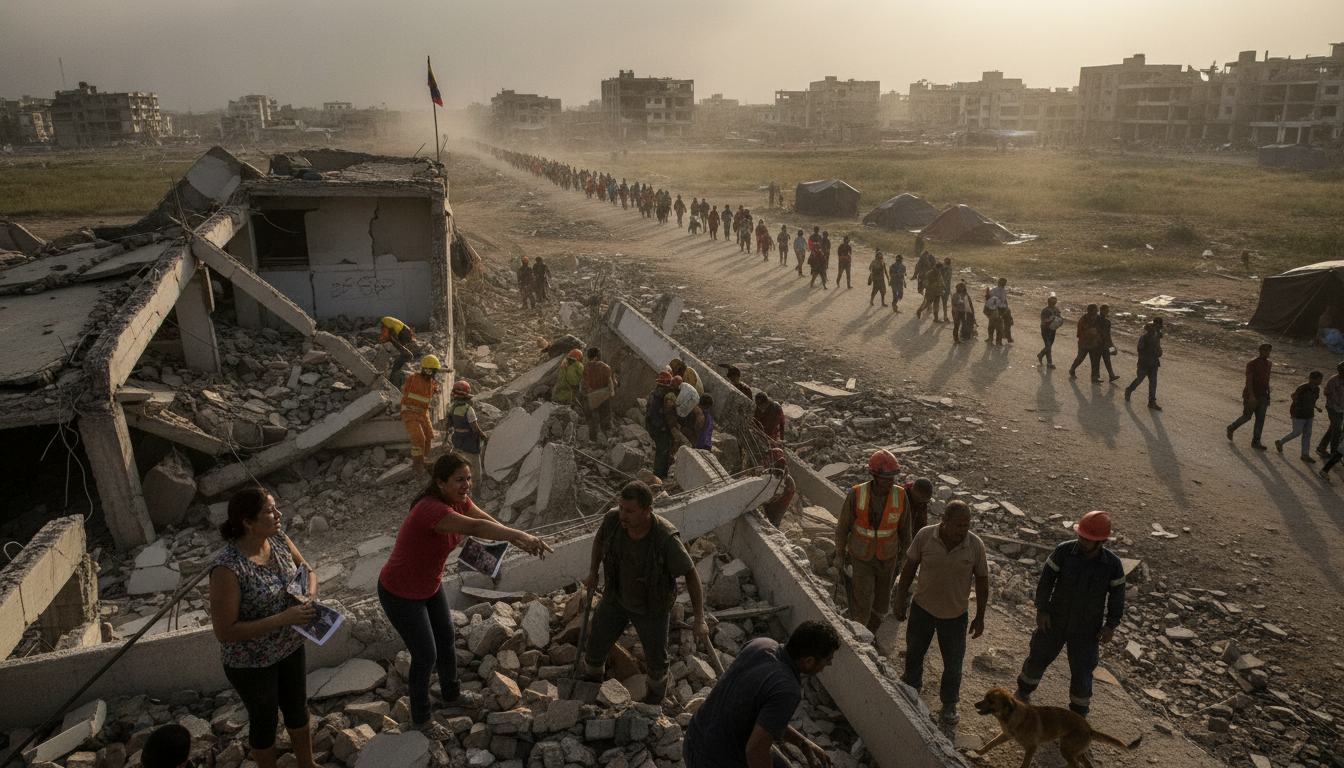
One month after Venezuela earthquakes, families still search rubble as toll tops 5,500
One month after Venezuela’s June 24 earthquakes, families continue to search collapsed buildings for missing loved ones as the death toll tops 5,500 and calls for urgent aid grow. The Venezuela earthquakes remain at the centre of national mourning and mounting international concern over recovery capacity. (daily-sun.com)
Search teams and families keep digging
Volunteer rescue crews, neighbours and relatives have carried out rounds of painstaking searches amid heaps of concrete and twisted metal, refusing to leave sites where loved ones are believed to be trapped. Makeshift altars and memorials have appeared outside damaged apartment blocks as communities mark the month since the twin temblors.
Local rescuers say operations are hampered by continuing instability in damaged structures and the slow arrival of heavy equipment needed to remove large volumes of debris. Families and volunteer groups report frustration over access to lifting gear and forensic capacity to recover and identify remains.
Confirmed toll and large numbers still missing
Venezuelan and international sources report the disaster has killed more than 5,500 people, with thousands more listed as missing on public registries and community lists. Authorities and humanitarian agencies caution that official counts may rise as search efforts continue in hard-hit coastal zones. (daily-sun.com)
Officials have repeatedly warned that the scale of destruction — hundreds of collapsed or structurally compromised buildings across the Caracas and La Guaira corridors — complicates accurate accounting and delays closure for many families. Survivors describe months of uncertainty as the names of the missing accumulate on community-led databases.
Damage assessment and reconstruction costs
A preliminary World Bank assessment puts direct physical damage from the June 24 quakes at about $19.6 billion, underscoring the financial challenge of rebuilding homes, schools and infrastructure. The bank’s early estimate stresses that total recovery costs, including debris removal and stronger reconstruction standards, could be two to two-and-a-half times higher. (worldbank.org)
Experts say Venezuela will need a coordinated mix of public finance, concessional lending and international grants to mount a multi-year recovery. The World Bank and regional development partners have begun technical discussions with Venezuelan authorities to scope immediate financing and the steps needed to resume long-term reconstruction planning. (worldbank.org)
Humanitarian needs and aid delivery gaps
United Nations agencies and relief organisations report large humanitarian needs across health, shelter, water and sanitation, and protection services, with children especially vulnerable to disruption. UNICEF and other UN offices warned that hundreds of thousands of children require urgent assistance for basic services and psychosocial support as displacement and camp conditions persist. (unric.org)
Humanitarian coordinators have described bottlenecks in scaling up aid, including logistics constraints, limited safe access to some neighbourhoods and funding shortfalls for programmes already under way. While some countries and organisations deployed search-and-rescue teams and shipments of relief goods in the immediate aftermath, agencies say more predictable financing is required to shift from emergency response to early recovery. (relief.unboundmedicine.com)
Public health, shelter and child protection concerns
Health services remain strained where hospitals were damaged or where clinics cannot operate at full capacity, increasing risks of secondary health crises such as infections and interruptions in chronic care. Humanitarian actors report gaps in clean water and sanitation that raise the potential for disease outbreaks in informal camps and damaged neighbourhoods. (unric.org)
Protection groups warn of heightened risks to children and women in displacement settings, including loss of documentation, family separation and exposure to exploitation. Agencies are prioritising family-tracing, mental-health support and emergency education to reduce longer-term harms while reconstruction planning proceeds. (unric.org)
Political and logistical hurdles to a swift recovery
Observers note that Venezuela faces not only a physical rebuilding task but also political and financial hurdles that could slow reconstruction. The complexity of unfreezing or reallocating international assets, the country’s pre-existing economic challenges, and limited access to some forms of multilateral finance are cited as obstacles by analysts and development banks. (worldbank.org)
Coordination between national authorities, UN agencies and bilateral partners will be critical to prioritise rehabilitation of lifelines such as water, power, roads and housing. Aid groups say transparent, needs-driven planning and rapid mobilization of equipment and funds are essential if communities are to be rehoused safely and quickly. (relief.unboundmedicine.com)
As families marked the first month since the twin tremors, the sense of urgency remained palpable: relatives still search for the missing, communities mourn the dead, and humanitarian and development bodies press for scaled-up, sustained support to move Venezuela from rescue to recovery.
