
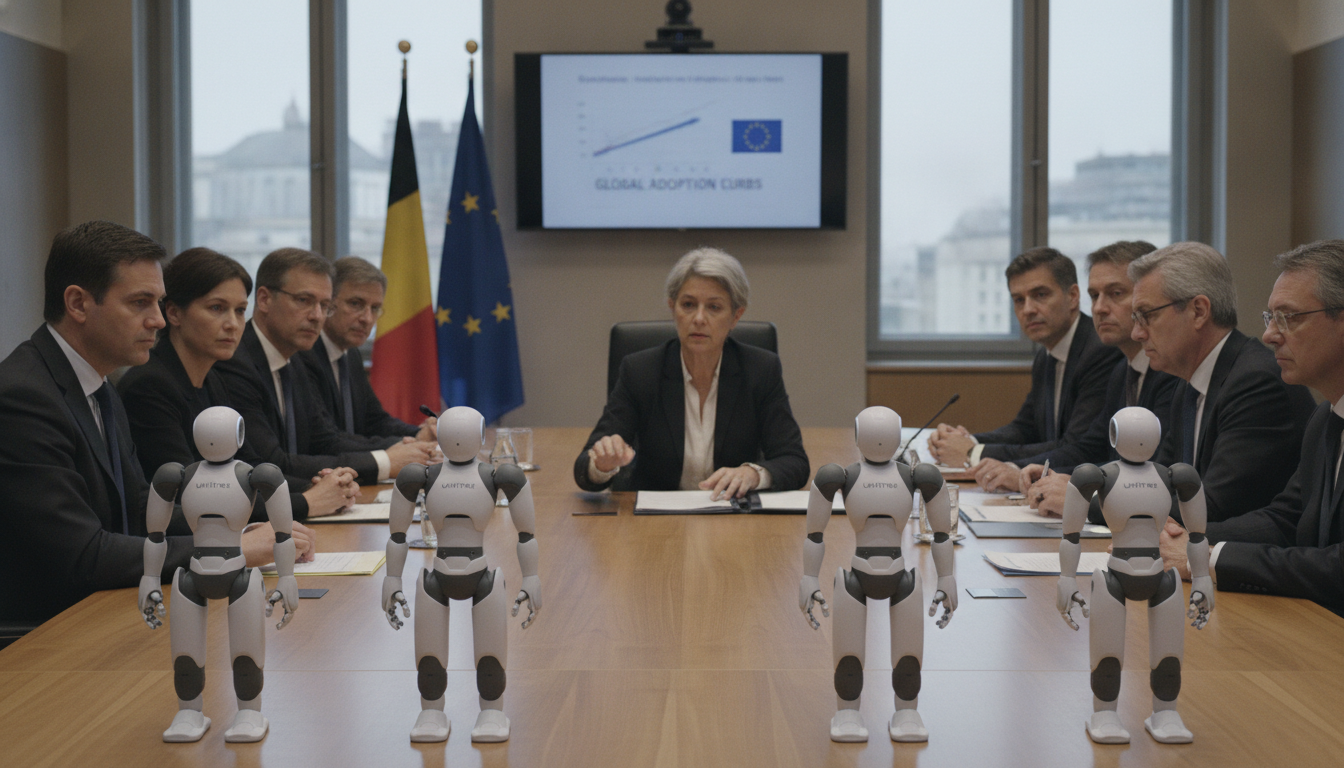
Proposed ban on AI-powered humanoid robots could hit Unitree, analysts warn
Proposed restrictions on AI-powered humanoid robots may hurt Chinese maker Unitree, which holds nearly one-fifth of the global market, analysts warn.
Humanoid robots equipped with AI-driven control systems are poised for wider industrial and consumer use, but a proposed ban on certain models threatens to upend market forecasts and supplier plans. Market researcher Counterpoint Research estimates Unitree commands just under 20% of the global humanoid robot market, a concentration that would leave the company particularly exposed. Industry observers say the debate over limits has intensified as hardware capabilities and onboard artificial intelligence advance rapidly. Regulators and policymakers are weighing options that could reshape deployment timelines worldwide.
Unitree’s Market Share Leaves It Vulnerable
Unitree has emerged as one of the most prominent manufacturers in the nascent humanoid robot category, securing a significant share of sales outside of legacy industrial robotics. Counterpoint Research’s estimate that Unitree controls nearly one-fifth of the market places it among a small group of firms defining early standards. That concentration means any broad restrictions or bans would likely have outsized commercial consequences for the company. Suppliers, investors and customers are watching regulator signals closely for indications of enforcement scope and timing.
Unitree’s product lineup, focused on cost‑competitive, AI‑enabled platforms, helped the firm scale quickly into new markets. Analysts note the firm’s rapid growth stems from aggressive pricing, modular designs and partnerships that accelerate integration into service and logistics trials. Still, dependence on a limited number of markets and components could magnify the impact of export controls or domestic prohibitions. Company responses to regulatory moves will determine how much market share it may retain or cede to rivals.
Regulatory Proposals Target AI-Powered Humanoid Robots
Lawmakers and regulatory bodies in several jurisdictions have opened consultations on how to manage risks linked to autonomous humanoid systems, citing safety, privacy and dual‑use concerns. Proposals under discussion range from stricter certification requirements to outright restrictions on certain capabilities for consumer-facing models. Those proposals have not coalesced into uniform global policy, but even localized restrictions can ripple through international supply chains and distribution agreements.
Regulatory uncertainty is prompting firms to reassess deployment timetables and compliance budgets. Manufacturers designing for global markets now face the prospect of multiple, potentially conflicting compliance paths. That could slow product rollouts, increase costs for certification and steer investment toward adaptable architectures that can be limited by software rather than hardware.
Industry Momentum for Humanoid Robots Remains Strong
Despite regulatory headwinds, demand signals for humanoid robots in manufacturing, logistics, inspection and hospitality remain robust. Companies cite potential labor shortages, repetitive task automation and new service models as drivers for adoption of humanoid platforms. AI capabilities that enable perception, manipulation and navigation are central to these use cases and continue to improve, widening the range of feasible deployments.
Venture capital and corporate R&D funding have continued to flow into humanoid systems, though investors are increasingly factoring regulatory risk into valuations. Startups and incumbents alike are focusing on modular software stacks, safety certification processes and partnerships with established industrial integrators. These strategies aim to make adoption simpler for enterprise customers while addressing compliance expectations.
Supply Chain and Manufacturing Implications
A ban or restrictive regime affecting AI-powered humanoid robots would reverberate through component suppliers and contract manufacturers that support the sector. Key subsystems—sensors, actuators, onboard compute and specialized servos—are produced by a web of suppliers across multiple countries. Disruptions could force manufacturers to retool sourcing strategies or to relocate production to jurisdictions with clear regulatory frameworks.
Smaller suppliers could be squeezed if demand contracts or requirements for certified components rise. Conversely, firms specializing in compliant safety modules and sensors could see new business opportunities. The net effect will depend on the specificity of any measures and whether regulators favor certification over prohibition.
Consumer Adoption and Safety Concerns
Consumer interest in humanoid robots is growing alongside industrial use cases, but concerns about safety, misuse and privacy persist. Advocates for regulation argue that clear rules will protect the public by limiting risky capabilities and ensuring robust safety testing. Opponents caution that overly broad restrictions could stifle innovation and deny consumers access to useful technologies.
Manufacturers are responding by adding fail‑safe behaviors, user control mechanisms and transparent operation modes to their designs. Developers emphasize that many current humanoid platforms rely on supervised operation and are not fully autonomous, but regulators and the public continue to demand demonstrable safeguards.
Analysts say a balanced approach that targets specific risks while preserving pathways for testing and controlled deployment would minimize disruption. They recommend phased implementation of rules and harmonized standards to avoid fragmenting markets and supply chains.
The proposed restrictions on AI‑powered humanoid robots present a pivotal moment for an industry on the cusp of wider adoption. How regulators frame the rules, and how firms such as Unitree adapt their product strategies, will shape the sector’s growth trajectory and who leads the market in the years ahead.
