
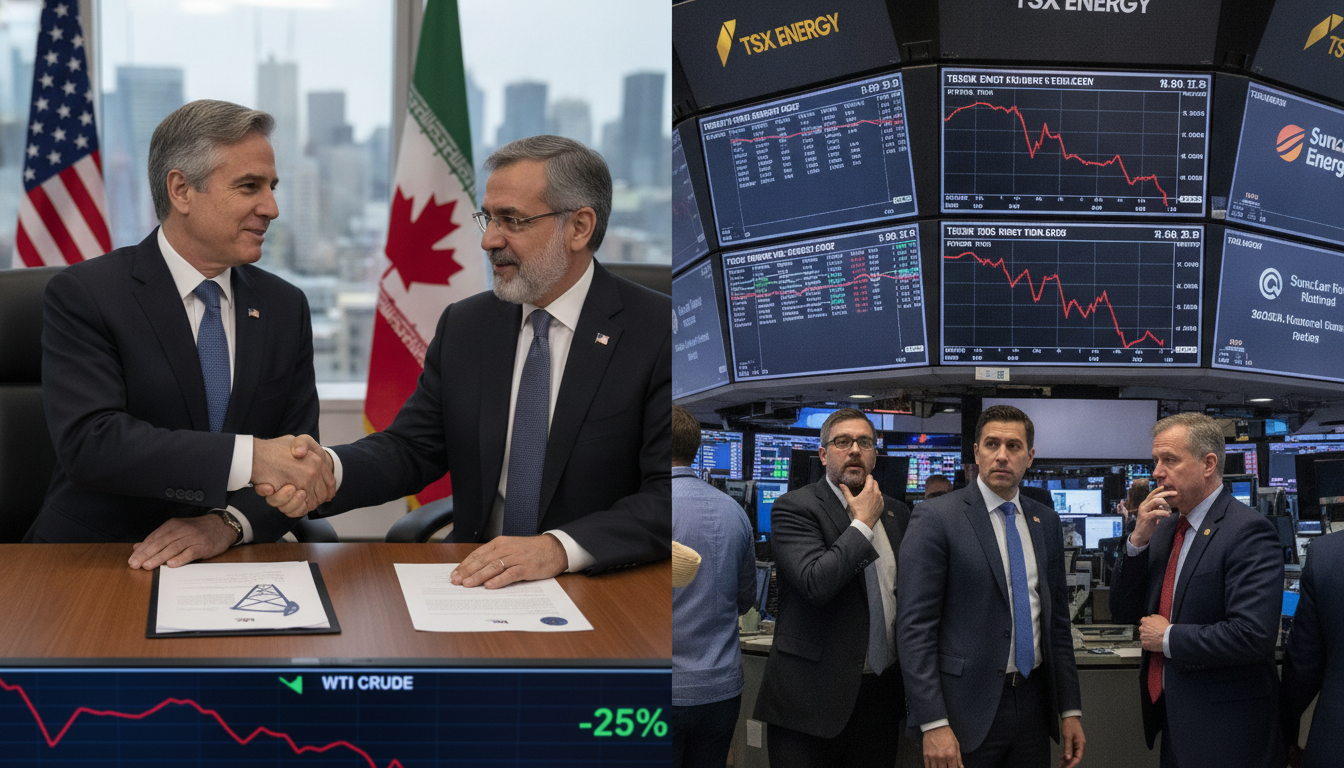
Strait of Hormuz reopening seen as conditional; oil prices fall and Canadian energy stocks retreat
A tentative U.S.-Iran agreement and talk of the Strait of Hormuz reopening pushed U.S. crude down to US$80.75, denting Canadian energy shares and clouding fuel and economic forecasts.
U.S.-Iran conditional deal triggers crude price drop
U.S. benchmark West Texas Intermediate tumbled more than four per cent on Monday to close at US$80.75 a barrel after reports that Washington and Tehran reached a conditional agreement. The outline reportedly allows 60 days for negotiators to resolve outstanding issues tied to Iran’s nuclear program, and U.S. officials signaled the Strait of Hormuz could reopen if terms hold.
President Donald Trump publicly promised the strategic waterway would be reopened under the deal, a development that briefly eased risk premia in oil markets. Traders reacted to the prospect of resumed shipments, but market participants cautioned the announcement did not instantly restore lost production or inventories.
Supply disruption persists despite agreement
The conflict that began at the end of February effectively halted shipment flows through the Strait of Hormuz, a choke point that normally handles roughly one-fifth of global oil and liquefied natural gas. Damage to regional energy infrastructure sent WTI above US$112 a barrel in early April after the year began near US$57.
Energy analytics firms estimate global output has fallen about 10 million barrels per day from pre-conflict levels, while inventories have been drawn down by roughly half a billion barrels. Analysts warn those deficits will limit how quickly markets can normalize even if the strait reopens on schedule.
Analysts warn inventories keep prices elevated
Executives and market strategists signaled that a headline agreement may not immediately change the supply-demand picture. Enverus vice-president of intelligence Al Salazar said the report is constructive but does not erase a structurally tight market, noting potential for prices to drift higher as low stock levels become more apparent.
Forecasts from industry analysts remain elevated: Brent crude is expected to average around US$110 a barrel for the remainder of the year, with WTI about US$5 below that level, reflecting continued concern about constrained supplies and the summer driving season.
Canadian markets and energy sector reaction
Canadian oil and gas stocks declined as U.S. crude pulled back, with the S&P/TSX Capped Energy Index dropping roughly 2.7 per cent on the day. Despite the pullback, the energy index remains materially higher year to date, reflecting earlier price spikes and renewed investor appetite for producers.
The broader S&P/TSX composite closed up nearly one per cent, gaining more than 300 points, as other sectors offset weakness in energy. Producers in Canada have generally adopted a cautious stance on capital spending, lifting budgets modestly for the back half of the year but stopping short of large-scale investment increases.
Alberta outlook and corporate caution
Provincial forecasts remain resilient even if crude prices retreat from recent highs. ATB Financial has revised Alberta growth to an estimated 2.6 per cent for the year, up from a December forecast of 2.1 per cent, based on an assumed oil price near US$84 a barrel.
Industry leaders stressed discipline will likely continue. Executives at services and exploration firms said demand fundamentals have not shifted dramatically due to the reported deal, and many companies plan to preserve capital discipline rather than chase short-term price moves.
Fuel prices and motorists’ prospects
Retail gasoline in Canada averaged about $1.76 per litre on Monday, according to fuel analytics firm Kalibrate Canada, and consultants note that price relief for motorists will lag any crude decline. Historical pass-through suggests each US$10-per-barrel move in oil translates to roughly a nine-cent-per-litre change at the pump, but low inventories and peak summer demand will slow that transmission.
With the busy driving season under way, analysts caution that even a sustained easing of geopolitical risk may not produce immediate cuts at the pump. Market participants said it will take time for refined-product flows and inventories to rebuild to levels that put downward pressure on retail prices.
Looking ahead, investors and policymakers will watch the coming 60 days closely as negotiators attempt to convert the conditional agreement into a durable settlement that restores regional flows. Even if the Strait of Hormuz reopens, physical repairs, shipping logistics and depleted global inventories mean energy markets are likely to remain volatile in the months ahead.
