
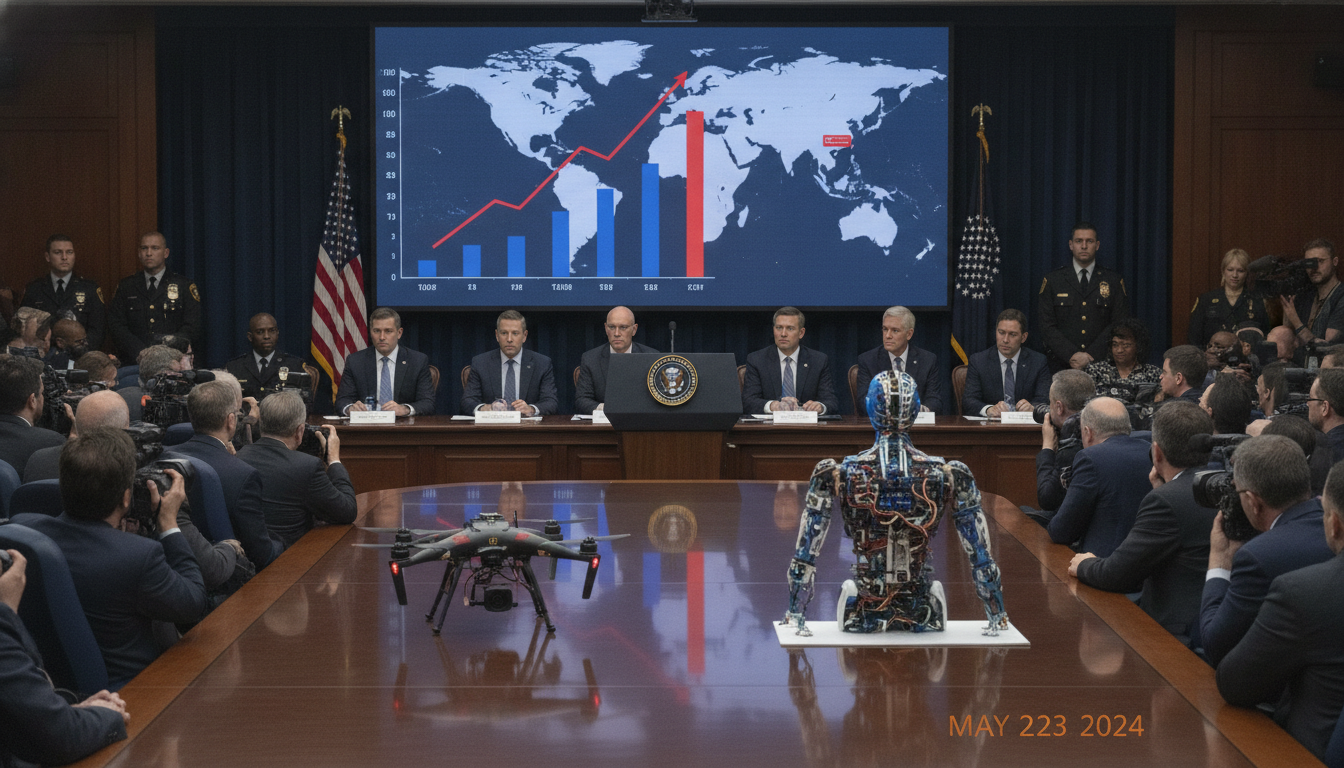
U.S. Restrictions on Chinese Drones and Humanoid Robots Reshape Global Robotics Market
New U.S. tariffs and FCC limits on Chinese drones and humanoid robots aim to protect national security while prompting a fragmented, regionally driven robotics market.
U.S. policy moves narrow market access
In July and August, Washington announced a pair of measures targeting foreign-made advanced robotic systems, tightening FCC controls and imposing steep tariffs on imported drones and components. The U.S. restrictions on Chinese drones and humanoid robots are being framed by officials as national-security steps to prevent foreign technologies from becoming embedded in critical infrastructure and defense supply chains. The tariffs are scheduled to begin in September, with additional component duties rolling out in 2027, signaling a phased effort to reduce reliance on certain foreign suppliers. Industry observers say these actions mark a significant policy shift with immediate commercial and strategic consequences.
China’s manufacturing scale and cost advantage
Chinese manufacturers have rapidly scaled production of both consumer and industrial robots, dominating global shipments of humanoids and low-cost drones. Counterpoint Research and other market trackers report that the majority of recent humanoid robot volumes come from Chinese firms, allowing them to push prices lower and gain deployment data at scale. That combination of manufacturing depth, supply-chain integration and aggressive cost curves gives Chinese companies an advantage that simple trade restrictions cannot erase. Analysts warn that without long-term investment in domestic scale, the United States risks ceding broad segments of the market on price alone.
Where Chinese firms are likely to expand
If barred from the U.S., Chinese robotics companies are expected to pursue growth in markets with high demand for affordable automation, including Southeast Asia, Latin America, parts of Europe, and the Middle East. Executives and analysts say those regions face labor shortages and rising wages that make low-cost robotic solutions particularly attractive, creating commercial openings for high-volume Chinese producers. Companies may follow a familiar pattern: build dominance at home, export to price-sensitive markets, and then localize production to overcome trade barriers. The result could be a China-led ecosystem that serves much of the world outside strict-security jurisdictions.
Fragmentation: two ecosystems for drones and robots
Observers describe an emerging split in the robotics industry: a U.S.-led, security-focused ecosystem and a China-led, cost-driven ecosystem. In drones, this bifurcation is already visible through the growth of NDAA-compliant systems in the U.S. and high-volume, lower-cost platforms elsewhere. For humanoid robots, the divergence could intensify as buyers with security priorities favor vetted suppliers, while other customers prioritize price and rapid deployment. This fragmentation raises questions about interoperability, standards and the future shape of global supply chains for components such as batteries, sensors and AI software.
Opportunities for allies and regional manufacturers
The U.S. restrictions are likely to accelerate investment and partnerships among allied manufacturers in Japan, South Korea, Taiwan and parts of Europe. These countries bring strengths in precision manufacturing, electronics, semiconductors and automotive-scale production that could form the backbone of a diversified allied supply chain. Automakers and industrial groups already moving into robotics may bridge gaps between the low-cost and high-security segments by offering mid-market alternatives. Still, experts caution that no single country can immediately replace China’s scale, so a patchwork of regional supply chains is the more plausible near-term outcome.
Technology competition shifting beyond hardware
Industry leaders argue that the next competitive front will be software, energy systems and payload capabilities rather than just mechanical platforms. Battery and power-architecture improvements, advanced autonomy stacks, and specialized payloads for inspection or logistics could determine which suppliers capture high-value segments. Western firms may concentrate on these areas where security and performance matter most, while Chinese firms exploit volume advantages in standardized hardware. The interplay between component innovation and manufacturing scale will shape winners and losers across commercial and defense markets alike.
The U.S. restrictions on Chinese drones and humanoid robots represent a deliberate attempt to reshape where and how advanced robotics are sourced and deployed, but they do not eliminate the underlying global economic pressures that favor scale and low cost. Policymakers face a choice between rapid defensive measures and long-term industrial strategies that build domestic capacity and allied partnerships. The coming years will reveal whether the measures spur new regional alliances and investment, or simply redirect Chinese manufacturing power into other global markets where security constraints are lower.
