
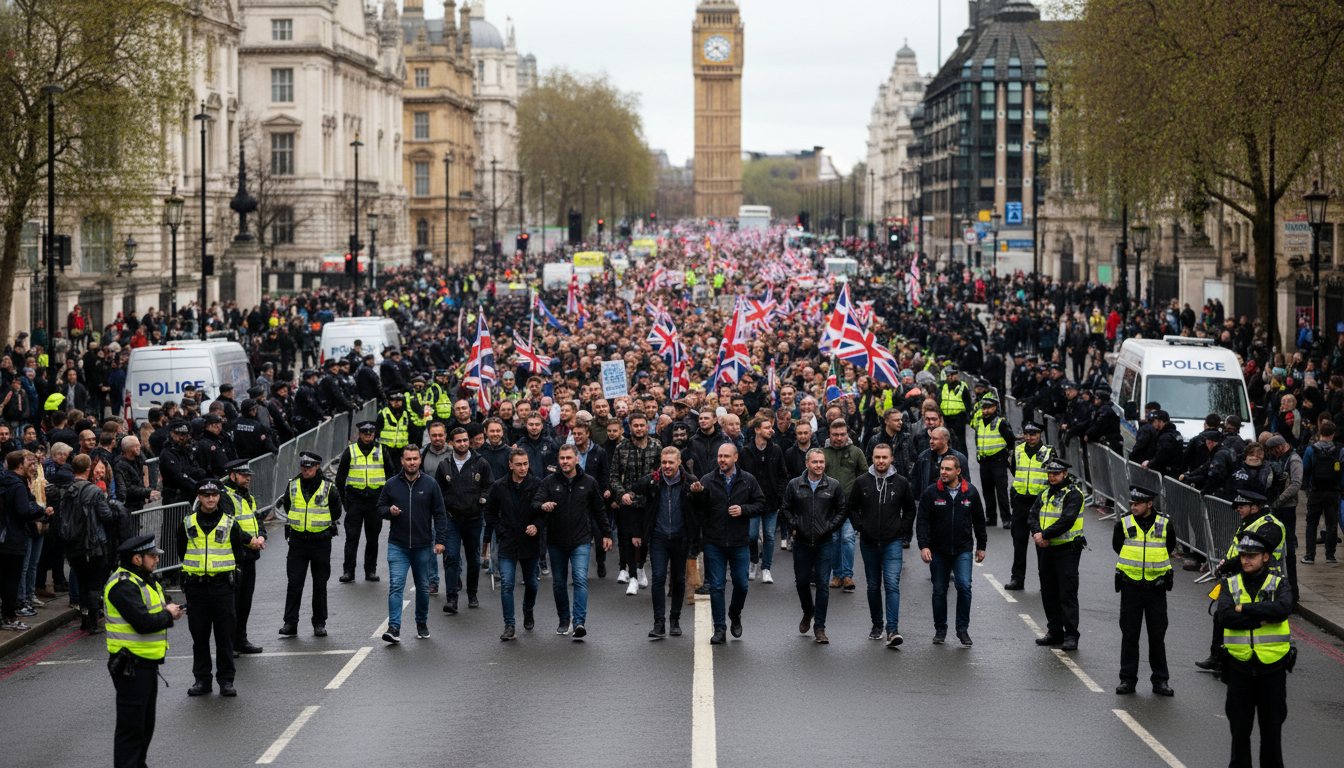
Tommy Robinson rally in London draws tens of thousands amid heavy police operation
Tommy Robinson rally in London drew tens of thousands on May 16, 2026, as a major police operation managed parallel Nakba commemoration and multiple arrests across London.
Large pro-Robinson rally draws tens of thousands
On Saturday, May 16, 2026, a Tommy Robinson rally in London gathered tens of thousands of supporters on the esplanade beside the Houses of Parliament. Organizers billed the event as "Unite The Kingdom," and crowds waved Union Jacks as speakers, musicians and religious figures took turns on a raised platform. The demonstration recalled a larger march in September, when organisers said up to 150,000 people attended, though police figures for Saturday were not immediately provided.
Supporters included well-wishers from across the UK and abroad, some carrying portraits and religious imagery, while others wore historical costumes or displayed nationalist symbols. The protest was led by Stephen Yaxley-Lennon, known publicly as Tommy Robinson, a polarizing activist with a history of legal trouble. Organisers said the rally aimed to defend freedom of speech and national borders.
Police deploy unprecedented security operation
Metropolitan Police deployed a large security operation to manage the two rival demonstrations and a major sporting event held the same day. Authorities said nearly 4,000 officers were mobilised, supported by armoured vehicles, drones, helicopters and live facial recognition technology — a measure the force said was used at a demonstration for the first time. Police maintained cordons to keep rival groups apart and said their planning sought to prevent disorder on some of central London’s busiest streets.
The force issued an updated statement late Saturday reporting 43 arrests linked to the two demonstrations, with a further 22 arrests at the FA Cup final at Wembley. Police said four officers were assaulted and six had been subjected to offences deemed to be hate crimes, but added that none of the injured had been seriously harmed. The operation reflected concerns about clashes and the need to secure large public gatherings across the capital.
Parallel Nakba march draws thousands and condemns far-right
A separate pro-Palestinian march marking the 78th anniversary of the Nakba was held in parallel and drew several thousand participants, according to journalists at the scene. Demonstrators carried keffiyehs, Palestinian flags and chanted slogans calling for an end to British support for Israeli policies, and many described their presence as both a commemoration and a protest against the far right. Police established buffer zones to keep the two processions apart and to reduce the risk of direct confrontations.
Organisers of the Nakba march described the event as a remembrance of displacement and a stand against racism and fascism in Britain and Europe. Voices at the rally said they were alarmed by what they see as a rise in xenophobic rhetoric and stronger far-right organising. The atmosphere was charged but, according to police, did not erupt into widespread violence.
Speakers and symbols on Whitehall reflected varied agendas
Speakers at the Robinson rally ranged from political firebrands to religious preachers, and groups from outside the UK also appeared on stage. Members of the French identitarian collective Nemesis, including its leader, were reported to have joined the platform, drawing attention with provocative dress and rhetoric denouncing Islamist influence in Europe. Among the crowd were people carrying crosses, images of Jesus, and others dressed in medieval-style armour advocating symbolic calls for a "return to the crusades."
Attendees interviewed at the event voiced a mix of concerns over immigration, border security and cultural identity. An 81-year-old supporter described himself as encouraged by growing public backing, while younger participants cited family safety and illegal migration as motivators for attending. Opposing protesters and many observers, however, characterised the messages on display as divisive and extremist.
Political leaders and parties respond amid election-year watch
Although the rally was not officially affiliated with Reform UK, the event took place in a political climate reshaped by recent local-election gains by Nigel Farage’s party and polling that leaves attention on future national contests. Prime Minister Keir Starmer publicly condemned organisers, describing them as "thugs" and accusing some of spreading hatred and division. Parliamentary figures and community leaders voiced concern that such gatherings could deepen social fractures if unchecked.
Security services and ministers had already signalled heightened vigilance after the government raised the national terrorism threat level to "severe" in early May, citing increased risks from both Islamist and far-right actors. That wider security context shaped police tactics on the day and informed political debate about how to balance public order, civil liberties and the right to protest.
Wembley final and citywide policing added complexity
The FA Cup final at Wembley Stadium, where Manchester City defeated Chelsea before a crowd of around 90,000, added a further layer of operational pressure for police and emergency services. Authorities said 22 arrests were made in connection with incidents at or around the stadium, though officers did not link the football-related arrests directly to the political demonstrations. The concurrent high-profile sporting fixture meant resources had to be coordinated across multiple sites in central London.
Commanders said the simultaneous events created logistical challenges but argued that careful planning and visible policing helped to prevent large-scale disorder. CCTV, mounted units and public-order teams were positioned on key routes such as Whitehall and in the vicinity of the Palace of Westminster. Officials emphasised that preventing escalation between rival groups remained the priority throughout the day.
Despite the scale and emotive content of both gatherings, the Metropolitan Police maintained that no major incidents occurred that would have led to wider public harm. The events underscored the deep divisions in British public life over immigration, national identity and foreign policy, and they left communities and politicians debating how best to respond to heightened tensions while protecting the right to protest.
