
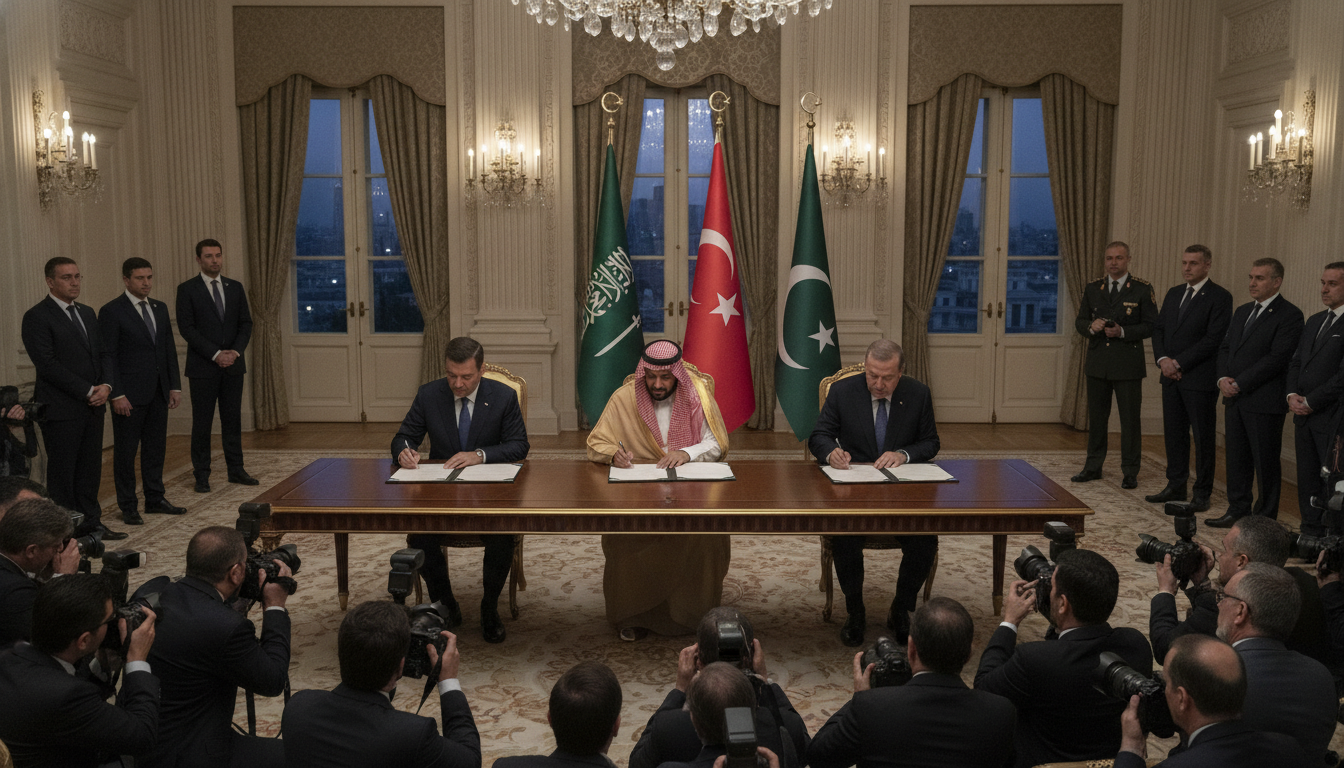
Saudi Arabia defence pact: Riyadh signs trilateral military agreement with Turkiye and Pakistan
Saudi Arabia’s new defence pact with Turkiye and Pakistan signals Riyadh’s move to diversify security ties amid Gulf tensions and scrutiny of US influence.
Saudi Arabia has signed a trilateral defence pact with Turkiye and Pakistan, a move Riyadh says will broaden its security partnerships beyond longstanding reliance on the United States. The Saudi Arabia defence pact was announced at a ceremony in Mecca as regional tensions spike, notably around the conflict in Yemen and enduring Iran–US diplomatic frictions. Analysts say the agreement aims to formalize military cooperation and send a diplomatic signal that Riyadh is recalibrating its strategic options.
Agreement announced in Mecca
The three nations unveiled the Mecca pact in a coordinated announcement that officials described as a framework for defence cooperation. Details released by the governments emphasize joint training, logistics support and high-level military consultations rather than permanent basing or immediate force deployments. Saudi, Turkish and Pakistani officials said the pact was designed to be flexible, allowing bilateral follow-up arrangements tailored to each partner’s capabilities.
Timing amid intensifying regional clashes
The pact arrives as Saudi-backed Yemeni government forces have launched operations against Houthi units, and as Iran and the United States remain unable to finalize a diplomatic settlement that could stabilise parts of the region. Riyadh’s move to deepen ties with Ankara and Islamabad comes amid heightened maritime and aerial security concerns across the Red Sea and Gulf of Oman. Regional analysts note the timing underscores Riyadh’s desire to build contingency options should diplomatic or military support from traditional partners falter.
Scope of military cooperation outlined
Government statements and officials present at the announcement described the agreement as covering training exchanges, intelligence sharing, joint exercises and defence industry collaboration. Military planners from the three countries are expected to establish working groups to identify interoperable capabilities and logistical support mechanisms. Observers say the pact could accelerate procurement links, allowing Riyadh to diversify suppliers and develop co-production arrangements with Turkish defence firms and Pakistani logistical networks.
Security experts weigh implications for US influence
Analysts interviewed following the announcement suggested the Mecca pact questions, but does not immediately displace, the decades-long US security role in the Gulf. Some experts argue the agreement functions as strategic hedging—Riyadh expanding its options to avoid over-dependence on a single external guarantor. Others caution that deep bilateral ties with Ankara and Islamabad will take time to translate into a durable alternative to American force posture and intelligence cooperation that the Gulf security architecture has long relied upon.
Potential impacts on Yemen and regional hotspots
Officials involved in planning described the pact as potentially easing coordination on contingencies tied to Yemen, counter-piracy operations and regional contingency responses. Riyadh’s immediate operational priorities will determine whether the agreement becomes an active tool for current military operations or remains a diplomatic signal of alignment. The presence of Turkish naval and air capabilities and Pakistan’s logistical reach were cited by officials as complementary assets that could support multinational responses if political leaders choose to operationalize the pact.
Diplomatic balancing with Washington and other partners
Diplomats say the agreement reflects Riyadh’s desire to pursue multi-vector diplomacy while maintaining functional relations with the United States and Gulf Cooperation Council partners. Riyadh has not indicated any withdrawal from existing US-led security arrangements, but the trilateral pact offers negotiating leverage by creating alternative relationships. Western officials, while publicly cautious, have opened private channels to discuss how new regional initiatives might intersect with existing cooperative frameworks.
The Saudi Arabia defence pact marks a notable shift in Riyadh’s security posture by formalizing ties with Turkiye and Pakistan at a moment of heightened regional uncertainty. Whether the agreement becomes a substantive operational partnership or chiefly a political signal will depend on the pace of subsequent implementing measures, the willingness of the three militaries to align standards and the broader trajectory of regional diplomacy.
