
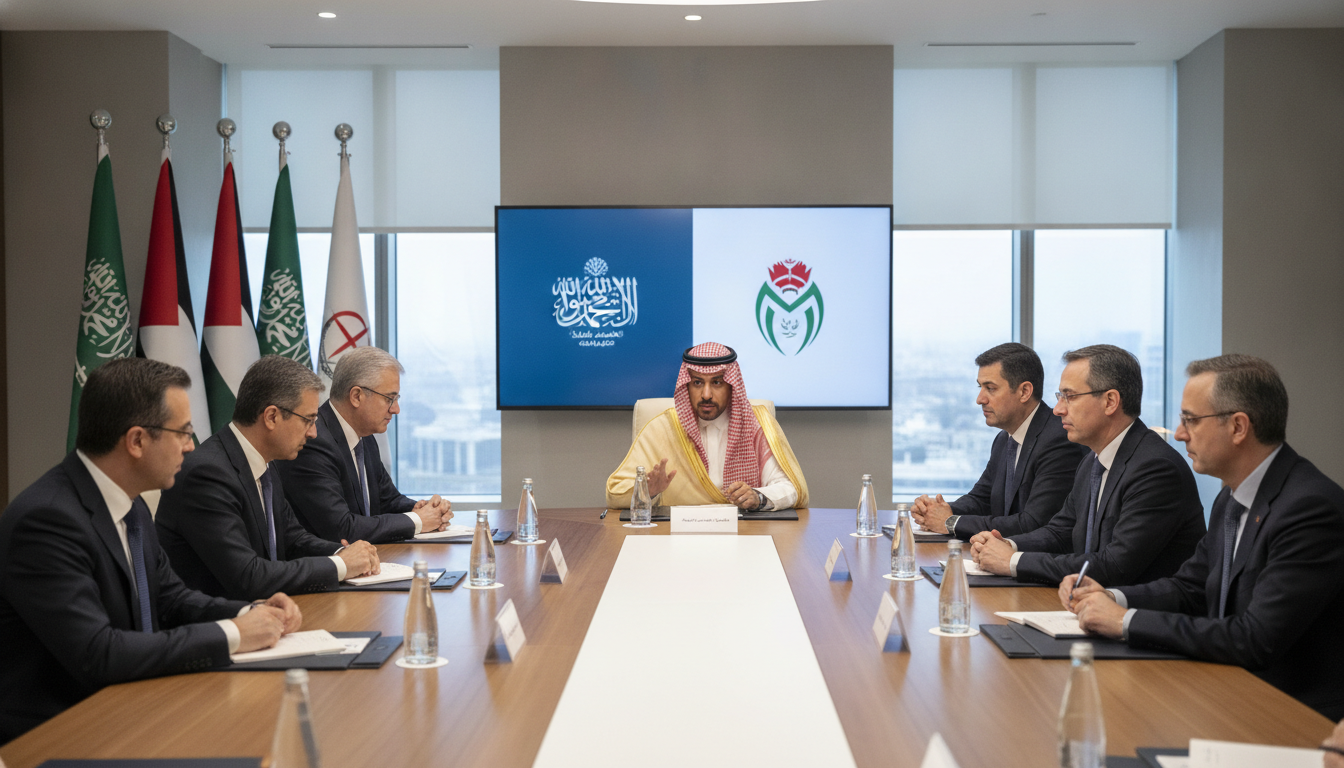
Saudi Arabia and Palestinian statehood drive new global push for a two‑state solution
Saudi Arabia and Palestinian statehood take centre stage as Riyadh co‑leads an international alliance aiming to crystallize a sovereign Palestinian state alongside a lasting peace with Israel, beginning with a 2024 Rome convening.
Saudi Arabia and Palestinian statehood are central to a renewed diplomatic campaign that seeks to translate decades of proposals into an enforceable settlement. Riyadh’s cosponsorship of the Global Alliance for the Implementation of the Two‑State Solution, which met in Rome in 2024, signals a strategic intensification of Saudi engagement.
Historic Saudi policy on Palestinian self‑determination
Saudi leaders have long framed Palestinian statehood as a core national and regional priority, tracing back to policy decisions made under King Faisal. Successive monarchs adapted that principle to changing diplomatic realities while maintaining the central goal of Palestinian sovereignty.
For Riyadh, the question of Palestinian statehood intersects with both domestic legitimacy and regional leadership, making the issue a stable pillar of Saudi foreign policy across generations.
From the Fahd Plan to the Arab Peace Initiative
The kingdom translated its long‑standing doctrine into formal proposals like the Fahd Plan of 1981 and the Arab Peace Initiative of 2002, which offered Israel comprehensive Arab normalization in exchange for withdrawal from territories occupied in 1967 and the creation of an independent Palestinian state. Those frameworks established the concept that recognition of Israel and Palestinian sovereignty are complementary elements of a single settlement.
That diplomatic legacy provides the current leadership with a clear strategic template: seek conditions that make any peace comprehensive, legitimate and irreversible rather than sequentially prioritizing recognition or statehood.
Abraham Accords reshaped regional diplomacy but not the Palestinian issue
The 2020 Abraham Accords demonstrated that some Arab states could normalize ties with Israel without a Palestinian settlement, altering regional alignments and diplomatic incentives. Yet those agreements did not resolve the foundational question of Palestinian statehood or complete the broader peace process.
Saudi officials and many regional actors view Riyadh’s potential participation as qualitatively different from the earlier accords, given the kingdom’s wider political, economic and religious influence across the Arab and Muslim worlds.
Diplomatic environment after October 7 and Gaza ceasefire efforts
The 2023–2024 conflict in Gaza created a new diplomatic milieu, prompting ceasefire initiatives and reconstruction frameworks designed to stabilize the territory and open space for political talks. International mechanisms, including a recently established peace‑board format, aim to create operational conditions under which a political settlement might be pursued.
Riyadh’s approach treats those security and humanitarian steps as prerequisites rather than substitutes for a final political arrangement anchored in a sovereign Palestinian state.
Religious authority and economic leverage behind Riyadh’s stance
Saudi decisions carry religious weight because the monarchy holds the title of Custodian of the Two Holy Mosques, a role that confers considerable influence across Muslim communities. Any Saudi calculation on recognition would therefore require broad religious legitimacy alongside political agreement.
Economically, Saudi Arabia is the region’s largest economy and a global energy heavyweight. That combination of religious and economic clout gives Riyadh leverage that could shape calculations in capitals from Beirut to Jakarta if the kingdom were to endorse a settlement tied to Palestinian statehood.
Regional ripple effects of a Saudi‑backed settlement
A Saudi‑endorsed settlement founded on Palestinian sovereignty would shift the political dynamics in countries that have withheld recognition of Israel, including Lebanon, Syria, Iraq and Algeria. Such a settlement would lower political and religious barriers that now prevent several Muslim‑majority states from normalizing relations.
In states like Pakistan, Indonesia and Malaysia, where domestic opinion and religious leadership have kept governments from recognizing Israel, a settlement accepted by Riyadh would create strong inducements to reassess longstanding positions.
International actors including Israel, the Palestinian leadership, the United States and the European Union all retain indispensable roles in converting this diplomatic momentum into a negotiated settlement. Saudi leaders have reiterated that their final decision will hinge on the irreversible creation of a Palestinian state that commands broad legitimacy.
The path ahead remains uncertain, but Riyadh’s current posture frames Palestinian statehood and Israeli recognition as twin, mutually reinforcing obligations rather than a sequence of unilateral concessions.
A successful outcome would require coordinated action across political, religious and economic spheres and a durable mechanism to guarantee both sovereignty for Palestinians and lasting normalization between Israel and its neighbours.
