
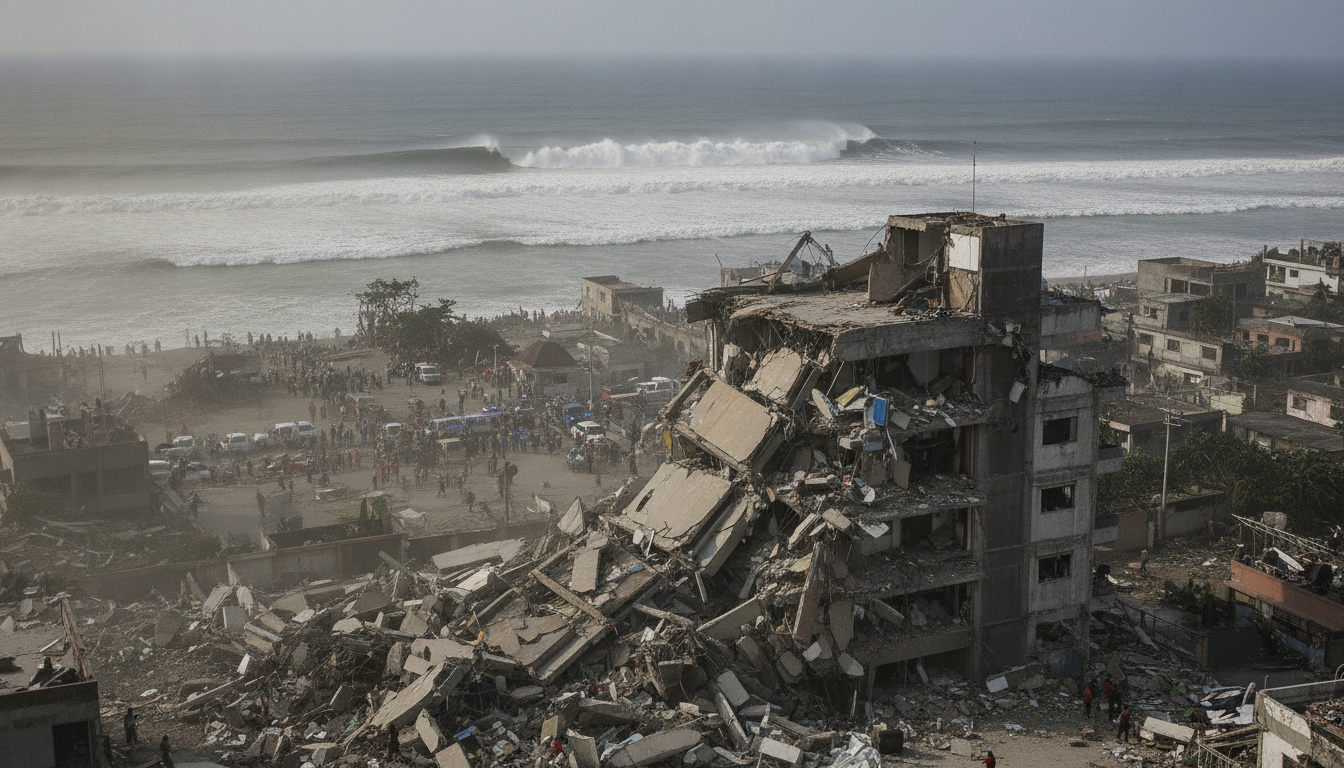
7.8-magnitude Philippines earthquake off Mindanao kills several, collapses buildings and triggers tsunami alerts
7.8-magnitude Philippines earthquake off Mindanao on June 8, 2026 kills several, topples buildings and triggers Pacific tsunami alerts and evacuations.
A powerful Philippines earthquake of magnitude 7.8 struck off the coast of Mindanao on June 8, 2026, causing multiple building collapses, triggering tsunami warnings across the Pacific and prompting large-scale evacuations. The main shock struck at 7:37 a.m. local time and was followed by strong aftershocks, officials and seismic agencies reported. Local authorities issued conflicting early casualty figures as emergency teams rushed to assess damage in coastal communities. Emergency centres in the region and international warning systems mobilized within hours as coastal residents were urged to move to higher ground.
Epicentre, magnitude and timing
The United States Geological Survey (USGS) located the quake’s epicentre about 24 kilometres off Sarangani province, near southern Mindanao, and later revised the hypocentral depth to roughly 55 kilometres. The main tremor registered magnitude 7.8 and was followed by multiple aftershocks, including at least one measured at magnitude 6.1. Seismologists noted the depth and offshore location increased the risk of tsunami generation, prompting immediate alerts from regional centres.
Early reports indicated the shaking was felt across much of southern Mindanao and on neighbouring islands, with videos and eyewitness accounts showing violent motion that threw people into the streets. Transportation services were disrupted and power outages were reported in several towns as assessment teams began moving into the hardest-hit areas.
Damage concentrated in General Santos and surrounding towns
Preliminary ground reports and verified footage showed significant structural failures in General Santos city and nearby municipalities. A shopping centre in General Santos that housed a popular fast-food chain partially collapsed, and local school buildings suffered severe structural damage, according to police and media verifications. Eyewitnesses described concrete slabs giving way and dust-filled streets as residents fled into open areas.
Local police and municipal authorities reported overturned vehicles, cracked roadways and sections of residential neighbourhoods reduced to rubble in the immediate aftermath. Emergency responders focused on search and rescue in areas where buildings had pancaked, but the full extent of casualties and structural losses remained unclear as night fell and communications with some coastal barangays were intermittent.
Tsunami warnings and regional evacuations
The Pacific Tsunami Warning Center (PTWC) in Hawaii issued a bulletin saying tsunami waves were possible along the coasts of the Philippines, Indonesia, Taiwan and as far as Japan within hours of the quake. The centre warned of potential wave heights of 1 to 3 metres above tide level for parts of the Philippines and up to about 0.3 to 1 metre for sections of Indonesia and Malaysia. Japan’s Meteorological Agency issued advisories for its Pacific coast, with waves expected to arrive in some areas later in the morning.
Philippine President Ferdinand Marcos ordered the suspension of classes in affected Mindanao areas and urged immediate evacuation from low-lying coastal zones, stressing the need to reach higher ground without delay. Indonesia’s disaster management agency gave evacuation orders for parts of Sulawesi and neighbouring islands, while coastal communities across the region activated local emergency plans and moved residents to safety.
Government and emergency services mobilize
National and local disaster agencies deployed search-and-rescue units, medical teams and disaster assessment squads to southern Mindanao, prioritizing areas with reported building collapses. Police and municipal officials assisted in evacuation of coastal barangays and established temporary evacuation centres for displaced families. Hospitals near General Santos prepared for surge admissions and emergency supplies were staged for rapid distribution.
The office of the president and the national disaster risk reduction authority coordinated with local governments to monitor aftershocks, tsunami bulletins and transport conditions. Authorities warned residents to avoid coastal roads that were congested with evacuees and to heed official instructions rather than unverified social media reports.
Seismic context and recent history of large quakes
The Philippines sits along the Pacific Ring of Fire, a region of frequent seismic and volcanic activity, and routinely experiences earthquakes of varying strength. The country has endured major earthquakes in recent years, including a deadly event in October 2025 that struck the central archipelago and resulted in dozens of fatalities. Geologists say offshore, shallow or intermediate-depth events in this zone can produce destructive shaking and secondary hazards such as tsunamis and landslides.
Experts reminded the public that aftershock sequences can continue for days or weeks and that further strong tremors are possible following a quake of this magnitude. Coastal communities were urged to remain on higher ground until authorities confirm the end of tsunami danger and to report any observed changes in sea level to emergency services.
Rescue and damage assessments continued into the afternoon and evening as regional agencies coordinated alerts and relief efforts. The situation remained fluid, with authorities stressing that casualty figures and damage estimates were preliminary while teams worked to reach isolated communities and verify conditions across southern Mindanao.
