
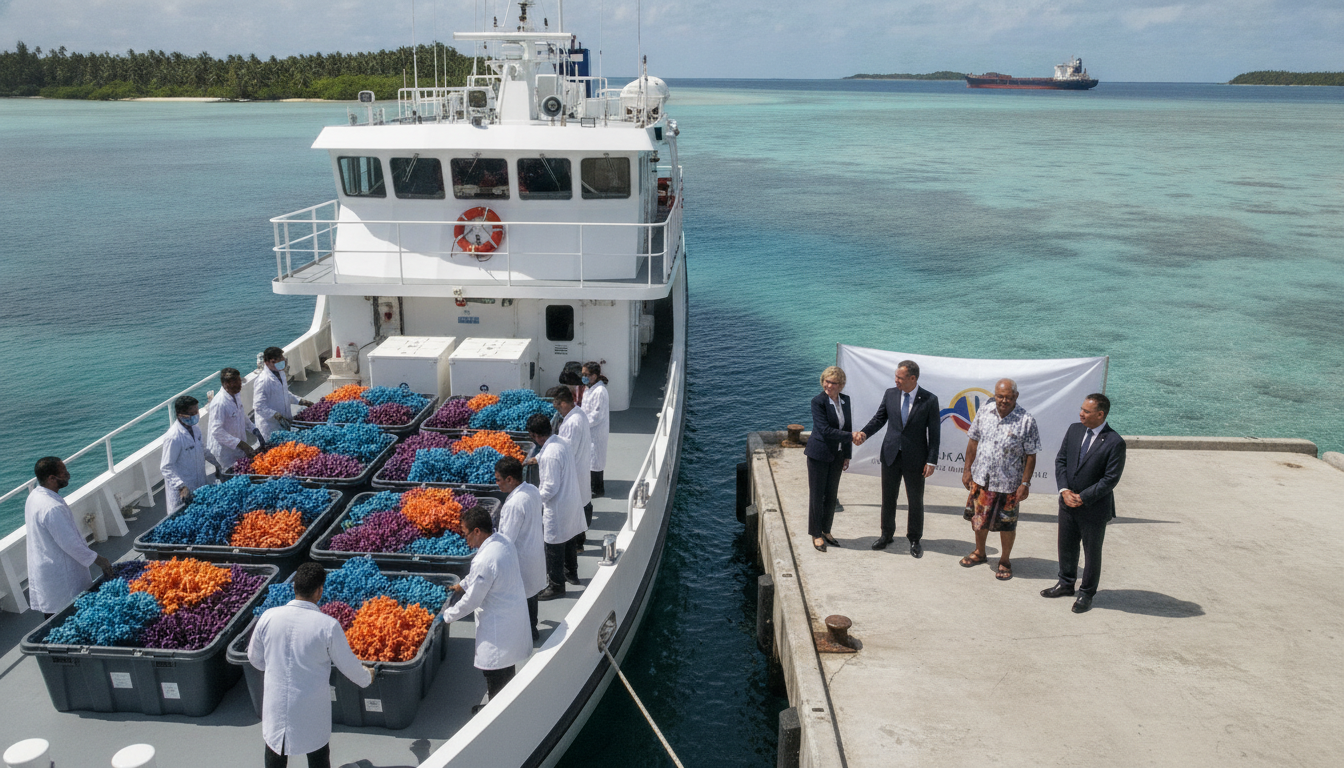
Super coral breeding offers new hope for reefs as Palau’s heat‑tolerant corals resist mass bleaching
A small Pacific nation, Palau, is at the centre of efforts to breed “super coral” — heat‑tolerant corals cultivated to withstand rising ocean temperatures — and researchers say these strains could be used to restore threatened reefs such as Australia’s Great Barrier Reef. The term “super coral” appears throughout early field trials and planning, and scientists are preparing targeted larval releases and cooling experiments to test whether engineered resilience can slow reef decline. If successful, the approach would combine selective breeding, larval propagation and local cooling measures as a potential toolkit for coral conservation under climate change.
Palau’s reefs show unusual heat resilience
Palau’s coral systems have so far avoided the catastrophic bleaching seen elsewhere because many colonies display unusually high tolerance to elevated sea temperatures. Researchers who visited the archipelago documented robust coral cover in locations where comparable reefs have been severely degraded. That resilience has made Palau a priority site for study and the sourcing of hardy coral lineages for breeding programs.
How scientists cultivate “super coral”
Conservation teams are using a mix of techniques to cultivate heat‑resilient corals, including selective breeding, assisted gene flow and larval rearing in controlled conditions. Gametes collected during spawning events are crossbred to favor thermal tolerance traits, then reared as larvae before being settled onto substrates for outplanting. Laboratory and in‑field nurseries are being used to scale up production while researchers monitor growth rates, symbiont communities and survival under heat stress.
Plans to seed the Great Barrier Reef with larvae
Australian researchers have identified the Great Barrier Reef as a priority site for field trials, with plans to disperse resilient larvae across targeted reef sections. Those initiatives aim to test whether introduced traits can increase population‑level resistance without undermining local ecosystem dynamics. Trials will include careful monitoring of genetic mixing, recruitment success and potential ecological trade‑offs over multiple seasons.
Complementary cooling and management strategies
Scientists emphasize that breeding resilient corals is not a standalone solution and must be paired with local cooling and management measures. Pilot projects include shading, increased water circulation and temporary cooling at high‑value reef locations to reduce acute heat stress during peak temperature events. Combined with reductions in land‑based pollution and fishing pressure, these interventions are intended to give restored corals a better chance to establish and reproduce.
Ecological and ethical considerations
Intervening in reef genetics raises ecological and ethical questions that researchers are addressing through staged trials and stakeholder consultation. Concerns include the risk of unintended consequences for local biodiversity, potential loss of genetic diversity if a narrow set of traits is favored, and long‑term ecosystem impacts that may only become apparent over decades. To mitigate these risks, programs are designing trials with diverse parental stock, phased rollouts and independent monitoring by conservation organizations and local authorities.
Regional collaboration and capacity building
Efforts to develop and deploy super coral involve partnerships between Pacific island governments, regional research institutes and conservation NGOs. Capacity building in reef nations is a priority, with training for local technicians in larval collection, nursery maintenance and monitoring techniques. Advocates say that building local capability ensures that restoration is sustainable and aligned with community priorities, including tourism and fisheries livelihoods.
While cultivation of heat‑tolerant coral strains and targeted larval seeding are generating cautious optimism, scientists stress that these measures buy time rather than replace the need for urgent global emissions reductions. Scaling up restoration to cover vast reef areas presents logistical, financial and scientific challenges that will require long‑term commitment from governments and funders.
The coming years will be critical for testing whether the combination of super coral breeding, larval propagation and local cooling can measurably improve reef resilience at ecologically meaningful scales. If field trials demonstrate durable gains in survival and reproduction, the methods could become part of a wider conservation strategy aimed at preserving coral ecosystems under a warming climate.
For now, Palau’s exceptional reefs offer a natural laboratory and a source of hopeful signs, but scientists caution that success will depend on careful experimentation, transparent governance and sustained action on climate change to reduce the underlying threat to the world’s coral reefs.
