
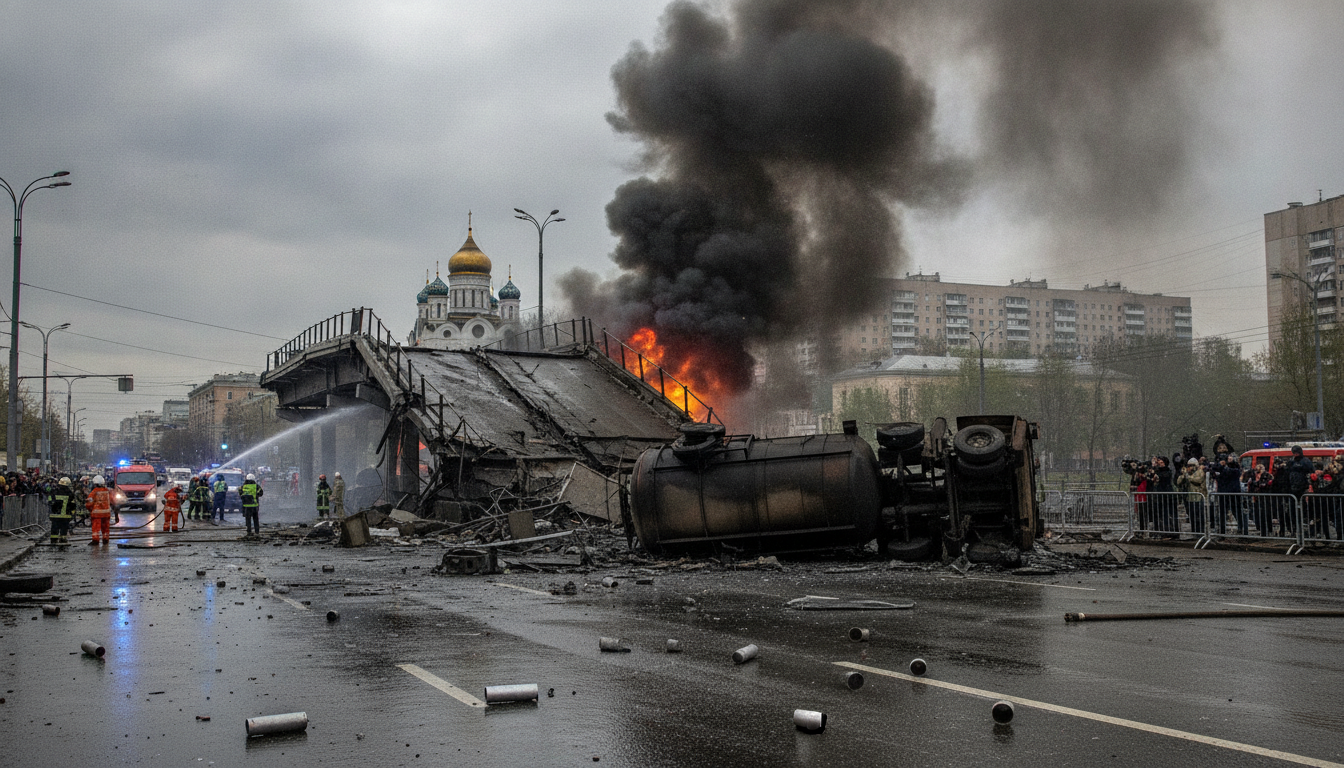
Video shows Moscow tanker blast likely caused by Russian missile
Verified video shows the Moscow tanker blast during a Ukrainian aerial assault was most likely caused by a Russian air-defence missile, analysts now say.
A verified video of a dramatic explosion during a Ukrainian aerial assault on Moscow on June 19, 2026, indicates the Moscow tanker blast was most likely triggered by a Russian air-defence missile. The footage shows the lid of an oil tanker being propelled into the sky as a bright detonation and smoke plume erupt over the site. Analysts who reviewed the imagery concluded the blast characteristics and debris trajectory are consistent with a missile intercept rather than a direct strike on the vessel.
Verified footage points to a missile intercept
Analysts said the high-speed video captured fragments and a shock pattern consistent with a surface-to-air or air-to-air missile engagement near the tanker. The rapid ascent of the tank’s lid and the angular dispersion of shrapnel in the footage were cited as evidence pointing away from an internal explosion on the vessel.
Investigators caution that visual analysis cannot provide a definitive forensic attribution without on-the-ground inspection and ordnance recovery. Still, the video review has narrowed the list of plausible causes and prompted further inquiries by local and international analysts.
Blast occurred during reported Ukrainian aerial operation
The blast happened amid reports of a Ukrainian aerial operation over Moscow on June 19, 2026, according to multiple sources monitoring the event. The sequence of events in the verified footage shows the explosion following an aerial engagement window that analysts say aligns with the timing of the reported operation.
Officials in Kyiv had not immediately taken public credit for the specific blast, and authorities in Moscow were assessing the damage and circulating preliminary accounts. The broader backdrop is a heightened period of aerial activity and countermeasures over populated Russian regions.
Local footage showed dramatic physical effects
Raw videos circulating from the scene captured the tanker’s lid being blasted skyward and a column of fire and smoke rising above the site. Those images have drawn attention both for their dramatic visual detail and for what they reveal about the force and direction of the blast.
There were immediate concerns for public safety, with residents and witnesses posting images and clips that highlighted falling debris and localized fires. Local official statements on casualties and property damage remained limited in the immediate aftermath while emergency services secured the area.
Military analysts point to air-defence behavior
Military analysts who examined the footage noted signature behaviors of air-defence intercepts, including abrupt flashes and concentric shock waves distinct from the burn patterns of fuel-on-board explosions. The analysts said intercepts can produce secondary detonations when fragments or blast pressure impact nearby structures or vessels.
Experts also noted that modern air-defence systems employ proximity-fused warheads that disperse lethal fragments at close range, which can produce the kind of rooftop and vessel damage shown in the verified clips. They urged caution, however, saying on-site munitions analysis and witness interviews are essential to corroborate visual findings.
Official statements were limited in first hours
In the immediate hours after the blast, public statements from Moscow authorities were cautious and focused on emergency response rather than attribution. Ukrainian officials similarly refrained from publicly claiming responsibility for the incident in initial briefings, according to available reports.
Independent verification efforts were under way, with international monitors and investigative analysts soliciting additional footage and metadata to construct a clearer timeline. The slow release of official detail reflected both the sensitivity of the incident and the technical work required for accurate attribution.
Implications for urban air-defence and civil safety
If confirmed as the result of a Russian air-defence missile intercept, the incident highlights the hazards that air-defence engagements pose in densely populated areas and near civilian infrastructure. Collateral effects from intercepts can endanger non-combatant property and complicate emergency response efforts.
Military and civilian planners face a continuing challenge to balance defensive measures with the protection of urban populations and critical infrastructure. The blast underlines the need for transparent investigations, improved incident data-sharing, and caution in deploying intercept systems over or near civilian zones.
The verified video of the Moscow tanker blast has focused attention on the risks inherent in modern air-defence operations and prompted further technical and on-the-ground investigation to establish a full account of what occurred on June 19, 2026.
