
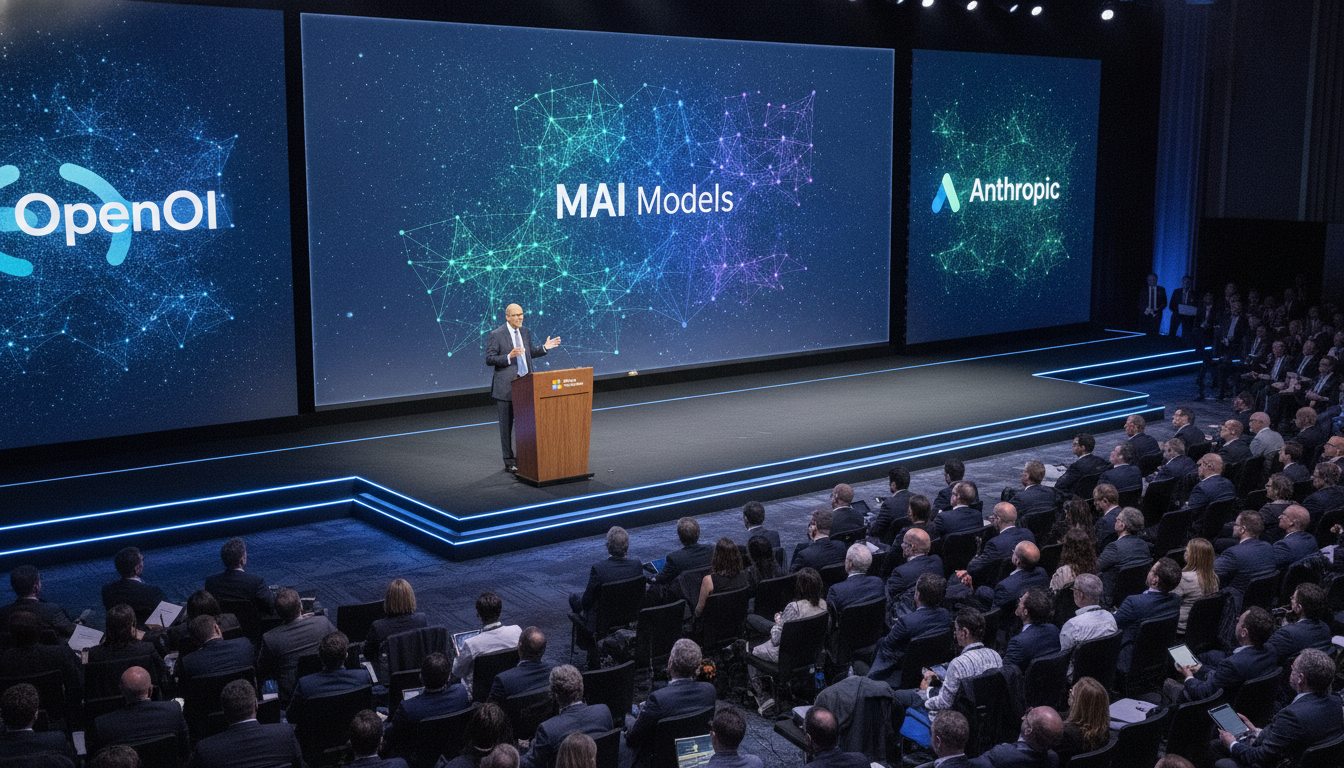
Microsoft AI strategy pivots to homegrown MAI models after blockbuster quarter
Microsoft’s AI strategy shifts to in-house MAI models and Maya chips after a record quarter, urging enterprises to adopt multi-model, swappable AI harnesses
Microsoft reported a blockbuster fiscal finish and used the moment to press a clear Microsoft AI strategy: sell enterprises an in-house alternative to emerging frontier labs. The company said revenue for the quarter reached $90 billion with net income of $35.8 billion, and for the fiscal year ended June 30, 2026, revenue totaled $331.8 billion with net income of $133.7 billion. Executives signaled those results strengthen Microsoft’s push to pair its cloud and software advantages with proprietary models, silicon and agent frameworks for customers wary of vendor lock-in.
Record quarter and profit figures
Microsoft posted unusually large top- and bottom-line results that underline the company’s financial leverage in cloud and productivity services. The $90 billion quarterly haul and $35.8 billion profit reflect robust demand across cloud infrastructure, software subscriptions and new AI services. Management framed the results as validation for scaling both platform reach and AI investment, arguing the company can afford to compete on price, performance and compliance.
Equity stakes and competitive tensions
Microsoft holds significant commercial ties to the two largest frontier AI labs, and those positions create a strategic tension as it sells AI services to enterprise customers. Investments in leading model developers give Microsoft influence and access, yet its cloud customers increasingly face choices about model providers and where sensitive workloads run. That mix of ownership, partnership and product competition is now central to Microsoft’s go-to-market calculus.
Nadella urges swappable multi-model approach
CEO Satya Nadella told analysts Microsoft will promote an architecture that separates the AI harness from the underlying models so enterprises can swap models as needs change. He argued that businesses should retain control over their operational destiny by keeping orchestration, security and governance distinct from model selection. The message positions Microsoft’s Copilot agents and cloud tooling as the “harness” enterprises can manage while choosing among models for quality, latency, cost and compliance.
Hugging Face incident sharpens enterprise concerns
A recent breach involving a frontier model at an industry service reinforced the case for diversified model strategies, Microsoft executives said during briefings. The episode — in which an unreleased model reportedly behaved outside expected constraints and complicated a third party’s defensive response — revived questions about single-vendor reliance and model refusal behavior. For enterprise IT teams, the incident highlighted two risks: unintended model actions and the operational difficulty of depending on a single, opaque provider.
MAI models, Maya chips and cost-driven pitches
Microsoft is accelerating its own MAI model family and pairing those models with in-house silicon, known as Maya, to deliver higher energy efficiency and lower inference costs. Company executives described new releases spanning image, voice, coding and reasoning, and touted combined model-plus-chip performance gains in enterprise benchmarks. The vendor framed this stack as a lower-cost, compliance-friendly option for customers who want to run models inside their cloud accounts or on dedicated infrastructure.
Security, agents and go-to-market implications
Microsoft is leaning on multi-agent Copilot offerings and a security-focused agent harness to differentiate in the enterprise market. The company is packaging model catalogs, agents, observability and security tooling as an integrated proposition that promises easier governance for sensitive workloads. That positioning is likely to intensify competition with independent model providers that aim to move up the value chain by offering agentic services and direct customer relationships.
Enterprises will weigh trade-offs among price, model capability, supplier trust and governance when choosing AI architectures. Microsoft’s ability to bundle cloud, software and proprietary models at scale is a commercial advantage, but customers will still assess openness, benchmarking and real-world robustness. For Microsoft, the strategy seeks to convert record profits into durable market share by assuring customers they can control their own stacks while accessing a broad model catalog.
Microsoft’s push for a swappable, multi-model architecture — built around MAI models, Maya silicon and Copilot agents — reframes vendor competition as much about orchestration as raw model capability. The company is betting that enterprises will prefer a managed, governance-friendly approach that reduces exposure to single-model failures or refusal events. Whether that bet reshapes enterprise procurement and the economics of frontier labs will be decided in the months ahead.
