
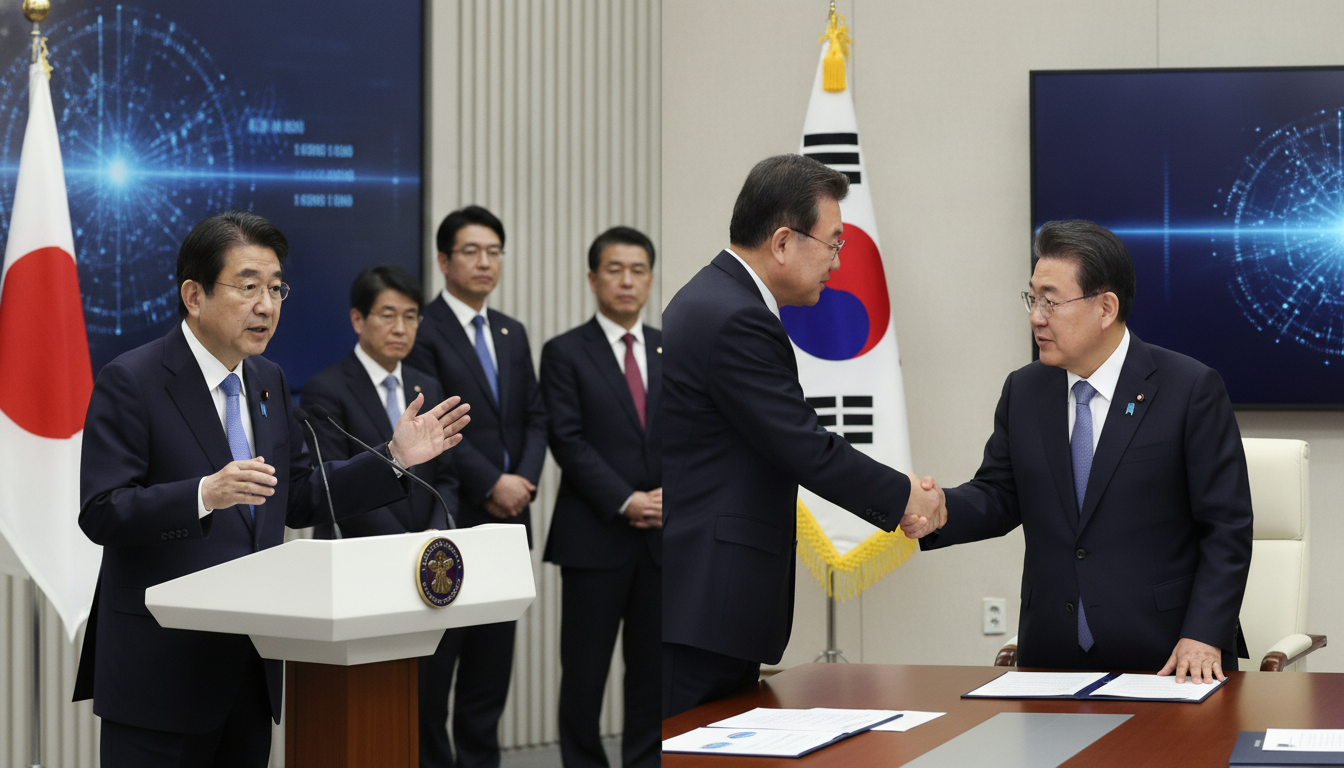
Japan and South Korea AI strategy: Separate industrial policies aim to make each country an indispensable US partner
Japan and South Korea AI strategy is shifting from competition to parallel positioning, as both countries roll out national industrial policies to become indispensable partners to the US AI industry while courting other Asian nations as neutral collaborators.
Both Tokyo and Seoul have moved to strengthen domestic AI ecosystems and supply chains through targeted subsidies, infrastructure investments, and regulatory reforms aimed at attracting US technology firms and chipmakers. Each government emphasizes that its Japan and South Korea AI strategy will be pursued independently rather than as a joint bloc, signaling a deliberate choice to offer alternative, reliable partners for American companies and regional states. Industry officials and analysts say the strategies reflect a broader effort to convert technological capacity into geopolitical leverage.
Tokyo’s roadmap for AI supply resilience
Tokyo has prioritized chip fabrication, data center expansion, and model development as cornerstones of its AI policy.
The Japanese strategy includes incentives for semiconductor fabs and partnerships with cloud providers to host large-scale AI workloads domestically. Policymakers are framing these moves as building resilience in global AI supply chains and reducing dependence on any single external source.
Seoul’s emphasis on domestic models and exportable services
Seoul’s approach focuses on nurturing homegrown AI models, talent pipelines, and commercial services that can be exported across Asia.
South Korean policy measures combine R&D grants, workforce upskilling programs, and support for startups to create competitive AI products. Officials portray this as part of a Japan and South Korea AI strategy that positions Seoul as both a technology producer and a neutral partner for neighboring countries seeking alternatives to larger powers.
Targeting the US AI industry and major vendors
Both governments are specifically courting major US AI firms and chipmakers without formal alignment with each other.
Attractive fiscal incentives, streamlined approvals for data infrastructure, and clearly articulated intellectual property protections are being used to lure investment from American cloud and semiconductor companies. The goal is to become indispensable nodes in the US-led AI ecosystem by offering reliable manufacturing capacity, regulatory clarity, and market access.
Appealing to other Asian nations as neutral partners
Beyond the US, Tokyo and Seoul hope to act as less politically fraught options for smaller Asian countries seeking AI partners.
By marketing themselves as technologically advanced but diplomatically pragmatic, both countries aim to win contracts for data centers, joint research, and government-to-government AI projects. This dimension of the Japan and South Korea AI strategy taps into regional demand for secure, high-quality AI infrastructure that avoids entanglement in great-power rivalry.
Economic incentives and industry response
Financial carrots and regulatory reforms are central to making the Japan and South Korea AI strategy attractive to global firms.
Subsidies for chip fabrication, tax breaks for data center construction, and direct funding for AI startups have drawn strong interest from local and international companies. Industry leaders note that while incentives help, long-term competitiveness will depend on workforce development, access to talent, and the ability to scale AI models cost-effectively.
Geopolitical balancing and export-control risks
The dual objectives of deepening ties with the US and courting other Asian states create a delicate geopolitical balancing act.
Both governments must navigate US-led export controls and alliance expectations while maintaining trade and diplomatic ties with nearby powers. Observers warn that missteps in export-control compliance or perceived favoritism could complicate either country’s attempts to act as neutral partners.
Private sector adaptation and supply-chain implications
Companies in Japan and South Korea are adjusting strategies to capitalize on government initiatives and shifting global demand.
Semiconductor firms, cloud providers, and AI startups are investing in regional partnerships, joint ventures, and expanded manufacturing footprints. These corporate moves are likely to reshape supply chains by increasing regional capacity for chips, servers, and AI services that previously flowed through a narrower set of hubs.
The unfolding Japan and South Korea AI strategy reflects more than industrial policy; it signals a strategic attempt to leverage technology for influence and economic growth. As both nations implement incentives and regulatory changes, their success will hinge on closing talent gaps, ensuring compliance with international rules, and demonstrating that each can reliably host the infrastructure and innovation that the US AI industry and regional partners demand.
