
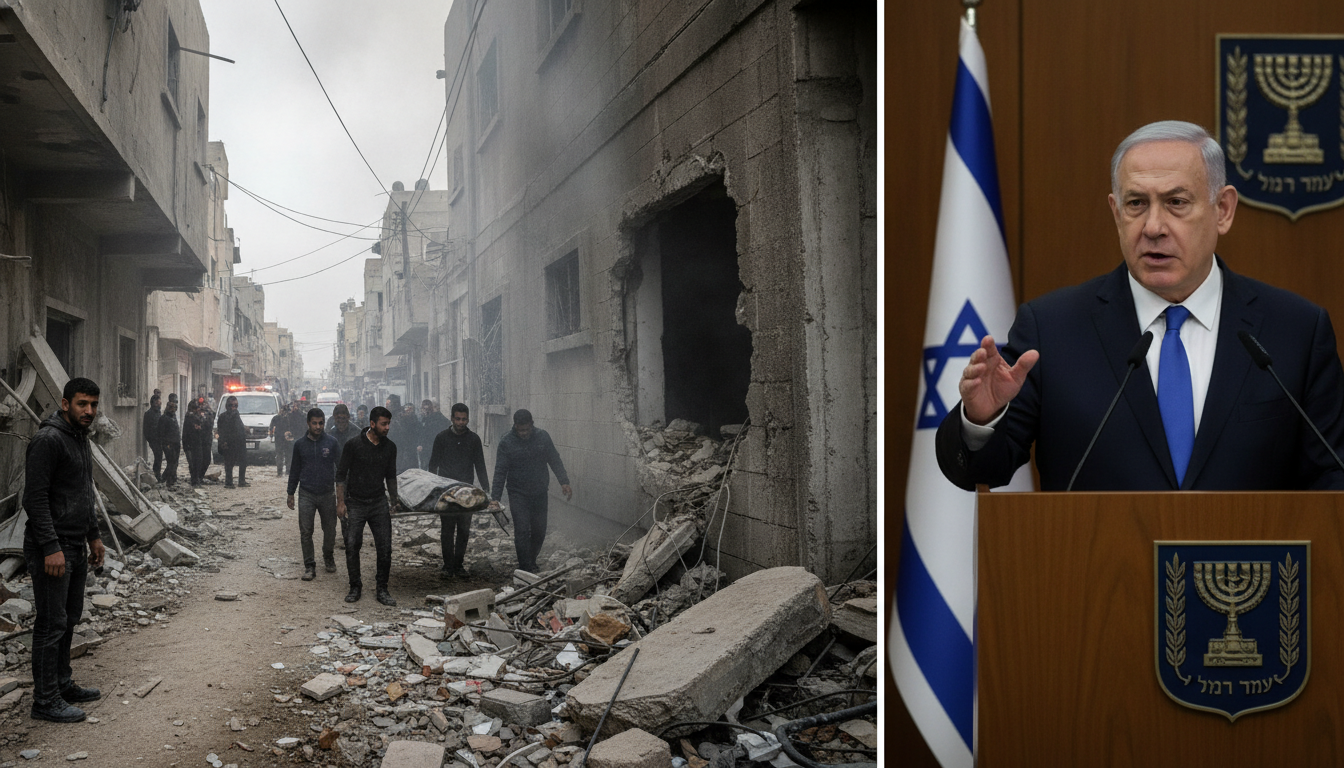
Jenin air strike kills three Palestinians as Israeli leaders praise operation
Israeli forces carried out a Jenin air strike on 28 August 2026 that killed three Palestinians, stirring fresh tensions in the occupied West Bank as officials and militant groups traded accusations.
Three killed in Jenin air strike, military says
The Israeli military said it “eliminated” three people on Friday after a targeted strike on a vehicle in the western area of Jenin City. The army identified one of the dead as Qais Bitawi and described him as a Hamas operative, while Palestinian Islamic Jihad said Bitawi was a senior figure in its armed wing.
Local Palestinian news agency Wafa and witnesses reported the strike hit a house under construction and that the three were killed instantly. The military characterized the operation as a precision action against “terrorist” suspects, saying it specifically targeted the car carrying the men.
Ground raid followed the drone strike
After the aerial attack, Israeli ground troops entered the strike site, according to the Palestine Red Crescent. The Red Crescent said medics arriving to treat the wounded were detained briefly and prevented from transporting the dead and injured to hospital.
Photographs distributed by international agencies showed Israeli soldiers removing at least one body from a building on the outskirts of Jenin. Service sources and eyewitnesses described a rapid security operation that secured the scene and restricted civilian movement in the area.
Prime minister and defence minister publicly back the strike
Prime Minister Benjamin Netanyahu posted on X calling the operation a “successful thwarting” of the targeted individuals. Defence Minister Israel Katz publicly congratulated the military, police and Shin Bet for the strike and said the Jenin camp had been “evacuated of residents.”
Katz added that Israeli forces were now “permanently stationed there, like other terrorist camps” in the West Bank, signaling an intensified security posture. The statements reflect an assertive line by senior Israeli officials about continuing operations in parts of the occupied territory.
Palestinian groups condemn the attack and demand accountability
Hamas issued a statement mourning “the martyrs who fell in the occupation’s bombing of Jenin,” and urged Palestinians to remain steadfast in defence of their land and rights. The group called on the international community to act “to stop these crimes and end impunity,” holding Israel “fully responsible for the repercussions,” according to its statement.
Palestinian Islamic Jihad also disputed the military’s account, asserting that Bitawi was a senior operative in its armed wing, while Hamas did not claim him as a member. The divergent claims underscore competing narratives among Palestinian factions about the men targeted and the strike’s justification.
Aid access concerns and reports of detained medics
The Palestine Red Crescent’s account raised immediate concerns about humanitarian access and the treatment of medical personnel at conflict scenes. International humanitarian groups generally regard unfettered medical access as a basic obligation in occupied territories, and the reported detentions prompted calls for clarification.
Local healthcare facilities said they received limited information about the wounded following the attack, complicating efforts to verify casualty figures independently. The constraints on first responders illustrate persistent obstacles that follow high-intensity operations in populated West Bank areas.
Wider West Bank instability and threats to the Gaza ceasefire
The strike came amid a broader rise in violence across the occupied West Bank, where settler attacks and Israeli raids have surged in recent years. While the Gaza Strip has borne the brunt of major aerial campaigns since October 7, 2023, targeted strikes inside the West Bank have been relatively rare; Israeli forces last carried out a strike there in February 2025.
On the same day, separate Israeli strikes in Gaza killed several people, and international monitors warned the fragile ceasefire arrangements were under strain. Nikolay Mladenov, the high representative for the United States-led Board of Peace, cautioned that failure by both sides to follow agreed roadmaps risked a collapse of the ceasefire in Gaza.
Israeli officials framed Friday’s operation as part of a broader campaign to disrupt militant networks, while Palestinian leaders and rights groups warned the action risked escalating violence across the occupied territories. Both the immediate aftermath in Jenin and the regional ripple effects will be closely watched by diplomats and humanitarian organizations.
The situation in Jenin remains tense as security forces maintain a presence and Palestinian authorities and residents assess the human and political consequences of the strike.
