
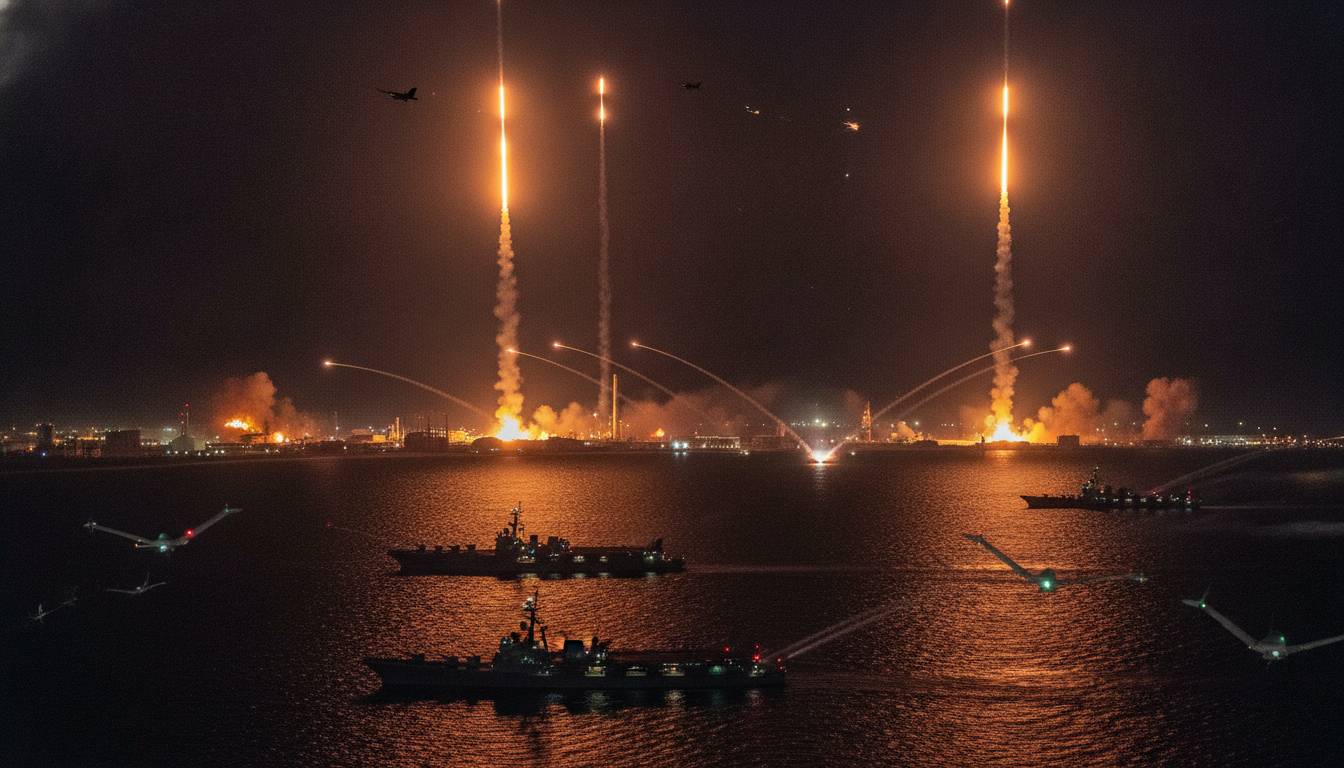
US strikes on Iran escalate as Tehran fires missiles and drones across the Gulf
US strikes on Iran intensify as Tehran responds with missiles and drones across the Gulf, prompting regional air-defences, civilian casualties and renewed international calls for talks.
Regional air-defences activated across the Gulf
Tehran launched missiles and drones into airspace over the Gulf and neighbouring countries after a sustained series of US strikes on Iranian territory. The escalation forced Bahrain, Iraq, Kuwait, Oman, Qatar, Jordan and Syria to take defensive action, with multiple states reporting interceptions and air-raid alerts. Washington says its strikes targeted Iranian military and infrastructure sites, while Tehran framed its response as strikes on US facilities and monitoring assets in the region.
Damage and casualties reported inside Iran
Iranian authorities and local media reported significant damage to civilian infrastructure in the south of the country following the US campaign. Telecommunications networks, railway links and the Bandar-e Khamir bridge in Hormozgan province were among the facilities hit, and local outlets said at least seven people were killed in the bridge strike. Tehran has also released a toll of casualties attributed to the unfolding exchanges, underscoring the human cost behind the broader military moves.
Iran’s military claims against US regional bases
The Islamic Revolutionary Guard Corps announced it struck multiple US assets across the region, including an airbase in Bahrain and monitoring installations in Oman and Kuwait. Iranian statements said air control and maritime surveillance radars were destroyed and that missile defence systems and weapons depots were targeted. Tehran further asserted operations against a US special operations facility in Syria’s al-Tanf area, describing the actions as strikes on sites used to launch attacks against Iran.
Gulf states report civilian impacts and alerts
In Qatar, which hosts major US facilities, residents woke to loud explosions and mobile security alerts as authorities raised the national threat level early on Friday. Officials later reported a child injured by falling shrapnel who is receiving medical care, and Qatar denied reports it planned to join further military action. Jordanian authorities said their air-defence systems intercepted three missiles transiting their airspace, and engineering teams worked to clear debris with no reported casualties.
Incidents in Iraq and Syria increase regional tension
Coalition and local security forces reported multiple drone and missile interceptions in Iraq and Syria during the early hours of the exchanges. Kurdish counterterrorism units said US coalition jets shot down several explosive drones over Erbil, with no casualties reported, while Iran’s forces claimed strikes against US facilities in northern Iraq. Syrian and Iraqi airspace have become frequent theatres for these exchanges, amplifying concerns among neighbouring capitals about the prospect of wider fighting.
Diplomatic appeals and pressure to resume talks
As the military confrontation widened, diplomatic actors intensified efforts to revive negotiation channels between Washington and Tehran. China’s foreign minister and Pakistan’s foreign minister publicly called for an immediate ceasefire and for the resumption of talks to preserve a recently negotiated pause in hostilities. Officials from both mediating countries cautioned that the fragile agreement reached in June must be defended to prevent the conflict from spiralling further across the region.
Economic and strategic stakes for the Strait of Hormuz
The Strait of Hormuz, a vital corridor for global energy shipments, figured prominently in both sides’ statements and targeting claims. Iran’s forces emphasized control of the waterway as central to their operations, while the United States and its partners warned that continued attacks and retaliations could disrupt maritime traffic and global markets. Analysts and regional officials have repeatedly flagged the risk that damage to ports, bridges or surveillance infrastructure could produce knock-on effects for shipping and trade.
Tehran framed its actions as direct responses to what it described as a US campaign against its military and civilian infrastructure, while US officials characterized their strikes as efforts to degrade Iran’s ability to strike US forces and assets in the region. International diplomatic efforts now face the immediate task of preventing further escalation and restoring channels of communication before wider instability takes hold.
