
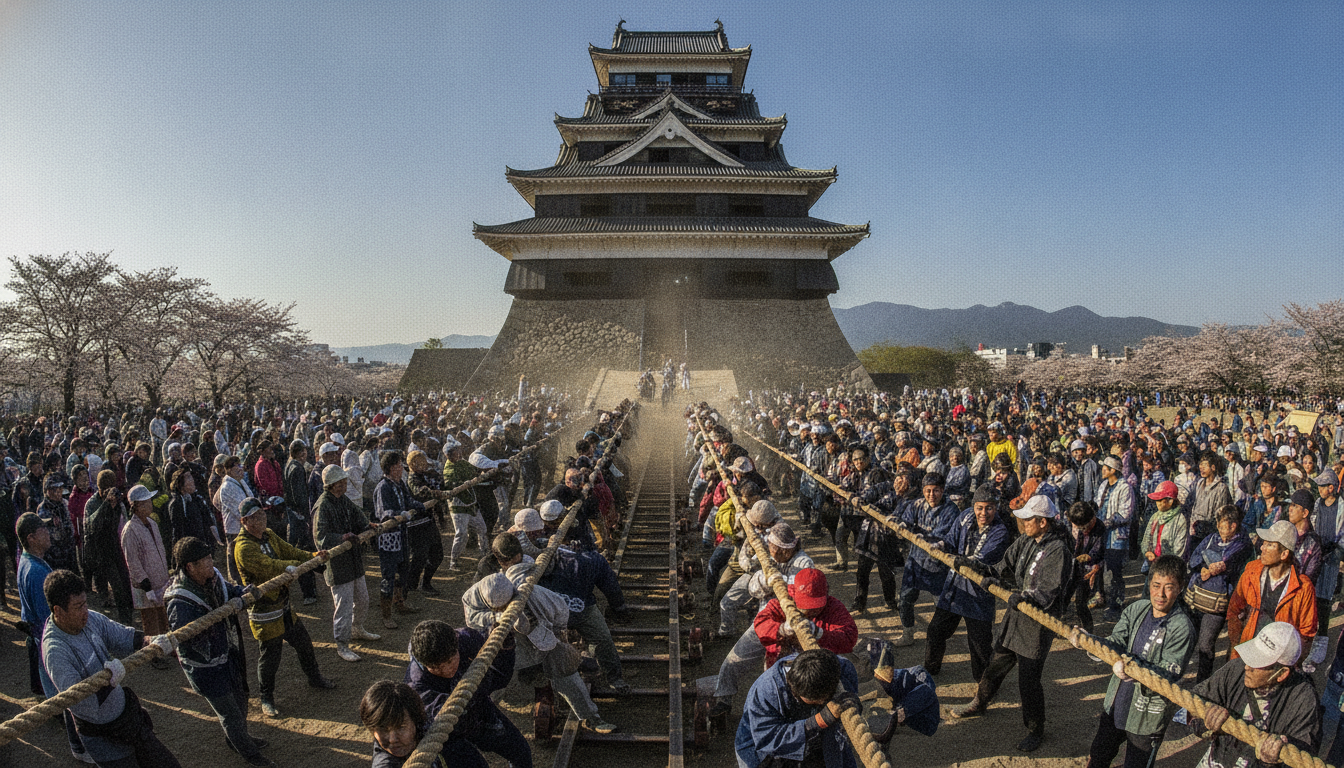
Hirosaki Castle pulled toward original site as about 4,000 volunteers join restoration effort
Thousands of volunteers pulled Hirosaki Castle toward its original site on August 26, 2026, in a coordinated event marking a milestone in a multi-year restoration project.
Around 4,000 people gathered in Hirosaki, Aomori Prefecture, to help move the historic Hirosaki Castle structure back toward its original footprint after years of renovation and stabilization work. The large-scale pull was documented in photos and videos that circulated widely on social media, drawing attention both in Japan and abroad. Organizers described the effort as a community-centred conclusion to a long preservation campaign that combined traditional care with modern conservation techniques.
Thousands mobilize for the pull on August 26, 2026
Volunteers included local residents, municipal staff and visitors who answered calls to participate in the physical repositioning of the castle element. The turnout reflected months of advance planning by restoration teams and cultural officials who coordinated schedules, safety briefings and public outreach. City authorities said the date was selected to coincide with the final phase of structural adjustments following restoration work.
Footage shared online showed long lines of people at ropes and safety zones, with journalists and civic leaders on site. Social platforms amplified the event, creating an international audience and renewed interest in Hirosaki’s heritage program. Organizers noted that the public response underscored local pride in preserving the castle and nearby Hirosaki Park, famous for its cherry blossoms.
Restoration aims to return the castle to its original footprint
The operation is part of a broader renovation campaign that treated the wooden keep and adjacent structures for stability, rot and seismic resilience. Officials say the recent pulling effort was designed to align the castle more closely with its original 17th‑century footprint while minimizing invasive work. The move follows careful structural assessment and phased conservation to protect original materials where possible.
Preservation teams emphasized that physical repositioning was coupled with ongoing conservation, including timber repairs and foundation reinforcement. Conservators described the balance they sought between maintaining historical authenticity and meeting modern safety standards for a structure that remains a major cultural property and tourist attraction.
How the mass pull was organized and managed
The event used a staged, supervised approach that divided participants into teams and assigned marshals to monitor movements and communications. Safety briefings were held before the operation, and medical teams, police and municipal workers were positioned to respond to incidents. Organizers said the manual pulling was symbolic as well as practical, allowing public involvement while heavy machinery handled precise adjustments offstage.
Coordinators stressed the importance of rhythm and coordination for a safe lift and shift, and documented procedures were followed to ensure even distribution of force. The union of volunteers with trained technicians enabled a low-impact move that protected the wooden superstructure, according to officials overseeing the project.
Historical context and significance for Hirosaki
Hirosaki Castle is a landmark of the region, surrounded by Hirosaki Park and long associated with spring cherry blossom festivals that attract visitors nationally. The castle’s wooden keep and associated grounds are valued for their cultural and historical resonance, and the restoration effort sought to preserve those ties for future generations. Local historians and community leaders framed the pull as an expression of civic stewardship.
The repositioning is expected to enhance the integrity of the site and improve visitor access while keeping the castle’s historic character intact. Cultural authorities have continued to emphasize educational programming alongside conservation, using the high-profile event to spotlight traditional carpentry and restoration practices.
Tourism, public reaction and the ripple effects
The event injected fresh tourism interest into Hirosaki, with hotels and local businesses reporting increased queries after images and videos spread online. Residents displayed a mix of pride and cautious optimism, noting both the spectacle and the careful technical work behind it. Commentators pointed to the pull as an example of community engagement in heritage preservation rather than a purely technical restoration.
National and international reaction highlighted the visual drama of thousands moving a historic structure by hand, but also raised questions about long-term maintenance funding and the role of public participation in major conservation projects. Local officials said they would continue outreach to sustain support for future phases.
Next steps in the conservation timeline
City officials and preservation teams say the pull represents a significant milestone but not the end of work at the site. Inspectors will carry out post-movement evaluations to confirm structural stability and complete any remaining reinforcement and restoration tasks. Authorities indicated that public access and special viewing opportunities will be scheduled once safety checks are complete.
Plans for interpretation, signage and programming tied to the restoration are in development, aiming to educate visitors about the castle’s history and the conservation methods employed. Officials added that they will document the project for use in future preservation efforts elsewhere.
The mass pull of Hirosaki Castle on August 26, 2026, showcased a rare blend of civic participation and professional conservation, drawing thousands of volunteers and global attention while advancing a careful program of restoration and site management.
