
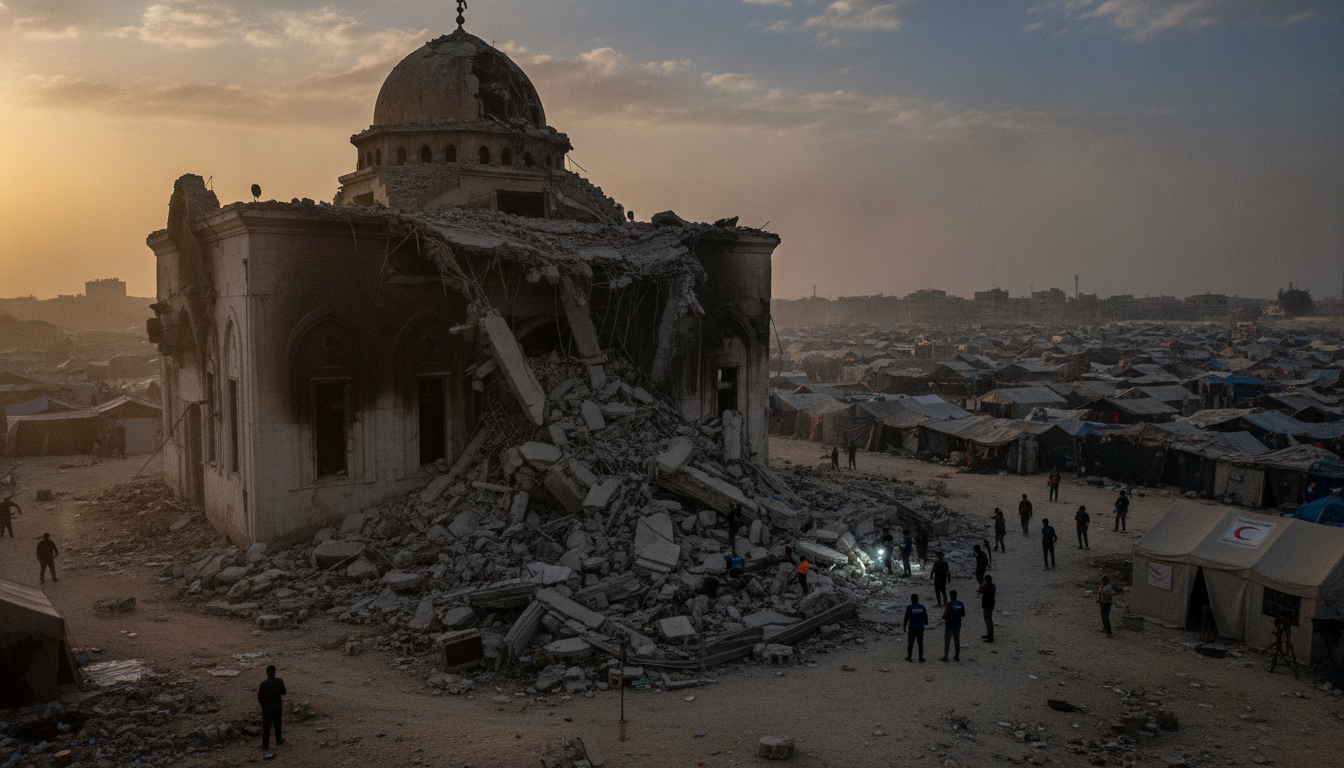
Gaza City mosque bombing sparks evacuation as Israeli military alleges weapons storage
Palestinians fled after a Gaza City mosque bombing near a displaced encampment; the Israeli military says weapons were stored there, Gaza authorities deny it.
Palestinians in Gaza City rushed to evacuate after an Israeli strike hit a mosque located close to an encampment for internally displaced people, according to local accounts. The Israeli military said the site had been used to store weapons for Hamas, an allegation that Gaza’s government rejected. No deaths were reported following the attack, though residents described widespread fear and disruption.
Attack and evacuation
Residents in the neighbourhood described a sudden escalation as explosions and heavy fire prompted immediate flight from the area around the mosque. Thousands of displaced people who had sought shelter nearby packed belongings and moved away from the site, fearing further strikes. Local civil defence teams and community volunteers assisted in guiding families to safer locations amid chaotic scenes.
Israeli military statement on weapons storage
The Israeli military issued a statement asserting the mosque had been used to store weapons linked to Hamas operations, framing the strike as targeting a military objective. The statement emphasized that precision measures were taken to limit civilian harm, according to the military account. Officials did not report any fatalities from the operation, but said the action was part of broader efforts against armed groups.
Gaza authorities deny the allegation
Gaza’s government categorically denied the claim that the mosque was used to store weapons, calling the Israeli account unsubstantiated. Gaza health and civil authorities reiterated that the mosque had been serving as a place of refuge for displaced families in recent weeks. The denial underscored continuing disputes over the presence of military assets in civilian structures and the challenge of verifying competing claims in real time.
Displaced encampment’s vulnerability
Encampments for displaced civilians in Gaza often form near community buildings, including mosques, which serve as temporary shelters during periods of intense fighting. Those shelters are frequently overcrowded and lack basic services, increasing vulnerability when hostilities intensify. Residents said the mosque’s proximity to the encampment made it a central point for families who had already endured repeated displacements.
Humanitarian concerns and aid access
Humanitarian groups typically warn that strikes near temporary shelters endanger civilians and complicate relief efforts, restricting access to food, water and medical care for those uprooted. Aid workers often face operational constraints and security risks that limit their capacity to respond immediately after such incidents. The displacement prompted by the strike added to an already acute humanitarian situation for many families living in makeshift conditions.
Verification and potential investigations
Independent verification of claims about weapons storage in civilian buildings is difficult in active conflict zones, where access is limited and information is contested. International observers and monitoring organizations commonly call for transparent investigations when attacks affect places used by civilians. Authorities on both sides may point to differing intelligence and rules of engagement, leaving secondary sources and forensics to play a critical role in clarifying events over time.
The strike near the displaced encampment in Gaza City highlights the persistent risks faced by civilians sheltering in community sites during armed confrontations. With no deaths reported in this incident, attention will turn to verifying the competing claims and to the immediate needs of those forced to flee once more.
