
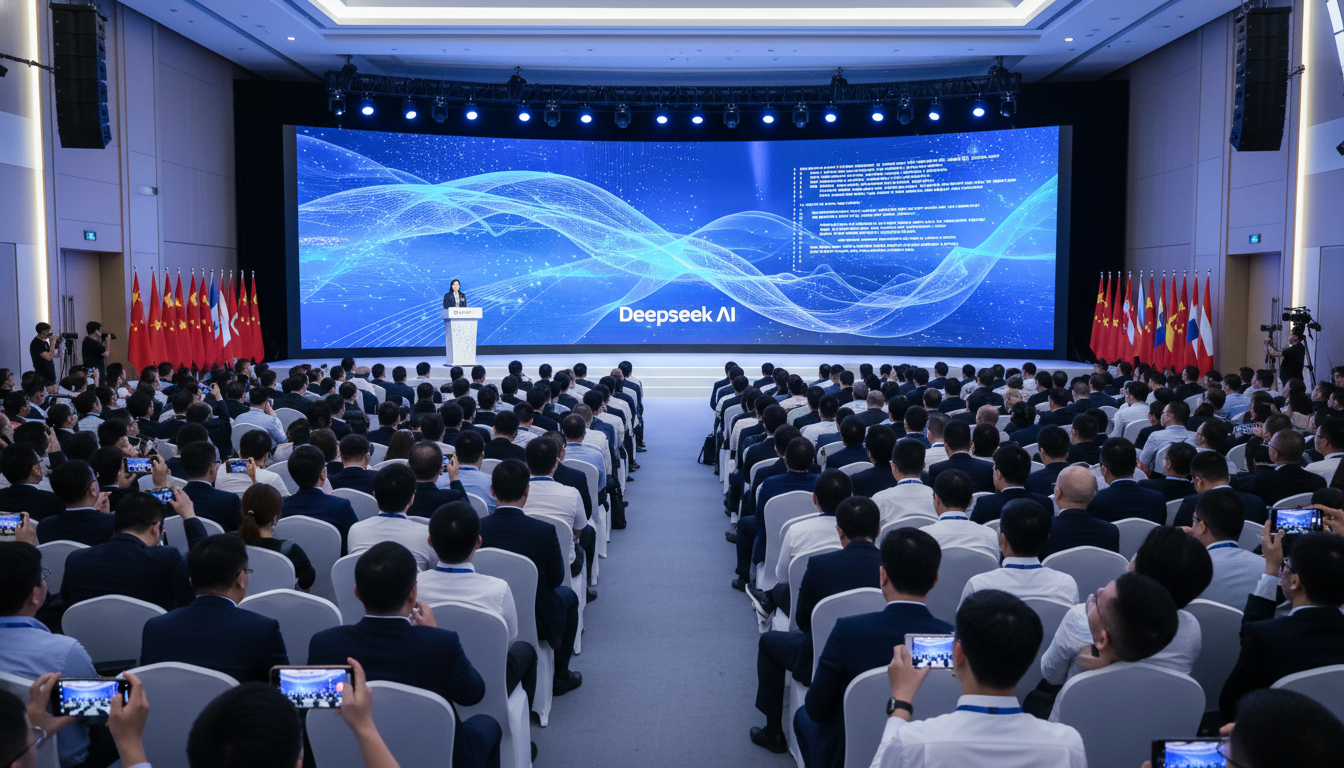
Deepseek V4 Pre-Release Positions Chinese Startup as Open-Source AI Contender
Deepseek V4 pre-release from Beijing startup claims to be the most powerful open-source AI platform. Early previews stress performance, scale, and compatibility.
Deepseek, the Beijing-based artificial intelligence startup, has returned one year after its industry-shaking debut with a preview of the V4 series, branding it the "most powerful open-source AI platform." The company released limited pre-release builds of the V4 models to selected partners and developers, saying the series advances model capacity and inference speed. The announcement marks Deepseek’s most ambitious public push yet to claim leadership in open-source generative AI.
Release Details and Distribution
Deepseek made the initial V4 builds available as pre-release packages to research collaborators and cloud partners. The company described the distribution as targeted and staged, focusing on controlled testing environments before broader public availability. Deepseek indicated plans for a wider rollout contingent on benchmark results and safety evaluations.
Claims of Open-Source Leadership
The company asserts that the Deepseek V4 series represents a step-change for open-source AI, citing scaled model architectures and performance optimizations. Deepseek’s marketing frames the release as a direct challenge to proprietary models by combining competitive results with permissive licensing. Industry observers say such positioning aims to attract developers and enterprises seeking high-performance alternatives to closed-source offerings.
Technical Advances and Architecture
Deepseek’s V4 preview materials emphasize several technical areas: increased parameter counts, refined training pipelines, and optimizations for inference latency. The company highlighted architectural tweaks intended to improve long-context handling and multimodal capability, though it has not published exhaustive technical white papers with complete training datasets and hyperparameters. Deepseek said the models were trained on a mix of public and licensed data and that further documentation will accompany the general release.
Benchmarks, Testing, and Independent Scrutiny
Deepseek provided preliminary internal benchmarks to illustrate V4’s performance gains, but independent third-party validation is still pending. Several academic and industry partners have been invited to run external evaluations, a step that experts say is crucial for objective comparison. Analysts caution that vendor-supplied metrics can be optimistic and recommend cross-testing on standardized benchmarks before accepting claims of superiority.
Ecosystem Integration and Developer Support
Compatibility with mainstream open-source tooling is a stated priority for Deepseek V4, with the company promoting support for popular frameworks and deployment platforms. The pre-release includes adapters and optimization kernels intended to ease integration with existing inference stacks and hardware accelerators. Deepseek is also offering documentation and early SDKs to selected partners to encourage rapid experimentation and third-party extensions.
Commercial, Security, and Regulatory Considerations
The V4 launch comes amid heightened scrutiny of large AI models for safety, intellectual property, and national-security implications. Deepseek has said it will implement staged access controls and red-teaming programs to mitigate misuse risks prior to a broad public release. Observers note that a powerful open-source platform could accelerate innovation but also complicate governance for regulators and enterprises balancing openness with risk management.
Deepseek’s V4 pre-release signals an intensifying competition between open-source AI projects and proprietary models, with potential effects across research, enterprise deployment, and cloud economics. As independent benchmarks emerge and broader access is granted, the industry will be watching whether Deepseek can substantiate its claim to lead the open-source segment. The company’s next steps — publishing detailed technical reports, enabling community testing, and demonstrating robust safety controls — will be decisive in determining how the V4 series is received by developers and customers worldwide.
