
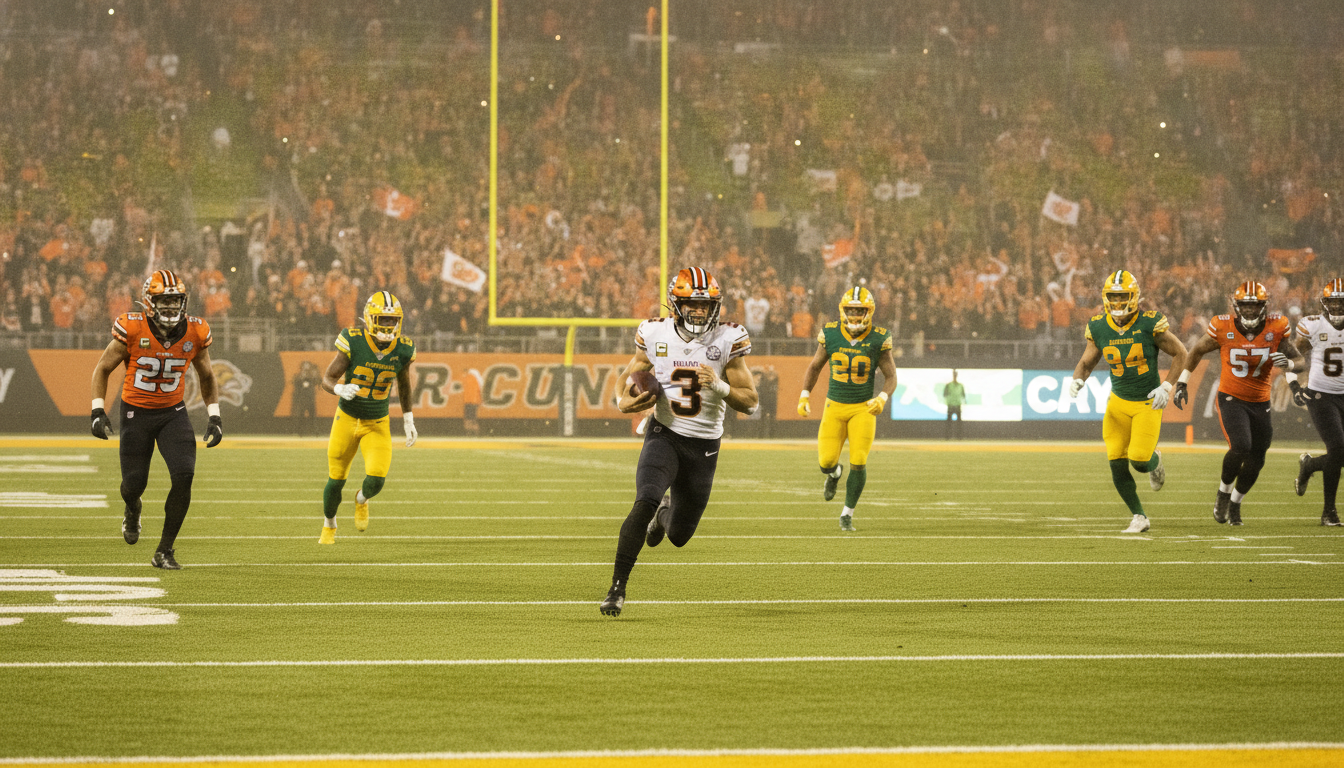
BC Lions grind out 36-24 road-style victory over Edmonton Elks in Kelowna
BC Lions beat Edmonton Elks 36-24 at Kelowna’s Apple Bowl; James Butler rushed for 135 yards and two TDs as Nathan Rourke passed for 300+ yards.
The BC Lions broke through for their first win of the CFL season, beating the previously undefeated Edmonton Elks 36-24 at Kelowna’s Apple Bowl on Saturday, July 4, 2026.
James Butler led the way on the ground with 135 rushing yards and two touchdowns, while quarterback Nathan Rourke topped 300 passing yards in a balanced attack that carried the Lions into the league’s midseason bye.
The sellout crowd of more than 19,000 — part of the Touchdown Kelowna festival — created a lively backdrop as the Lions dominated the line of scrimmage.
The victory served as a rebound after last week’s loss and provided momentum for B.C. heading into the break from league play.
Butler’s rushing display turns a close game in B.C.’s favour
James Butler’s running was the decisive factor in the Lions’ win, with back-to-back touchdown runs in the second quarter that transformed a 14-10 deficit into a two-possession lead.
The running back consistently found daylight behind an offensive line that opened lanes and sustained drives, enabling B.C. to control tempo and the clock.
Zander Horvath complemented Butler with two scores of his own, one on the ground early and another through the air in the fourth quarter, which helped keep Edmonton’s defence off balance.
A willingness to run the ball and build long, methodical drives kept the Elks’ offence off the field and reduced the number of possessions for a potent Edmonton attack.
Rourke’s passing kept the Lions balanced and efficient
Nathan Rourke again produced a 300-yard passing performance, spreading the ball to multiple targets and converting key third downs throughout the contest.
Four straight completions on B.C.’s second possession set up Horvath’s one-yard scoring run, an early sequence that energized the crowd and the offence.
Rourke’s decision-making and timing with his receivers allowed the Lions to mix run and pass effectively, preventing Edmonton from loading the box and daring B.C. to beat them through the air.
That balance helped B.C. sustain drives late in halves and convert red-zone opportunities into points rather than settling for field goals on every visit.
Defence forces turnovers and changes momentum
B.C.’s defence produced timely takeaways that swung momentum at critical junctures, finishing the game having forced four turnovers from Edmonton.
Jackson Findlay’s first-half interception was the club’s opening turnover and illustrated how the Lions’ secondary was prepared to capitalize on errant Edmonton throws.
Darnell Sankey’s interception near B.C.’s goal line late in the fourth quarter effectively ended Edmonton’s comeback attempt, prompting the capacity crowd to erupt and preserving the margin.
Those turnovers, combined with stout red-zone defence, limited Edmonton to a single offensive score after halftime and kept the Lions firmly in control.
Special teams contributions and local support influence outcome
Kicker Sean Whyte supplied three first-half field goals from 16, 33 and 40 yards, giving B.C. a steady scoring foundation while the offence worked through rhythm.
Special-teams play and timely kicking helped the Lions turn sustained drives into concrete points and maintained scoreboard pressure on Edmonton throughout the first two quarters.
The game also benefited from a boisterous Apple Bowl crowd, with more than 19,000 fans in attendance for the Touchdown Kelowna festivities, creating a difficult environment for the visiting Elks.
With B.C. temporarily displaced from BC Place during FIFA World Cup events in Vancouver, the team has made the Okanagan a strong short-term home and drew significant local support for the matchup.
Edmonton’s offensive flashes undermined by turnovers and limited running game
Cody Fajardo produced three touchdown passes for the Elks, finding Kaion Julien-Grant twice and connecting with Austin Mack for a late first-half score, showing the receiving corps’ ability to make plays.
Despite the passing production, Fajardo’s three interceptions and a crucial fumble by Justin Rankin deprived Edmonton of sustained second-half momentum.
Justin Rankin, entering the game as the Elks’ leading rusher and receiver through three games, was held in check on the ground and finished with modest rushing numbers while contributing more in the receiving game.
Rankin’s reduced impact and the team’s turnover issues prevented Edmonton from capitalizing on early opportunities and ultimately cost the visitors their unbeaten record.
Standings implications, upcoming schedule and context
The victory moves the B.C. Lions to 1-3 on the season while the Edmonton Elks fall to 3-1, altering early divisional dynamics and creating questions about consistency on both sides.
B.C. will head into the league’s scheduled bye week with renewed confidence after executing a disciplined game plan on offence, defence and special teams.
Edmonton is scheduled to host the Ottawa Redblacks on Thursday, July 9, 2026, a chance to get its running game and turnover margin back on track.
The Lions are slated to return to Edmonton for a rematch on Friday, July 17, 2026, giving both clubs an opportunity to make adjustments before their next head-to-head meeting.
B.C. head coach and offensive coordinator Buck Pierce praised the run-game performance and credited coaching staff and linemen for a plan that limited the impact of Rankin and neutralized key Elks threats.
From Edmonton’s perspective, the safe execution that had produced three close wins earlier in the season broke down at inopportune moments, leaving turnover management as a focal point ahead of the next game.
The first half of this matchup produced a combined 50 points and showcased both teams’ offensive talents, but it was B.C.’s ability to control the football and win key battles in short-yardage situations that defined the afternoon.
Fans and local businesses in Kelowna also took note of the event’s economic and social bump, as the city hosted thousands of visitors for the Touchdown Kelowna weekend.
Organizers and team officials pointed to the sellout attendance as evidence that staging CFL games outside the home stadium can generate significant community engagement.
Coaching staffs on both sides now face evaluation points: B.C. must sustain the offensive identity it displayed here while shoring up any remaining defensive gaps.
Edmonton’s staff will focus on ball security and tightening coverage schemes to prevent the kinds of big plays and turnovers that proved decisive in this contest.
B.C.’s balanced offensive approach — a productive running attack combined with an efficient passing game — offered a blueprint for how the Lions can compete over long stretches and under pressure.
Edmonton’s receiving corps showed flashes of dominance, but special-teams play and turnovers are areas that require immediate attention if the Elks are to remain a top-tier contender.
For the local community in Kelowna, the weekend’s finale delivered both a memorable football game and a demonstration of the CFL’s reach beyond its traditional venues.
The event’s success is likely to encourage future neutral-site opportunities and continued collaboration between the league and host cities that can accommodate large crowds.
The BC Lions leave Kelowna having won a physical, well-executed game that highlighted a reliable rushing attack, a steady quarterback performance and opportunistic defence.
Edmonton departs with a still-strong record but with clear corrective steps to take on turnovers and run-game efficiency if it hopes to maintain its early-season momentum.
Final takeaway: the Lions’ triad of Butler’s running, Rourke’s passing and a turnover-forcing defence combined to flip a tight matchup in their favour, delivering a 36-24 win that carries tangible momentum into the midseason break.
