
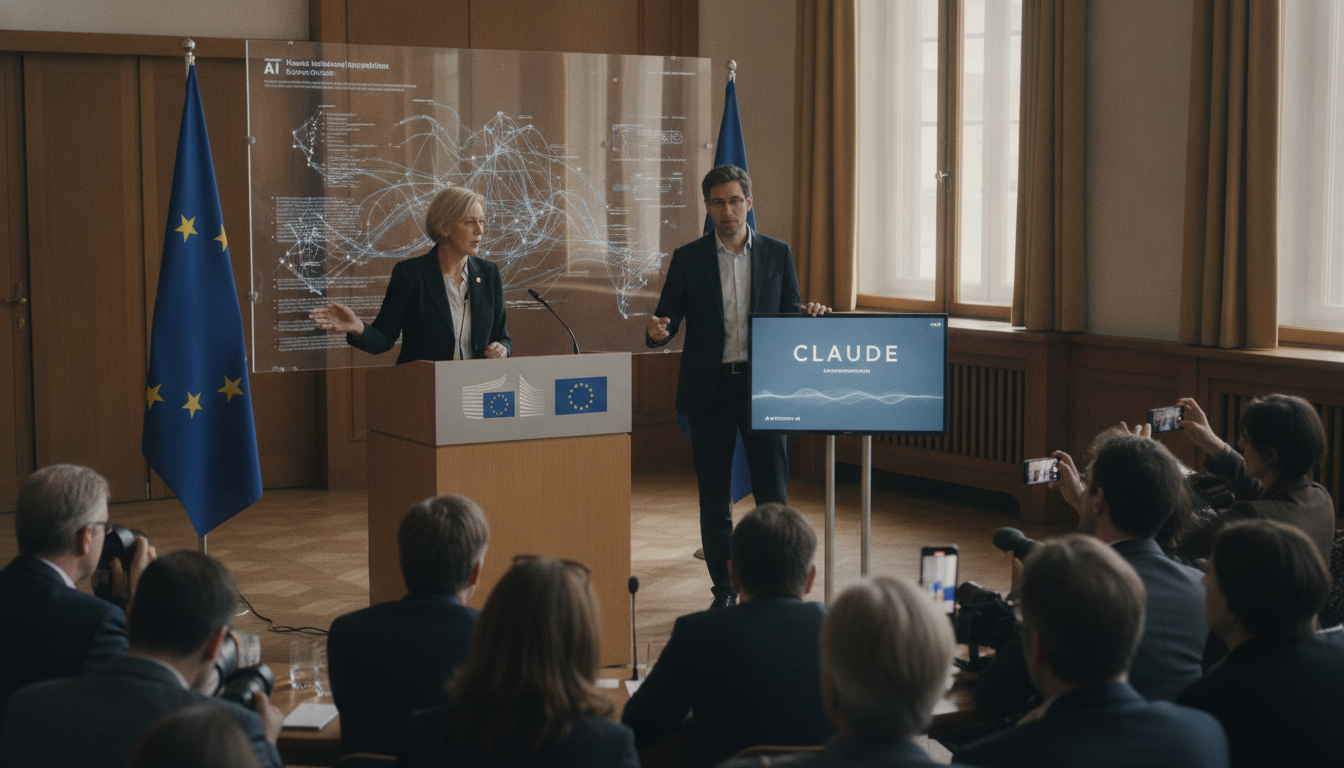
Anthropic details Claude watermarking to meet EU AI Act transparency requirements
Anthropic explains Claude watermarking system, detection limits, user backlash, and industry rollout in a new technical post.
Anthropic on Friday outlined how Claude watermarking will mark AI‑generated text to meet the EU AI Act’s Transparency Code and to allow third parties to identify machine‑produced content. The company said the technique embeds subtle patterns in word choices that are invisible to readers but detectable with a key, and it plans to publish a watermark detection API for verification. The announcement prompted debate among Claude users about detectability, editing, and the practical effects on code and creative work.
Regulatory motive and compliance with the EU AI Act
Anthropic presented watermarking as a tool to satisfy the EU AI Act’s Transparency Code, which requires mechanisms to make AI‑generated material identifiable. The company framed the move as a compliance measure rather than a product feature change, emphasizing detectability by parties who hold the decoding key. Anthropic also noted that other major model developers have agreed to the same Code of Practice and will implement their own watermarking solutions.
Technical approach and how the watermark is embedded
The watermarking approach relies on low‑stakes lexical choices where the model can select among near‑equivalent words to create a detectable pattern over many tokens. Anthropic said it will use the SynthID‑Text style method outlined by researchers previously, encoding a cryptographic pattern into otherwise natural word selection distributions. The company maintained that the watermark is designed to be imperceptible to readers and to preserve output quality while remaining machine‑verifiable given the appropriate key.
Detection constraints and the effect of editing
Anthropic cautioned that light edits are unlikely to fully remove a watermark, while a comprehensive rewrite that replaces most words can eliminate the encoded pattern. The company explained that detectability depends on how much of the text remains unchanged and on document length, with short or heavily human‑edited passages offering little for a watermark to attach to. Anthropic also distinguished watermark checks from heuristic AI‑detection tools that look for stylistic “tells,” saying the two approaches are fundamentally different.
How Claude watermarking applies to code and technical output
Anthropic said code will generally carry a weaker watermark because functional programming requires precise tokens and fewer arbitrary word choices. Where arbitrary elements exist—such as inline comments, variable names, or documentation text—the watermark can still be applied, but it should have a negligible effect on executable code. The company emphasized that the need for working code limits the model’s freedom to insert detectable patterns without affecting correctness.
User reaction and subscription cancellations
The announcement provoked immediate reaction among Claude users, with debate spreading across social platforms and communities. Some users characterized the policy as a threat to privacy or as a constraint on legitimate use cases, while others argued watermarking is necessary to prevent deception and restore transparency. Reports of subscription cancellations and vocal criticism on forums and social networks have surfaced, reflecting a mix of ideological opposition and practical concern about false positives and workflow disruption.
Industry rollout, detection API and next steps
Anthropic said it will publish a watermark detection API to enable verification by third parties, regulators, and platforms seeking to enforce content provenance rules. The company expects other model providers to adopt comparable systems under the shared Code of Practice, which could produce a landscape where multiple watermark schemes and verification tools coexist. Anthropic also acknowledged limits: watermarks are not foolproof, and adversaries can remove them through sufficient rewriting or transformation of the text.
The debate now shifts to how publishers, educators, platforms, and policymakers will use watermark signals in practice and whether standardized detection methods and dispute processes will emerge. As adoption grows, the balance between user expectations, functional accuracy, and regulatory transparency will determine how widely and effectively Claude watermarking and similar schemes are applied.
