
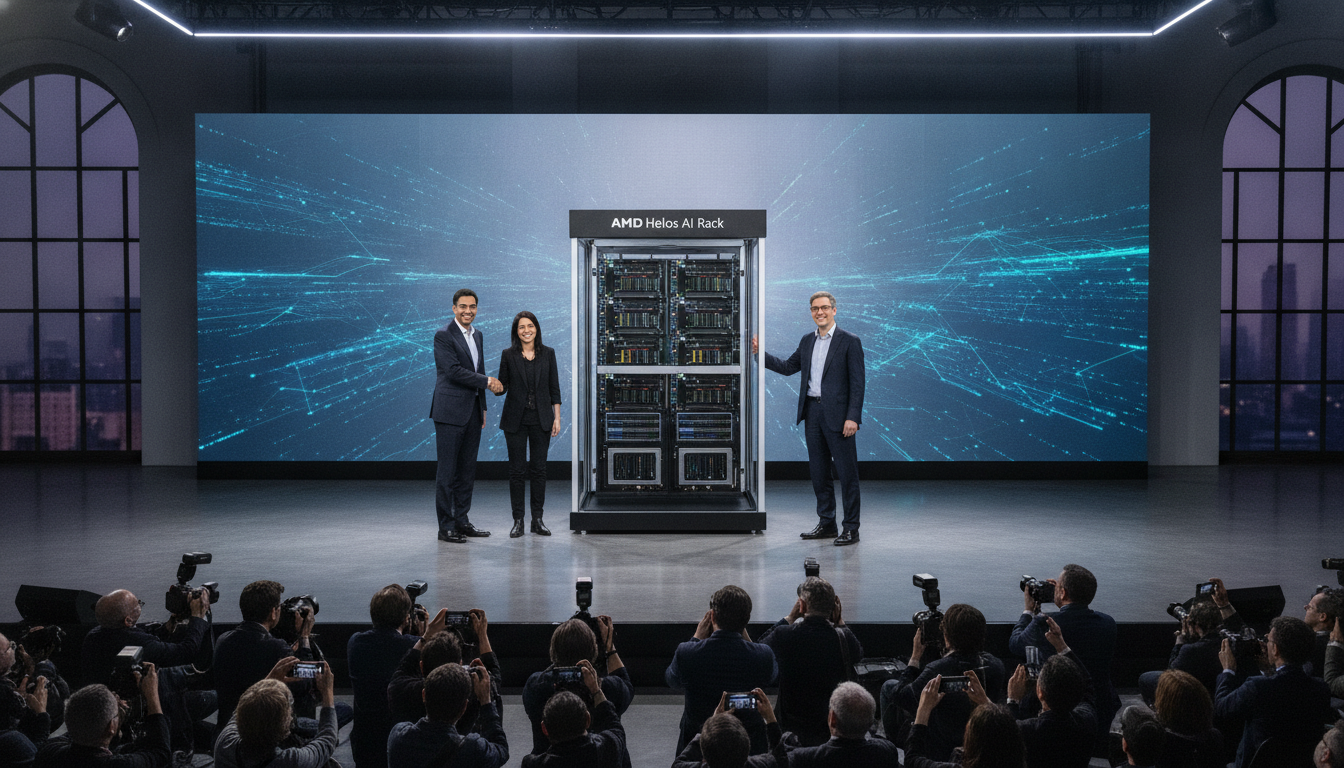
AMD Helios Rack Targets Nvidia with Gigawatt-Scale AI Deployments
AMD Helios AI rack challenges Nvidia with gigawatt customers and major deployments, while AMD readies Venice‑X CPU and plans shipments later this year.
AMD unveiled its Helios AI rack at a sold‑out Advancing AI conference in San Francisco, positioning the system as a direct challenge to Nvidia in the rack‑scale market. The announcement, promoted by AMD Chair and CEO Lisa Su, highlights Helios as a high‑performance unit intended for training and running massive, frontier AI models. AMD said the rack will ship later this year and that a roster of hyperscalers and AI labs has committed to deploy the system at large scale.
Conference reveal and company positioning
AMD introduced Helios during a keynote that emphasized the company’s drive into infrastructure for agentic AI workloads. The pitch framed Helios as a turnkey rack solution that combines many accelerators and processors into a single enclosure designed for data center scale. Executives said the system is built for the most compute‑hungry AI projects and for operators planning deployments measured in gigawatts.
The company also used the event to underscore a broader product roadmap that links Helios with upcoming server CPUs and accelerator families. AMD described Helios as part of a full‑stack approach to serve customers that require dense, highly programmable compute for evolving AI algorithms.
Customer commitments and deployment plans
AMD disclosed a lineup of major customers that have agreed to deploy Helios across cloud and enterprise footprints. Microsoft was singled out for a planned expansion of its Azure infrastructure using the new rack, and AMD said several leading AI developers and cloud vendors have active deployment plans. One announced partnership includes a commitment to deploy up to two gigawatts of GPUs through Helios systems.
Those commitments aim to demonstrate commercial traction for Helios and to reassure enterprise buyers that the hardware can be supported at hyperscale. AMD emphasized that early adopters are preparing to run large training jobs and production agentic workflows on the platform.
Performance claims and market competition
AMD presented performance metrics that it says position Helios competitively against incumbent rack offerings from other vendors. The company characterized Helios as designed to handle the highest‑intensity model training and inference tasks and noted gains on several benchmarking measures. AMD framed these results as evidence that Helios can meet demand for frontier model development and at‑scale deployments.
The move places AMD directly into a segment long dominated by other chipmakers and system providers. Industry observers see Helios as AMD’s bid to capture share in the rack market where dense accelerator configurations and system integration are critical buying factors.
Venice‑X CPU and future product roadmap
Alongside Helios, AMD introduced the Venice‑X CPU, a server processor family targeted at data center workloads and high performance computing. The company said Venice‑X is tuned to support large‑memory, high‑throughput AI tasks and that it is scheduled for launch in 2027. AMD positioned the CPU as complementary to Helios, enabling tighter integration between processors and accelerators in customer deployments.
The roadmap signals AMD’s intent to offer not just accelerators but a broader silicon stack for AI infrastructure. Company officials noted that programmability and a flexible silicon ecosystem remain important as AI workloads continue to evolve.
Market outlook and executive forecasts
AMD Chair and CEO Lisa Su outlined a bullish view of the AI accelerator market, projecting substantial growth through the end of the decade. She argued that agentic AI workflows drive sustained increases in compute demand because agents often execute many sequential steps, call external tools, and access large datasets repeatedly. According to AMD’s projections, the AI accelerator market could approach roughly $1.4 trillion by 2030.
Company leaders expect GPUs and accelerators to represent a major slice of that market given current algorithmic trends and the need for programmable hardware. AMD used this forecast to justify its investment in rack‑scale systems and in expanding its server CPU lineup.
Helios shipments later this year and Venice‑X availability in 2027 mark concrete near‑term milestones in that strategy. AMD signaled that it intends to support customers as they scale to gigawatt deployments and that it will continue to iterate on system performance and cooling to meet data center requirements.
AMD Helios arrives as enterprises and cloud providers rush to add capacity for larger and more complex AI models. The company’s claims about performance and its list of early customers give the rack system a runway for tests and production rollouts across major data centers. As AI workloads diversify, AMD is betting that a mix of dense racks, programmable GPUs, and server CPUs will win business from organizations building the next generation of large models.
Industry observers will monitor how Helios performs in broad deployments and how rival suppliers respond on price, power efficiency, and system integration. The path to wide adoption will hinge on real world benchmarks, supply timelines, and how quickly operators can scale infrastructure to keep pace with rising compute needs.
Demand for rack‑scale AI infrastructure shows no sign of slowing, and AMD is positioning Helios to be a central piece of that market shift. The coming months and the first shipments will reveal whether the system can convert early commitments into sustained commercial momentum.
