
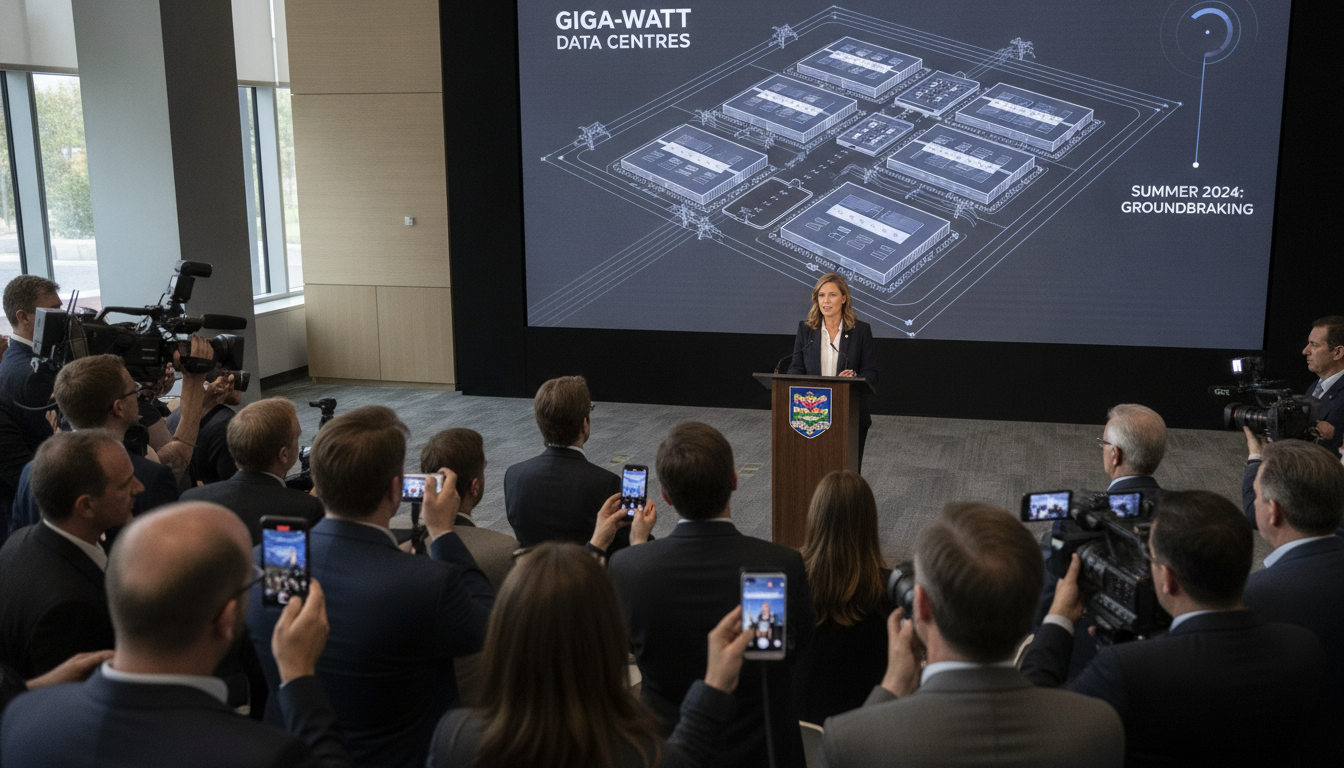
Alberta data centres poised for gigawatt-scale construction after Global Energy Show announcement
Alberta data centres may begin gigawatt-scale construction this summer, minister says, as the province seeks $100B in investment amid energy and local concerns.
The Alberta government signalled on June 10, 2026 that major data centre projects could move from planning into construction before the end of the summer, with officials saying the first campuses could be operational within roughly a year to 18 months. Technology and Innovation Minister Nate Glubish told an audience at the Global Energy Show in Calgary that several large-scale proposals are approaching shovel-ready status, with permits and financing expected soon. The pledge underscores Alberta’s bid to capture a large share of global investment tied to artificial intelligence and cloud infrastructure.
Minister predicts ‘shovels in the ground’ this summer
Glubish told delegates that the province anticipates gigawatt-scale announcements later this summer and that some projects will have construction underway once approvals and financing are complete. He said officials expect the earliest campuses to be energized about 12 to 18 months after breaking ground, framing the timeline as a rapid build-out compared with traditional industrial projects.
The minister and other presenters stressed that the provincial goal to attract roughly $100 billion in data centre investment by 2030 remains a central economic objective. That target forms part of a broader effort to diversify Alberta’s economy as global demand for AI-related computing capacity surges.
Industry outlines the scale of demand driving projects
Executives at the Global Energy Show highlighted the magnitude of capital flowing into data centre development worldwide and the rationale for rapid expansion in Alberta. Wes Cullum, senior vice-president of power generation at Beacon Data Centers, said major cloud and social media firms have announced extremely large investment programs this year, and consulting analyses project trillions of dollars of cumulative spending on data centre capacity through the end of the decade.
Beacon and other large developers are pursuing multiple sites across North America, and some proposals in Alberta are valued in the billions. Company representatives declined to detail all local projects on the record at the conference, but industry comments emphasised that the projected scale reflects sustained demand for AI compute capacity.
Local proposals face regulatory and public scrutiny
Not all proposals are advancing smoothly. Some projects in Alberta and nearby provinces have encountered regulatory hurdles, resubmissions and community pushback. The future of a proposed Synapse Data Center facility near Olds is uncertain after the proponent was required to revise and resubmit elements of its application to provincial regulators, according to local reporting and public filings.
Officials and developers acknowledged that regulatory processes and rigorous environmental assessments will determine which sites move forward. Panelists said proponents must present detailed plans on land use, water management and emissions to obtain permits and public confidence.
Community opposition and protests highlight local concerns
Public resistance has surfaced in multiple jurisdictions, underscoring worries about land use, water consumption, visual impacts and the strain on local services. In British Columbia, hundreds of residents recently demonstrated against planned data centres in Vancouver, and Alberta stakeholders have also raised questions about potential local impacts from large campuses.
Industry speakers repeatedly stressed the need for robust community engagement to address those concerns. They warned that projects lacking local support risk delays or cancellation, and they urged early, transparent consultation to explain benefits such as jobs, property tax revenue and potential infrastructure upgrades.
Energy and infrastructure commitments shape project viability
Data centres require substantial electricity and, in some cases, dedicated on-site generation, a point repeatedly emphasized by policymakers and utilities representatives. The Alberta government has encouraged developers to include their own generation assets to avoid increasing costs for other ratepayers and to reduce strain on existing grid capacity.
Mike Shaw, vice-president of business development at ATCO’s energy systems division, said electricity and natural gas infrastructure will be critical to serving any new campus. He argued that projects with credible plans to supply or manage their energy needs will be more likely to receive community and regulatory approval.
Developers call for collaboration and long-term planning
Industry leaders at the show urged collaboration among governments, utilities, developers and communities to ensure projects are built responsibly and at scale. Aric Carlisle of SLB said the coming “megaprojects” and gigawatt campuses represent a massive undertaking that requires coordinated planning across permitting, generation, transmission and workforce development.
Panelists added that the economic benefits are significant but contingent on careful sequencing of approvals and mitigation measures. They said successful projects will be those that can articulate concrete community benefits while meeting environmental and grid reliability standards.
Alberta’s pitch for $100 billion in data centre investment hinges on translating optimistic timelines into completed projects without creating undue local impacts, and the coming weeks of announcements and permit decisions will test the province’s ability to balance rapid build-out with public and regulatory expectations.
