
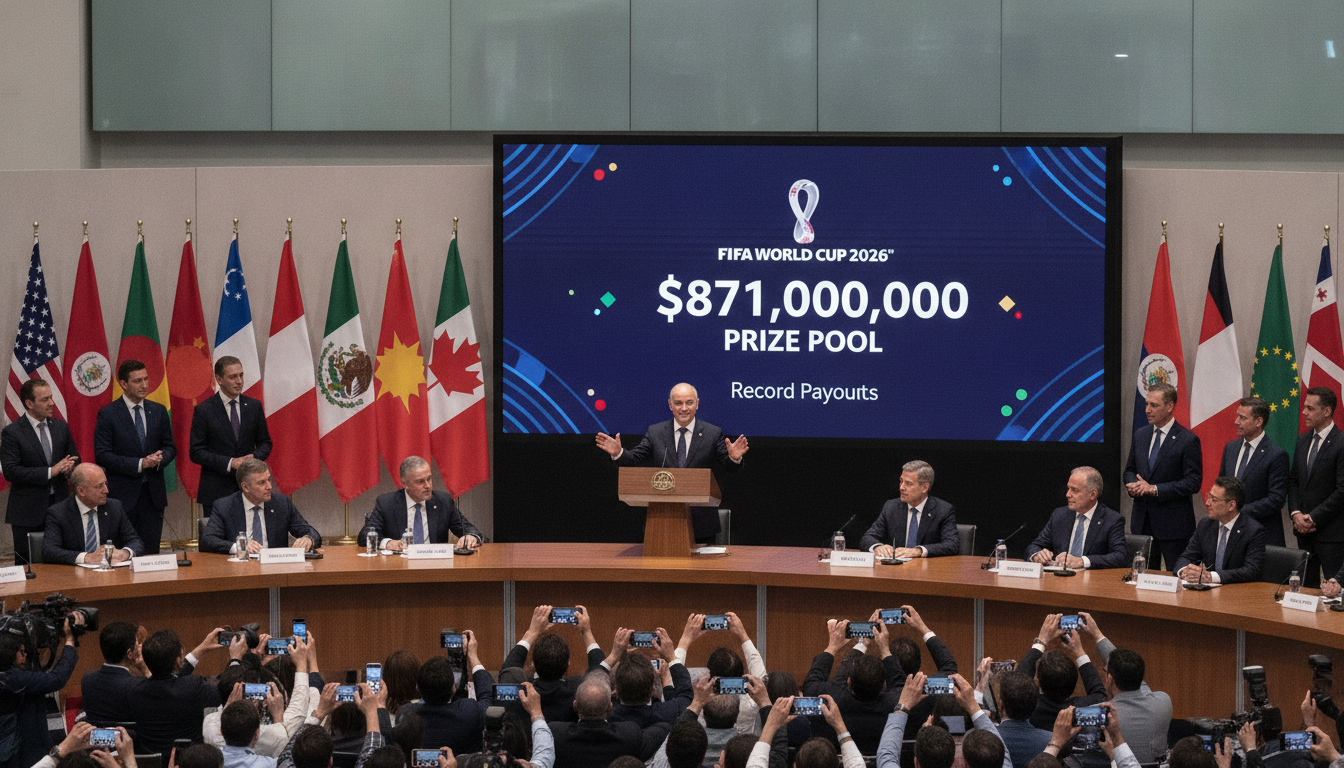
2026 World Cup prize pool hits record $871 million — how the money will be split
FIFA boosts payouts, guaranteeing every qualified nation at least $12.5 million ahead of the expanded 48-team tournament.
FIFA raises payout to $871 million
FIFA announced a record financial contribution to teams for the 2026 World Cup, increasing the distribution pot to US$871 million for the 48 participating associations. This move followed a series of council decisions in 2025 and 2026 to expand support for national teams in the expanded tournament format. (vod.fifa.com)
Breakdown of the $871 million distribution
The $871 million pot is composed of several distinct allocations intended to cover performance rewards, upfront support and extra team-related costs. FIFA confirmed increases for qualification and preparation funding and additional team contributions for delegation costs and ticketing. (vod.fifa.com)
Every qualified nation receives a $10 million qualification payment plus a $2.5 million preparation fee, creating a guaranteed floor of $12.5 million before any performance payments are added. Those guaranteed payments are aimed at helping federations cover the logistical and operational costs of participating in the tournament. (fanduel.com)
Performance prize pool and stage payments
A separate performance prize fund — widely reported at about US$655 million — will be paid out to teams according to how far they progress in the competition. That performance pool is allocated across the tournament’s expanded stages so that teams advancing further receive larger sums, while no nation leaves empty-handed. (fifaworldcupnews.com)
Under the confirmed structure, the champions are set to receive the largest single-team prize in World Cup history, with subsequent payments stepping down through runner-up, third and fourth places and the various knockout and group-stage exit tiers. The arrangement reflects FIFA’s intent to reward performance while also offsetting participation costs for all entrants. (soccergraph.com)
What each finishing position will approximately earn
FIFA and independent analysts have published stage-by-stage figures showing how the performance pool will be split among the 48 teams. The champion’s performance cheque is US$50 million, the runner-up US$33 million, third place US$29 million and fourth place roughly US$27 million. Teams eliminated in the quarter-finals and earlier rounds receive progressively smaller amounts. (carleton.ca)
When the guaranteed qualification and preparation payments are added, a nation that wins the tournament can expect a total payment in excess of US$52 million, while teams exiting at the group stage still receive a combined minimum that substantially exceeds prior editions. The redistribution is non-cumulative: each team takes the payment associated with its final placement plus the preparatory and qualification grants. (fanduel.com)
Club Benefits Programme: money for clubs that release players
Alongside federation distributions, FIFA has set aside a separate US$355 million Club Benefits Programme to compensate clubs that released players for qualifiers and the final tournament. That fund was designed to recognise clubs’ role in developing players and to reimburse them on a per-player, per-match or per-day basis for both qualifiers and tournament participation. (vod.fifa.com)
FIFA’s club payments are split into allocations for clubs whose players participated in qualifiers and those whose players appear in the final tournament, with a small reserve to cover administrative costs and other agreed priorities. The programme increases the total World Cup-related financial outlay when combined with association distributions. (vod.fifa.com)
Operational support and additional team contributions
Beyond qualification, preparation and performance funds, FIFA’s package includes additional team contributions intended to subsidize delegation costs and increase team ticketing allocations. The council specified these extra allocations would total more than US$16 million as part of the full US$871 million distribution. These measures are intended to reduce out-of-pocket expenses for federations and improve match-day logistics. (vod.fifa.com)
Officials have framed the expanded payments as reinvestment in global football, pointing to stronger commercial returns from the 2023–26 cycle as the enabling factor. FIFA has emphasised that the balance of revenues will continue to be redistributed among its 211 member associations for broader development objectives. (vod.fifa.com)
The tournament’s larger financial package comes amid ongoing public and political scrutiny about host costs, commercial arrangements and the broader economics of elite football. National associations are expected to publish how they allocate incoming funds between player bonuses, federation budgets, grassroots programmes and operational expenses.
Overall, the 2026 World Cup prize pool and associated funds represent the biggest redistribution of World Cup revenues in the sport’s history, combining record performance prizes, guaranteed payments to every qualified nation and a significant new mechanism to reward the clubs that supply the players.
