
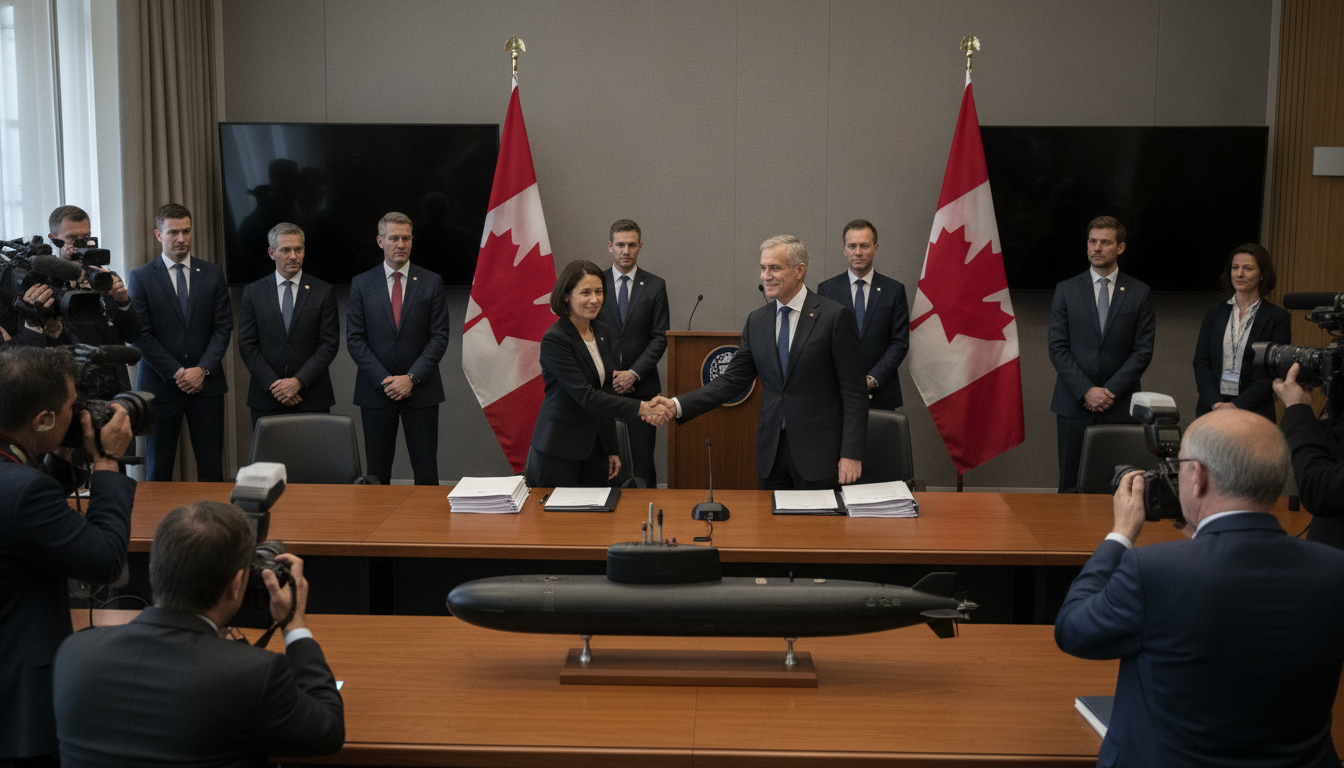
ThyssenKrupp-led consortium chosen for Canadian submarine program
Ottawa has named a ThyssenKrupp-led consortium as preferred bidder for the Canadian submarine program to build 12 boats in a $90-billion procurement process.
Federal government names preferred bidder
The federal government has indicated it will favour ThyssenKrupp Marine Systems (TKMS) in a decision that sets the stage for the largest military procurement in Canadian history. Sources confirmed to CBC News and reporting first published in the Globe and Mail say the German-Norwegian consortium now holds preferential status in the competition. The announcement is scheduled to be made by the prime minister at Halifax’s naval base this afternoon, though a formal contract has not yet been signed.
Contract remains subject to negotiation
Under the procurement rules Ottawa has designated a preferred proponent and will now enter detailed talks to finalize the deal. If negotiations over price, timelines or industrial commitments break down, officials say the government can move to the runner-up bidder. Procurement insiders stress that designation as preferred bidder does not guarantee a contract award, and legal and commercial reviews are expected before any final agreement is executed.
Competing bids and intensified outreach
TKMS faced off against South Korea’s Hanwha in a months-long contest that saw both groups accelerate outreach to Canadian industry and public campaigns. Both contenders submitted initial proposals in March that Ottawa judged insufficient on domestic economic benefits, prompting a two-month extension of the bidding period. Final offers were received on April 29, and sources close to the process told Radio‑Canada those revised submissions addressed many of Ottawa’s earlier concerns.
Industrial partnerships and economic promises
In the weeks after the submission extension, both bidders announced a series of Canadian partnerships aimed at boosting local work share. TKMS formalized four agreements with Canadian companies, while Hanwha reported roughly a dozen deals with domestic firms, spanning steel, defence suppliers, simulation and artificial intelligence. Government sources cited in reporting estimate the program could generate as much as $86 billion in economic activity in Canada and support hundreds of thousands of full‑time positions over the lifetime of the project.
Delivery timeline and fleet replacement
TKMS has proposed an accelerated delivery schedule that would see its first four submarines delivered by 2036, two years earlier than its original offer, according to multiple sources. That timing, if realized, would align with the planned retirement window of Canada’s Victoria‑class submarines, which are due to be phased out around the early 2030s. Officials caution that industrial scaling, shipyard preparation and supply‑chain work will be required to meet those target dates.
Strategic rationale and international context
Defence analysts say the selection reflects Canada’s desire for a platform tailored to its three‑ocean mission set rather than a purely deterrence‑focused design. Christian Leuprecht, a political science professor at the Royal Military College of Canada, has argued that the CD212 design offered by TKMS better matches Canada’s needs for sustained sea lines of communication, intelligence collection and long‑range patrols. The timing of the announcement also dovetails with the prime minister’s planned travel to the NATO summit in Ankara, a move Ottawa frames as reaffirming Canada’s commitment to European security and transatlantic partnerships.
Remaining hurdles and parliamentary scrutiny
Even with a preferred bidder named, the file faces further examinations including cost verification, industrial benefit audits and parliamentary review. Critics of the procurement warn that multi‑decade defence projects carry significant risks of cost growth and schedule slippage. Defence procurement officials will need to demonstrate how Canadian shipyards will be prepared, how domestic suppliers will be integrated, and what oversight mechanisms will be applied to safeguard public funds.
The government has said it will continue consultations with industry and stakeholders as negotiations proceed, and sources indicate discussions will focus heavily on Canadian content, job creation and transfer of key technologies. Reporting on the file has drawn on contributions from CBC’s Murray Brewster and Radio‑Canada’s coverage, which tracked supplier agreements and timeline revisions from both bidders.
The coming weeks are likely to determine whether the preferred‑bidder designation converts into a signed contract, or whether the competition will shift to the alternate proposer if talks falter.
