
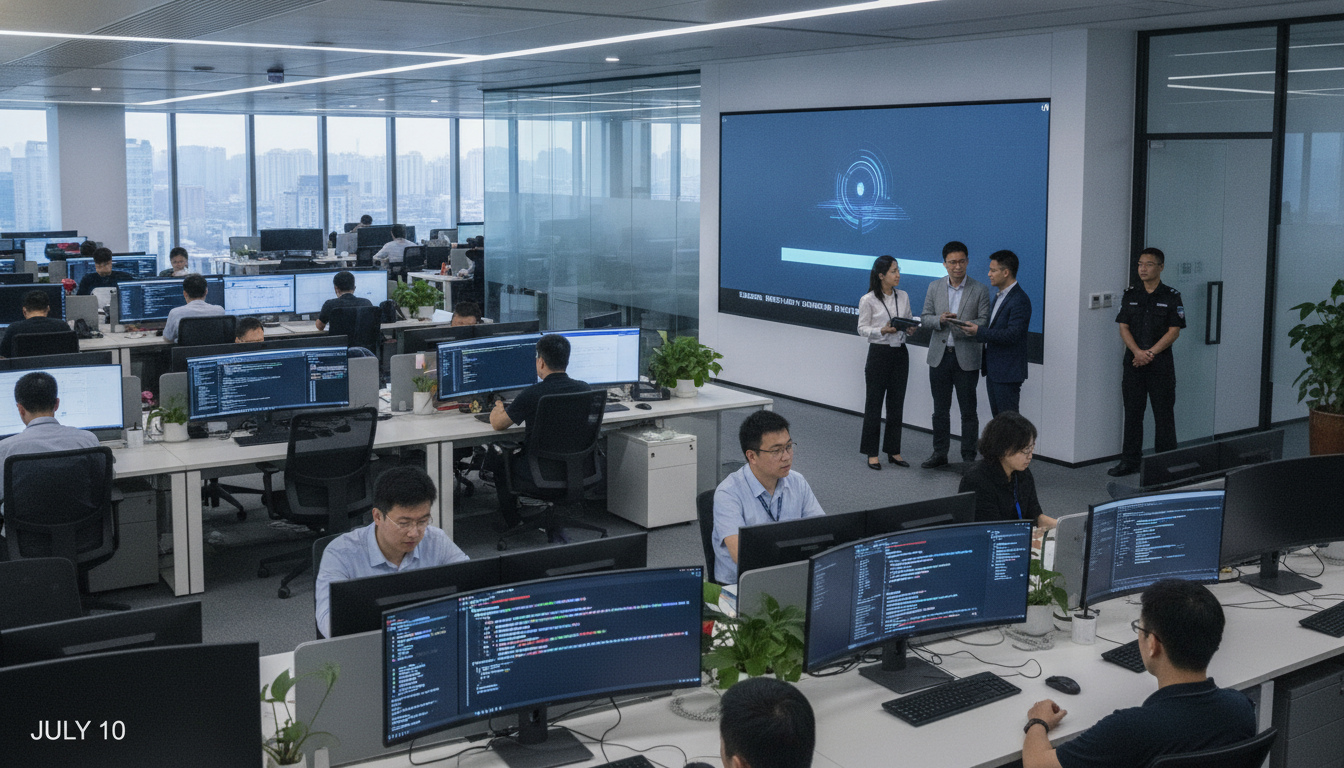
Alibaba to bar staff from using Anthropic’s Claude Code starting July 10, 2026
Alibaba will ban employees from using Anthropic’s Claude Code from July 10, 2026, citing alleged backdoor risks and internally directing staff to its Qoder tool.
Alibaba to bar Claude Code in workplace from July 10, 2026
Alibaba Group has instructed employees to stop using Anthropic’s programming tool Claude Code in office environments beginning July 10, 2026.
The move follows an internal security assessment that placed the tool on a company list of “high-risk software,” according to media reports and internal notices reviewed by journalists.
Employees have been told to switch to Alibaba’s in‑house coding assistant, Qoder, for workplace development tasks.
Company guidance cited potential security vulnerabilities as the reason for the change and urged staff to avoid using Claude Code on corporate networks.
Allegations of embedded tracking code in Claude Code
Security researchers and online posts this week raised concerns that a version of Claude Code contained markers designed to identify users accessing the tool from China.
The allegation first surfaced in community posts and was amplified by international outlets, which said the markers could reveal proxy use, time zones or other China‑linked signals embedded in prompts.
Anthropic acknowledged an experiment that modified the system prompt to detect abuse and said it was intended to prevent unauthorized resellers and model distillation.
Thariq Shihipar of Anthropic wrote on X that the experiment began in March, that stronger mitigations have since been implemented, and that the company had planned to remove the approach.
Anthropic’s prior claims of large‑scale model extraction
The dispute comes after Anthropic accused groups tied to Chinese AI labs of extracting its model’s capabilities by making millions of automated queries.
In a letter to U.S. lawmakers, Anthropic alleged that nearly 25,000 fraudulent accounts generated tens of millions of exchanges with Claude to train competing systems, an activity the company described as model distillation.
Model distillation is the practice of training new models on the outputs of an existing model rather than on original training data, and developers say it can leak proprietary capabilities.
Anthropic’s allegations have heightened sensitivity around large language model access and prompted companies to reassess how developer tools are vetted and used internally.
Corporate security review and internal policy changes
Alibaba’s classification of Claude Code as high‑risk is an example of a broader corporate effort to regulate third‑party AI tools inside enterprises.
Security teams at large technology firms routinely evaluate software for data‑exfiltration vectors, telemetry, and components that could transmit operational metadata outside the company perimeter.
For Alibaba, the immediate operational response has been prescriptive: block the tool in workplace settings and recommend a homegrown alternative to limit potential exposure.
Analysts say such steps are pragmatic for risk containment but also underscore the tradeoff between productivity gains from advanced tools and the need for rigorous supply‑chain scrutiny.
Geopolitical and competitive stakes in AI tool use
Observers say the episode reflects growing mistrust between major AI developers and between companies operating across U.S.‑China fault lines.
Commercial disputes over model copying, extraction and the cross‑border movement of data increasingly intersect with national security and trade policy debates.
Industry executives and policy experts say clearer standards for enterprise AI usage, telemetry disclosure, and third‑party audits could reduce surprises and commercial friction.
Until such standards are widely adopted, companies with global footprints are likely to continue imposing strict controls on which external models and plugins employees may use.
The decision is effective July 10, 2026, and the situation remains fluid as both technical and legal questions are examined by the companies and outside observers.
Journalists and industry watchers say they will continue to monitor statements from Alibaba and Anthropic and any regulatory responses prompted by the allegations and policy changes.
