
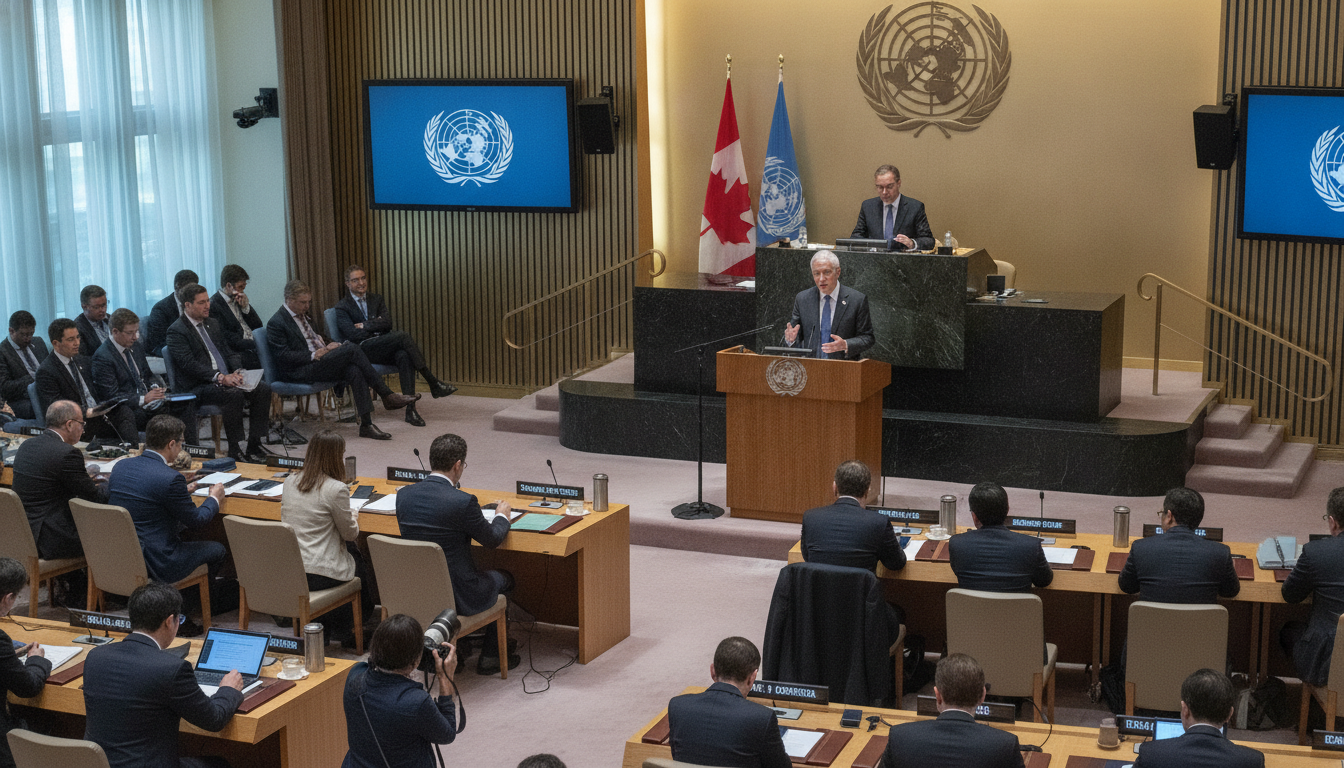
Canada urges stronger AI governance at United Nations to ensure safe, equitable adoption
Canada presses UN to lead global AI governance debate and protect developing nations while balancing innovation and security.
Opening: Ottawa places AI governance at centre of UN agenda
Canada’s ambassador to the United Nations, David Lametti, has made AI governance a central priority of his mission, pressing for coordinated international rules to ensure safe and equitable adoption of artificial intelligence. Lametti told reporters that the United Nations remains uniquely positioned to convene governments and private tech platforms on an equal footing to negotiate standards that protect security and promote shared benefits. He said AI governance occupies a significant portion of his diplomatic agenda and that Ottawa will press for multilateral solutions that include the concerns of emerging economies. The ambassador’s comments come as governments and companies accelerate work on regulation, oversight and risk mitigation for advanced AI systems.
UN as the forum for cross-sector dialogue
Lametti argued the UN is possibly the only global institution capable of convening large technology firms and nearly 200 member states in the same diplomatic space. He emphasized the need for a neutral forum where representatives from major cloud and AI providers, national governments and smaller states can debate rules without dominant actors dictating terms. According to the ambassador, equitable AI governance requires voices from every region, including countries that fear being left behind technologically. Ottawa’s pitch positions the UN as a place where technical expertise and geopolitical interests can be balanced in multilateral agreements.
Security concerns and the pace of technological change
Security risks associated with AI featured prominently in Lametti’s remarks, building on recent international assessments that warn of misuse in cyberattacks, coercion and other illicit activities. He referenced a range of threats flagged by experts, from sophisticated disinformation campaigns to potential misuse in developing biological or chemical agents. The ambassador stressed that governance must move quickly to address rapidly evolving capabilities while remaining grounded in realistic assessments of risk. Ottawa’s approach links safeguarding measures with policies that also enable legitimate innovation and economic growth.
Equity, inclusion and developing country participation
A core element of Canada’s stance is ensuring that AI governance does not sideline lower-income countries or deepen global inequalities. Lametti highlighted concerns raised by emerging economies that they could become mere consumers of AI rather than active participants in setting norms and accessing benefits. He pointed to recent Canada-Brazil collaboration on inclusive AI initiatives focused on empowering people with disabilities, Indigenous communities and women, while also cautioning that poorly designed systems can exacerbate existing disparities. Canada’s diplomatic push seeks to embed equity and capacity-building into any UN-led governance framework.
Diplomatic moves and multilateral engagement
Since taking up his UN post in November, Lametti has pursued a range of multilateral engagements aimed at framing Canada as an intermediary on AI policy. He hosted leading international voices on AI safety at the Canadian mission and plans to attend the global AI for Good summit in Geneva next month to advance dialogue on practical governance steps. Ottawa has also used recent international forums — including discussions at the G7 summit — to seek convergent approaches among the world’s largest economies while preserving space for multilateral rule-making. The ambassador said Canada will continue to work through coalitions and bilateral channels to build support for UN-led processes.
Balancing domestic priorities with global leadership
Lametti framed his diplomatic agenda as an extension of Canada’s domestic AI priorities, linking security, economic development and rights protections. He described his personal experience as a former federal justice minister and academic as informing his emphasis on legal frameworks and responsible innovation. While he signalled continuity with some previous Canadian UN commitments, he also indicated selective prioritization based on his assessment of where Ottawa can have the most impact. The ambassador’s strategy aims to synchronize national policy objectives with international rule-making to create coherent expectations for industry and governments.
Canada’s push at the UN underscores a broader international debate about how to govern technologies that are advancing rapidly and crossing national borders. By advocating for a UN-centred approach to AI governance, Ottawa is seeking to shape global norms while protecting national and allied security interests. The outcome of these diplomatic efforts will influence how countries, companies and civil society share responsibility for mitigating risks and expanding the benefits of artificial intelligence worldwide.
