
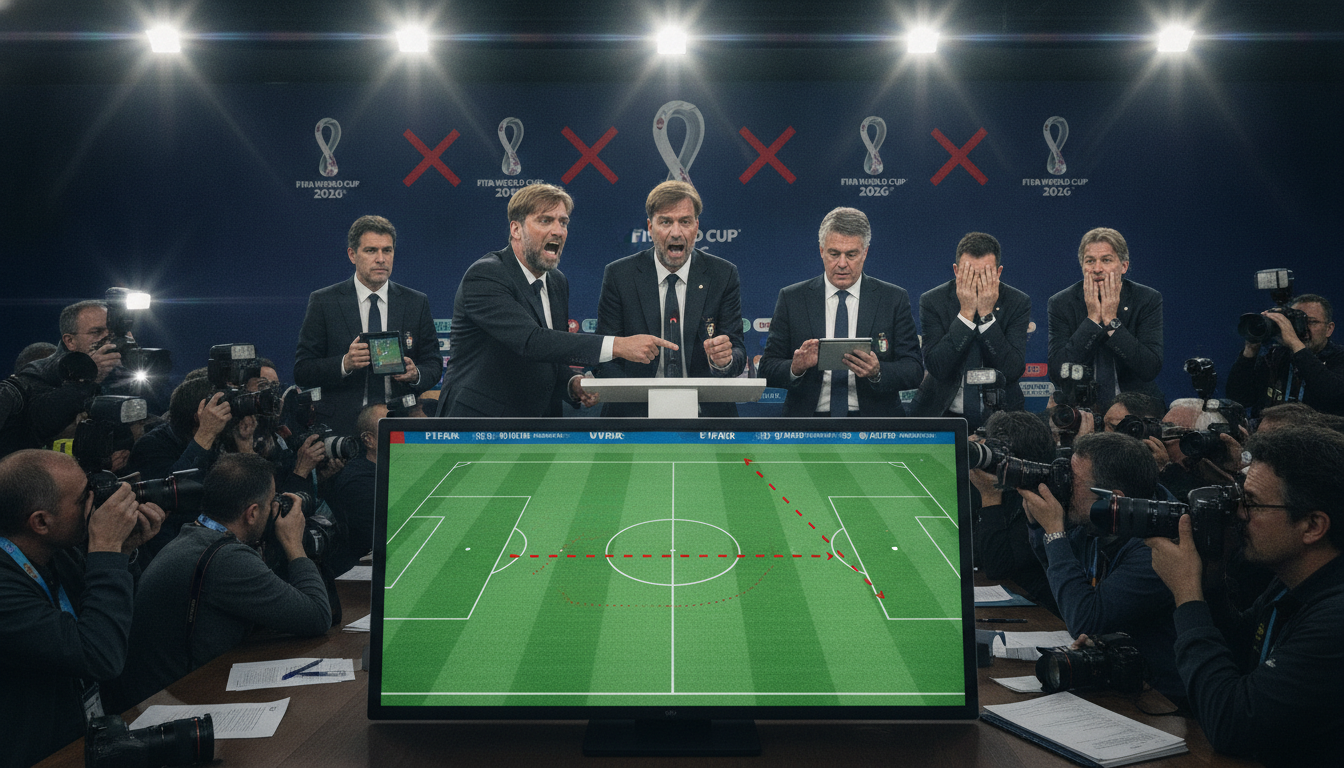
World Cup VAR controversies reshape group-stage outcomes
Five contentious VAR decisions at the 2026 World Cup group stage – from Iran’s disallowed winner to Ghana’s denied penalty – and their impact on qualification.
Stoppage-time goal for Iran overturned in Seattle
Iran looked to have clinched a historic knockout spot when Shoja Khalilzadeh converted in the third minute of stoppage time at Seattle Stadium on June 26, 2026. Stadium screens and players erupted, but a VAR review flagged an offside in the build-up and the goal was ruled out by a margin described as a few millimetres on replay. The reversal preserved a 1-1 draw with Egypt and eliminated Iran from contention for the last-16 on goal difference.
The tightness of the call intensified debate over VAR’s threshold for offside, with critics arguing that such marginal decisions undermine the flow and finality of matches. Supporters of the system counter that it enforces accuracy, but the emotional fallout for Iranian fans highlighted the human cost of marginal video evidence in tournament football.
Davinson Sanchez offside cancels late Colombia winner in Miami
In a dramatic Miami match on June 27, 2026, Colombia believed they had secured a stoppage-time victory when Davinson Sanchez headed home Juan Quintero’s cross. The assistant referee’s flag and a subsequent review showed Sanchez marginally ahead of the last defender, with replays suggesting offside by only a toe. The ruling left Colombia with a draw and cost them a result that would have kept their perfect group record intact.
The episode added to a pattern of razor-thin offside interventions that have decided high-stakes moments at this World Cup. Players and coaches are increasingly calling for clearer guidelines on how much of a player’s body should be measured in frame-by-frame assessments, amid concerns that technology is replacing the spirit of the on-field call.
Ghana denied penalty after Konsa challenge in Boston
Ghana’s 0-0 draw with England in Boston on June 23, 2026, featured a contentious moment when England defender Ezri Konsa lunged at Prince Kwabena Adu inside the penalty area. Match officials chose not to penalize the challenge, and VAR did not overturn that decision, prompting public frustration from Ghana’s camp. Coach Carlo Queiroz’s quip that “VAR went for a coffee” encapsulated the team’s exasperation at a non-decision that might have altered their path to the knockouts.
The incident renewed scrutiny on VAR intervention criteria for fouls in the box, particularly where contact is clear but the ball is not involved. For Ghana, the outcome denied a clear chance to take the lead and exposed the tiny margin between perceived injustice and accepted officiating discretion.
Vinicius Jr strike disallowed in Brazil win sparks federation complaint
Brazil’s 3-0 victory over Scotland on June 24, 2026, included a controversial disallowed goal by Vinicius Jr after a VAR-recommended on-field review. Referees judged that Vinicius had fouled a defender in the build-up, despite visible minimal contact that many observers described as soft. The decision did not change the match result, but prompted the president of the Brazilian Football Confederation (CBF) to formally request consistent application of VAR standards and a review of referee appointments.
The complaint from Brazil’s federation represents a rare institutional challenge to VAR protocols during the tournament. It underscores an emerging tension between national associations seeking predictable adjudication and FIFA’s responsibility to interpret laws consistently across varied match contexts.
Germany goal stands despite high boot on Ecuador’s Vite in East Rutherford
Early in the Germany-Ecuador match at New York/New Jersey Stadium on June 25, 2026, Ecuadorians were incensed when Germany’s Leroy Sane finished a move that began with a high-boot challenge on Pedro Vite. VAR did not intervene and the goal was allowed to stand, a decision that angered Ecuador players and officials who argued the original contact should have stopped play. Germany went on to win 2-1, but the unresolved foul call left Ecuador feeling aggrieved.
The play highlighted uneven application of VAR’s scope for historical incidents versus clear, immediate stoppages. Teams can be left debating whether a missed infringement should be rectified retrospectively or accepted as part of the flow of play.
Growing scrutiny and calls for clearer VAR guidelines
Across these matches, common themes have emerged: minute margins, inconsistent outcomes, and widespread frustration among players, coaches and national federations. Critics say the current implementation places too much emphasis on pixel-level precision at the cost of common-sense decisions, while proponents argue that video review corrects obvious human error. The mixed reactions have prompted calls for clearer, stricter guidelines on offside precision, handball interpretation and the thresholds for overturning on-field referee calls.
FIFA faces mounting pressure to provide transparency on VAR protocols and to explain individual high-profile decisions during the World Cup. Federations are seeking assurances that intervention standards will be uniformly applied, and some are requesting expedited reviews of officiating practices before the tournament progresses to the knockout rounds.
The 2026 World Cup VAR controversies have not altered the tournament’s competitive drama, but they have intensified debate about technology’s role in football. As fixtures move into the knockout phase, teams and fans alike will be watching not just the players, but the match officials and replay rooms whose choices continue to shape outcomes on the global stage.
