
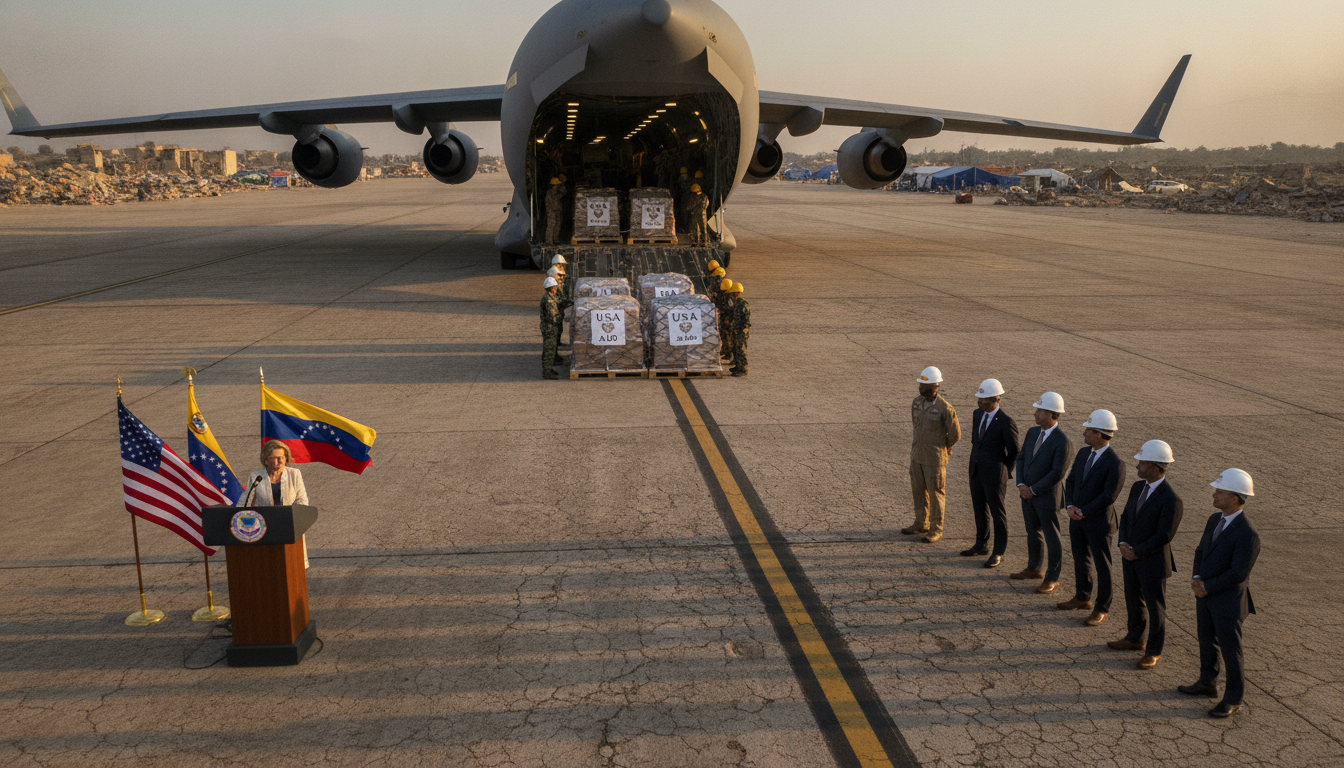
U.S. response to Venezuela earthquake: Washington sends rescue teams and emergency aid amid political shift
U.S. response to Venezuela earthquake: Washington sends search-and-rescue teams, pledges emergency funding and support as political transition unfolds.
The United States has mobilized a whole-of-government response after a powerful double earthquake struck Venezuela, leaving many people trapped beneath rubble and communities in urgent need of assistance. U.S. officials said the effort will include search-and-rescue teams, a disaster assistance response team of more than 250 personnel and millions of dollars in humanitarian funding as Washington navigates delicate diplomatic and commercial ties following the removal of Nicolás Maduro. The U.S. response to Venezuela earthquake relief is being presented as both an immediate humanitarian effort and a chance to shape longer-term relations with Caracas.
U.S. Deploys Search-and-Rescue Teams and DART
U.S. officials confirmed that specialist search-and-rescue crews are already en route from Fairfax County, Virginia, and Los Angeles as part of the initial response. Those teams are being coordinated through a disaster assistance response team (DART) organized by the State Department and other federal agencies to work directly with Venezuelan authorities and international partners.
The DART cohort, described by officials as comprising more than 250 personnel, includes specialists in urban search, emergency medical care and logistics planning. The teams are focusing on immediate life-saving operations while assessing needs that will guide further deployments and resource commitments.
State Department Announces $150 Million in Aid
The State Department announced a package of emergency funding to support relief operations, including grants to multiple non-governmental organizations and contributions to United Nations humanitarian mechanisms. Officials said the administration has committed roughly $150 million in total emergency assistance aimed at supporting search-and-rescue operations, medical supplies and the coordination of relief delivery.
Authorities emphasized that part of the funding will flow through established aid organizations with presence on the ground, while another portion is earmarked for multilateral channels to reach hard-to-access areas. U.S. officials framed the assistance as an urgent humanitarian priority and underscored the need to work with Venezuelan counterparts to ensure rapid distribution.
Airport Damage Forces Military and Imagery Support
U.S. officials described significant damage to Venezuela’s main airport infrastructure, complicating the rapid delivery of personnel and heavy equipment. Because civilian airfields and runways were reported damaged, Washington said it would rely on Defense Department assets for airlift and logistics support to move responders and supplies into the affected regions.
Officials also reported that the U.S. would provide overhead imagery and technical intelligence to help coordinate search-and-rescue efforts and map damaged zones. Those capabilities are intended to speed locating survivors and prioritizing areas for on-the-ground teams amid disrupted communications and transportation networks.
Diplomatic Contacts and Political Transition Talks
U.S. leaders have been in direct contact with Venezuela’s interim leadership, with Washington characterizing the calls as expressions of support for relief coordination. Interim President Delcy Rodríguez publicly thanked U.S. officials for their offers of assistance, while U.S. lawmakers and diplomats said engagement should also support steps toward a broader political transition.
The quake response follows months of rapid political change in Caracas after the capture of Nicolás Maduro earlier in the year and signals Washington’s intent to link humanitarian cooperation with longer-term institutional reforms. U.S. officials have said that a credible transition will require multiparty elections and restoration of democratic oversight bodies, and they welcomed a recent meeting between ruling-party figures and an opposition representative as an early step in that direction.
Oil Revenue Controls and Sanctions Adjustments Shape Assistance
Washington’s emergency response is unfolding against a backdrop of recent shifts in U.S. policy toward Venezuela’s oil sector and sanctions regime. The U.S. has eased certain restrictions in recent months, including a sanctions waiver that allowed limited engagement with Venezuela’s national oil company and arrangements for oil revenues to be managed in accounts under U.S. oversight for public expenditures.
U.S. officials said proceeds from ongoing oil sales have been deposited in controlled accounts and used for payroll and procurement of medical supplies, a practice they argue helps stabilize basic services as the country rebuilds. Critics, however, warn that close management of resources by foreign actors can fuel concerns about sovereignty and the appearance of economic control, and some observers caution against conflating humanitarian assistance with broader commercial interests.
Political Observers See Relief as a Test of U.S. Intentions
Analysts and regional experts say the earthquake response is a moment for the United States to demonstrate humanitarian priorities beyond commercial and strategic calculations. Some think-tank figures contended that timely, transparent aid could help build public trust and signal that Washington is invested in Venezuela’s recovery rather than only its energy assets.
Sceptics caution that the optics of military support and rapid re-engagement with commercial partners will be closely watched by Venezuelans and international actors alike. Observers also noted that internal political dynamics in Caracas, including the return of some political prisoners and tentative talks between factions, will shape how relief is received and how reconstruction is managed.
The unfolding humanitarian operation will test Washington’s capacity to deliver life-saving aid while balancing geopolitical and economic interests in a country still reeling from political upheaval and now physical catastrophe. U.S. officials have stressed their immediate priority is saving lives and restoring essential services while coordinating with Venezuelan authorities and international organizations to expand relief efforts.
