
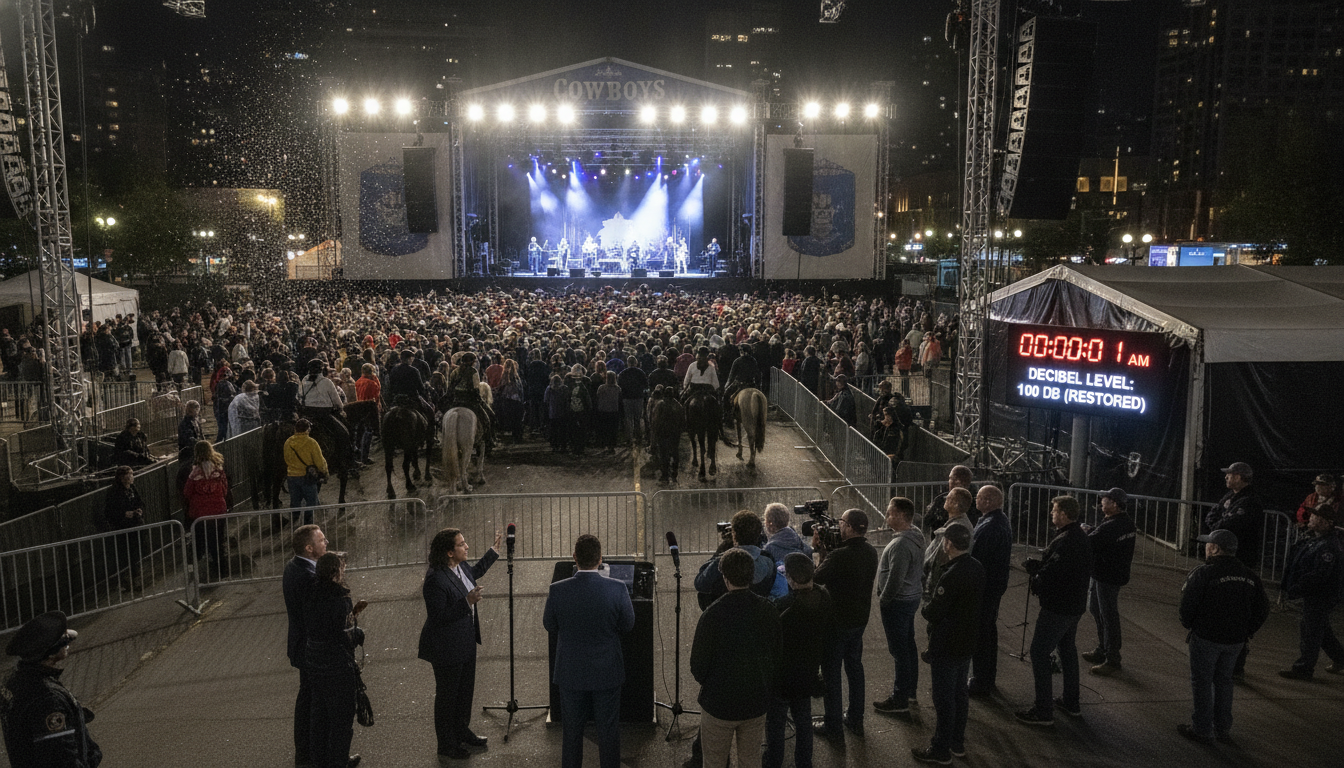
Cowboys Music Festival to End Concerts at Midnight After Calgary Reaches Noise Compromise
Calgary reaches deal with Penny Lane Entertainment to end Cowboys Music Festival shows at midnight and restore pre-midnight sound limits, easing community tensions.
Opening summary of the agreement
The City of Calgary and promoter Penny Lane Entertainment reached a compromise that will see Cowboys Music Festival concerts end at midnight each night, including weeknights.
Under the agreement, decibel limits before midnight will be restored to the levels permitted last year, and additional sound mitigation measures will be implemented.
Mayor Jeromy Farkas described the deal as a balance between quieter nights for nearby residents and preserving a major festival attraction.
Terms set out in the new compromise
The agreement requires shows to finish at midnight with a subsequent cool-down period designed to reduce residual noise into adjacent neighbourhoods.
Organizers accepted limits on bass and committed to installing further mitigation technology to reduce low-frequency spillover.
Officials say the restored pre-midnight decibel allowances match those used at Cowboys Music Festival in the prior season.
Background on complaints and prior operations
Last year, concerts at the site ran as late as 1:30 a.m., a schedule that produced about 125 noise complaints to city authorities.
City officials have said most grievances last season were related to sustained bass levels rather than short-lived peaks.
The scale of complaints and vocal concern from nearby residents prompted a formal review and negotiation ahead of this year’s events.
Political pressure and provincial involvement
The dispute drew attention from provincial figures, including Premier Danielle Smith, who publicly set a deadline for the city to resolve noise rules by June 30, 2026.
Federal Conservatives also weighed in, underscoring how the controversy quickly moved beyond municipal hall into provincial and national political debate.
Government interest accelerated discussions between city staff and the festival promoter and framed the compromise as an urgent matter of public policy.
Council decisions and administrative adjustments
Earlier in the week, Calgary council voted down a motion that would have eased sound restrictions and permitted off-site Stampede tents to run until 1 a.m.
City staff characterized the new agreement as an administrative adjustment that did not require additional council approvals.
Mayor Farkas said the approach allowed the city to act quickly while preserving established oversight mechanisms for noise exemptions.
Application to other festivals and fairness considerations
City officials confirmed the midnight curfew and sound conditions will apply to other events operating under noise exemption permits, including Badlands Music Festival.
The mayor framed the uniform rules as a fairness measure to ensure consistent treatment of all large-scale, permitted festivals.
Representatives from Cowboys and Badlands met with city leadership at City Hall to work through technical and operational details before the announcement.
Operational changes promised by organizers
Penny Lane Entertainment agreed to add sound mitigation measures such as directional speaker arrays, delay stacks, and revised stage orientations to limit off-site audio.
Promoters also committed to lowering bass energy where feasible and to working with independent sound engineers to document compliance.
Event operators said the changes are intended to preserve the audience experience while responding to neighbourhood concerns.
Monitoring, enforcement and measurement plans
The city has indicated that a third-party sound engineering firm will monitor noise levels during the Stampede period to assess compliance and inform future permits.
Officials expect continuous and spot monitoring at sensitive receptor points to verify that pre-midnight decibel restorations and post-midnight reductions are achieved.
Enforcement mechanisms could include warning notices, fines or further permit conditions should noise exceed agreed thresholds.
Community response and resident priorities
Nearby residents welcomed the curfew as a practical step to limit late-night disturbance, while some community groups said they will continue to press for stronger bass controls.
Advocates for local neighbourhoods noted that ending shows at midnight would preserve sleep hours without entirely canceling the summer entertainment slate.
At the same time, some residents said they will monitor whether mitigation measures translate into meaningful reductions in overnight low-frequency noise.
Business and tourism perspectives
Local businesses that benefit from festival crowds expressed relief that a compromise was reached, noting the economic importance of sustained event activity during Stampede season.
Event operators warned that stricter curfews could complicate headline scheduling and artist contracts, but said compromises were attainable.
Tourism stakeholders emphasized the need for predictable rules so that promoters, vendors and visitors can plan with confidence.
Details on venue and scheduling
Cowboys Music Festival will take place at the site formerly known as Shaw Millennium Park, located at 1220 9th Ave. S.W., and is scheduled to run from July 2 to July 12, 2026.
The promoter has said programming will be adjusted to respect the new midnight end times while maintaining a full slate of daytime and evening performances.
Organizers also plan staggered start times and curated set lengths to accommodate the truncated late-night window without compressing lineups excessively.
Technical review to inform future policy
City staff and the promoter agreed that data gathered this season will shape longer-term noise policies for downtown and stampede-adjacent venues.
A post-festival technical review by an independent engineering firm will analyze measured levels, mitigation effectiveness and recommended standards for subsequent years.
That evidence-based approach aims to create clearer permit criteria and reduce reliance on ad hoc political interventions.
Questions about measurement and perception of bass
Officials emphasized that low-frequency sound travels differently and is often perceived as louder inside homes, complicating community assessments.
Sound engineers will use standard metrics and strategically placed monitors to capture both dBA (overall loudness) and low-frequency energy readings.
City staff said those technical distinctions will guide targeted mitigation rather than solely adjusting overall volume caps.
Timeline for compliance and reporting
Penny Lane Entertainment must have agreed mitigation measures in place before the opening night on July 2, 2026, and testing will occur during the festival run.
The independent monitoring firm will provide interim reports during the event and a comprehensive assessment after July 12, 2026.
City officials indicated that future permit renewals will be contingent on the findings and the promoter’s responsiveness to recommended adjustments.
Political framing and municipal autonomy
The episode exposed tensions between municipal autonomy over local permits and provincial interest in broader economic and cultural priorities.
Mayor Farkas framed the deal as a municipal solution that respected both community livability and Calgary’s tradition of large-scale summer events.
Provincial leaders, meanwhile, described the resolution as a welcome development that avoided direct intervention in municipal affairs.
Promoter communication and public messaging
Penny Lane Entertainment has been asked to communicate the new schedule and sound policies clearly to ticket holders and performers to reduce confusion.
Organizers indicated they will update communications, event maps and on-site signage to reflect curfew times and to explain mitigation practices.
Promoters also said they will maintain an on-site liaison to handle resident complaints swiftly during the festival.
Impact on performers and programming
Artists and booking agents will need to adjust set times and possibly shorten headline performances to comply with the midnight cutoff.
Some managers cautioned that curfews can complicate international artist logistics, particularly when set lengths are part of contractual obligations.
Promoters said they are renegotiating specific set times where necessary and working with artists to preserve show quality within the new parameters.
Legal and permit implications moving forward
The arrangement sets a precedent for how noise exemptions and festival permits might be structured for downtown events going forward.
Legal counsel for the city and promoter reviewed the administrative amendment to avoid procedural challenges and to ensure enforceability.
Officials noted that any future significant alterations to noise policy would return to council for debate if they exceeded staff-level administrative authority.
Economic trade-offs and cultural value
City leaders framed the compromise as an attempt to balance the economic benefits of large festivals against the quality-of-life concerns of nearby residents.
Cowboys Music Festival draws large daytime and evening crowds that fuel hospitality and retail spending during Stampede, according to business groups.
At the same time, policymakers acknowledged that maintaining good neighbour relations is essential to the long-term viability of city-hosted cultural events.
Public safety and crowd management considerations
The earlier midnight end time will require revised crowd management and transit coordination plans to ensure safe dispersal of attendees.
City transit and emergency services are coordinating with promoters to align public transportation schedules with the earlier finish times.
Organizers said additional staffing and clear egress routes will be implemented to avoid congestion and to support safe departure after late performances.
Monitoring success and next municipal steps
City officials will evaluate success based on measured sound reductions, complaint volumes and community feedback following the festival.
If mitigation proves effective, authorities may codify similar conditions for future permits governing downtown entertainment spaces.
Conversely, if noise impacts persist, the city has signaled it will consider stronger permit conditions or operational restrictions.
Stakeholder reactions and expectations
Community associations, hospitality operators and performers all expressed cautious optimism that the compromise reflects a workable middle ground.
Stakeholders underscored the importance of transparent data sharing and timely reporting so that decisions are seen as evidence-driven.
Residents signalled they will remain vigilant and expect quick municipal response if agreed noise standards are exceeded.
How the outcome may influence other Canadian festivals
Municipal precedents set in Calgary could inform how other Canadian cities negotiate noise and curfew issues with large commercial promoters.
Cities balancing nightlife economies and residential livability may look to Calgary’s mix of technical monitoring and administrative flexibility as a model.
Industry groups will likely watch the independent engineering review closely to understand technical measures that effectively reduce off-site bass transmission.
Next steps for attendees and local residents
Event-goers should expect headliners and late-night programming to be scheduled within the revised time frame and organizers will publish updated schedules.
Residents near the venue are encouraged to monitor city updates and to report any post-midnight disturbances to the municipal hotline for rapid follow-up.
Both groups were urged to consult official festival communications for the most current operational details.
Broader implications for festival planning in urban settings
The compromise highlights the challenges of hosting large-scale outdoor music events in dense urban environments where sound carries into residential areas.
Designing festival layouts, investing in directional sound technology and establishing measurable permit conditions are emerging best practices.
Municipalities and promoters will increasingly need to marry technical solutions with clear operational rules to sustain urban festivals.
The city and Penny Lane Entertainment reached a negotiated solution that aims to reduce community disruption while allowing Cowboys Music Festival to proceed under defined conditions, and officials will use independent monitoring and post-event analysis to determine whether the approach succeeds in practice.
