
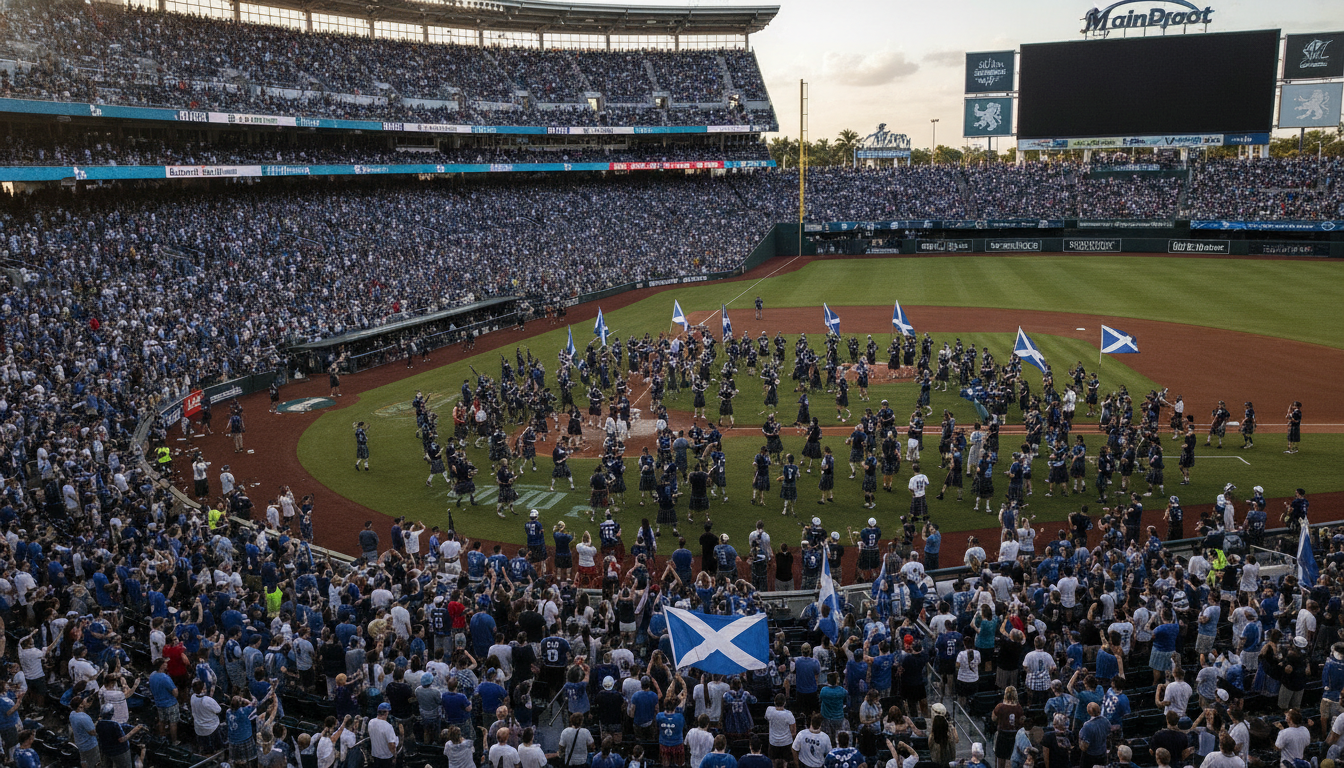
Tartan Army takeover energizes Miami Marlins game ahead of Scotland World Cup match
Tartan Army takeover sends 8,000 Scotland fans to loanDepot Park, boosting attendance and atmosphere as Miami Marlins host a lively weeknight game this week.
The Tartan Army takeover turned loanDepot Park into a sea of tartan and song Monday night as thousands of Scotland supporters descended on the Miami Marlins’ stadium ahead of their national team’s World Cup match. The influx of Scotland fans injected energy into a typically quiet weeknight crowd and briefly reshaped the ballpark’s character, as kilts, bagpipes and chants echoed through the concourses. The takeover drew international attention to a franchise that has often struggled with consistent attendance. Organizers and fans described the night as both a celebration and a warmup for Scotland’s midweek World Cup fixture.
Tartan Army Marches From Local Bars to the Ballpark
Fans gathered at neighborhood bars before beginning a roughly one-mile march to loanDepot Park, many wearing traditional Scottish dress and waving flags. Bagpipes led the procession and chants of “No Scotland, No Party” filled the streets as supporters moved toward the stadium in a visible show of unity. The march culminated in a boisterous entry into the ballpark concourse, where the crowd quickly became the dominant presence inside the venue. Organizers said the event was part fan pilgrimage, part pre-match ritual ahead of Scotland’s international fixture.
Attendance Spike and Stadium Context
Stadium officials announced a crowd of 20,008 for the game, with roughly 8,000 identified as members of the Tartan Army, a notable surge compared with the Marlins’ season average attendance of about 12,604. The packed sections stood in contrast to recent regular-season trends and recalled earlier baseball spectacles, such as the World Baseball Classic final that drew a sellout of 36,190. For a team that has sought broader visibility, the sudden bump in spectators offered both financial and publicity benefits for a single night. Concession lines and concourse activity intensified as vendors worked to accommodate the larger-than-usual crowd.
Fans Turn Baseball Into World Cup Warm-Up
Inside the ballpark, Scotland supporters treated the game like a warmup celebration rather than a traditional baseball outing, chanting at nearly every pitch and repurposing hits and groundouts as moments to roar. Some fans improvised by kicking empty canisters and corralling beach balls, and a pregame performance of a popular soccer chant helped fuse the football-supporter atmosphere with the baseball setting. The group’s signature refrain morphed playfully into baseball-specific slogans as they cheered for their temporary home team and for Scotland both. Stadium staff noted the enthusiastic but largely good-natured tenor of the takeover, which enlivened the evening for many longtime Marlins season-ticket holders.
Player and Manager Responses to the Takeover
Marlins personnel acknowledged the difference the Scotland contingent made to the night’s feel, saying the crowd’s noise and color were unmistakable as players emerged from the dugout. The club’s manager described the scene as unusually lively for a midweek game and praised the energy the visitors brought. Several players said the atmosphere was energizing and compared it favorably to raucous road crowds in other sports, expressing gratitude for the support. Fans and team officials alike suggested that the presence of international visitors can change the mental rhythm of a game and leave a lasting impression on both athletes and local supporters.
Local Reactions and Community Moments
Longtime Miami fans and new arrivals shared moments outside the formal game experience, with local season-ticket holders joining the march at a neighborhood bar and mingling with Scottish travelers. Some expressed amusement at the spectacle and concern about logistics such as food and beverage capacity, while others welcomed the international attention as a rare boost for the franchise. Conversations on the concourse ranged from soccer tactics to baseball prospects, illustrating how the World Cup crowd temporarily bridged two different sporting cultures. For many residents, the event was a reminder of Miami’s role as a crossroads for global fans during major sporting events.
Scotland’s supporters came to Florida having already animated other U.S. cities earlier in the World Cup run, and their Miami presence followed a pattern of traveling fans converting baseball stadiums into lively meeting points. Although the Marlins fell 4-3 to the visiting Texas Rangers that night, the overall tone after the final out was celebratory among the Tartan Army, who sang and cheered as if marking a victory. Team executives and marketing staff said they would review the event’s impact on merchandise sales, concessions and future promotions as they consider ways to engage fans who arrived with international enthusiasm.
The Tartan Army takeover provided a momentary but vivid reminder of how international sporting events can reshape local sports landscapes, drawing crowds that blur lines between fandoms and spotlight a club otherwise overshadowed by larger market teams. Whether the boost translates into sustained attention for the Marlins remains to be seen, but for one weeknight in Miami the stadium felt more like a festival than a routine ballgame. The evening left players, staff and local supporters talking about the novelty and potential of cross-sport fan engagement as the World Cup continued.
