
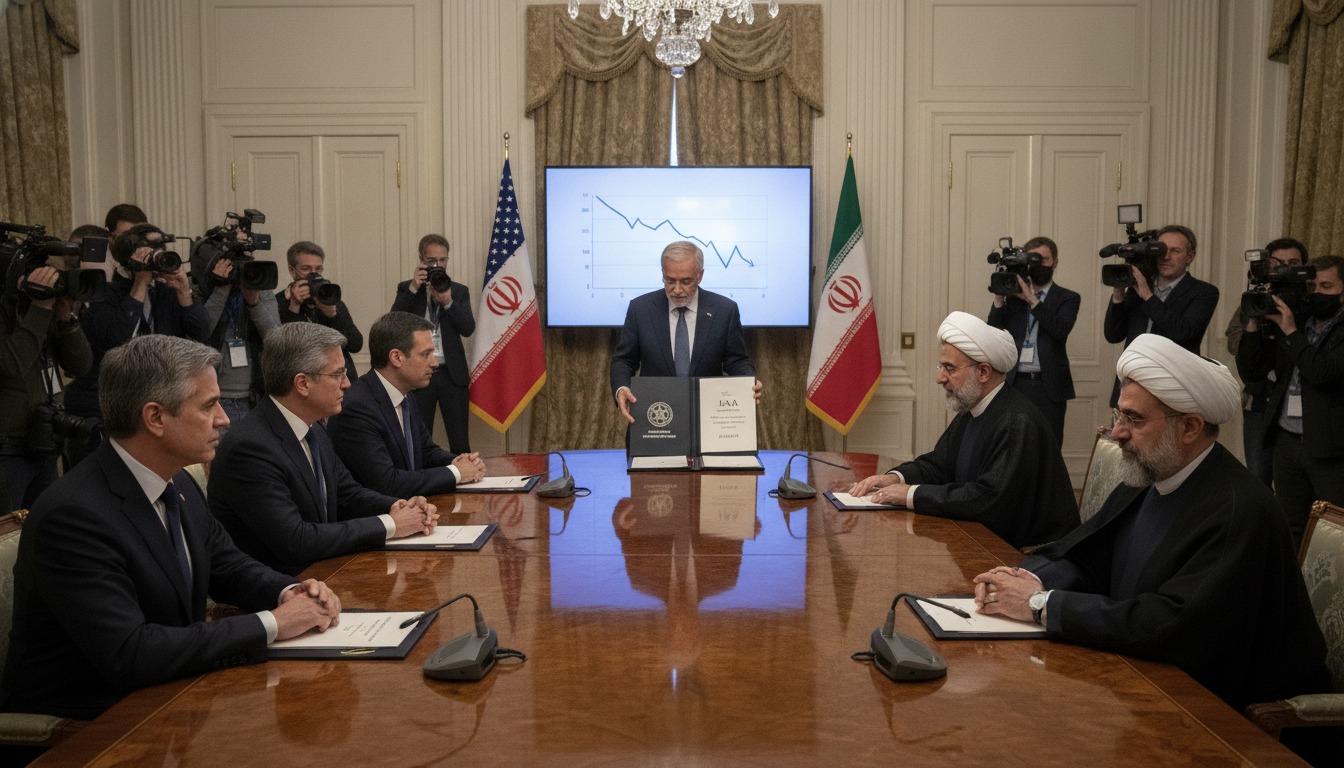
Iran-US talks in Switzerland create “very solid” basis for final Middle East agreement
Bürgenstock negotiations in Switzerland saw Iran and the United States agree on IAEA access and uranium dilution as part of a framework that could lead to a final accord within a 60‑day window.
The Iran-US talks that opened Sunday at the Bürgenstock resort near Lucerne produced what U.S. Vice‑President J.D. Vance called a “very solid basis” for a final agreement aimed at reducing nuclear risks and easing regional tensions. Delegations agreed on renewed access for International Atomic Energy Agency inspectors and a plan to dilute Iranian uranium stocks to below weapons‑grade levels as part of a protocol signed last week. The talks, launched amid initial confusion, are to culminate in a final document within a 60‑day renewable period, according to participants.
Talks at Bürgenstock and the 60‑day timeline
Delegations from Tehran and Washington met for intense sessions at the Bürgenstock complex on Sunday, with Iranian negotiators reporting up to 18 hours of discussions. Officials said the talks followed a protocol signed the previous week and were designed to resolve outstanding technical and political issues before a final accord. The agreement sets a 60‑day target to finalize terms, with the possibility of renewal if key technical points remain unresolved.
U.S. Vice‑President J.D. Vance told reporters he believed the teams “did exactly what we wanted to do” and described substantial progress, while Iranian representatives led by Parliamentary Speaker Mohammad Bagher Ghalibaf and Foreign Affairs official Seyyed Abbas Araghchi departed the resort after the sessions. Delegations from Qatar and Pakistan also joined as mediators, and both countries issued a joint statement outlining steps to manage conflict dynamics in the region.
IAEA access and uranium dilution commitments
A central element of the talks was Tehran’s agreement to invite International Atomic Energy Agency inspectors back to monitor uranium inventories, a move U.S. officials called a major step toward definitive denuclearization. The framework specifies dilution of enriched uranium to levels below 5 percent, a concentration well under the roughly 90 percent enrichment associated with weapons‑grade material. U.S. and allied experts said the dilution measures would limit Iran’s near‑term breakout potential and increase transparency around nuclear stocks.
Analysts cautioned that uncertainty remains over existing Iranian inventories, with some assessments estimating that Tehran could hold hundreds of kilograms of higher‑enriched material, including reports of up to 400 kilograms enriched to around 60 percent. The Bürgenstock protocol envisages continuous monitoring under IAEA supervision to track dilution and prevent diversion of material to military ends.
Economic measures and frozen assets
Negotiators also discussed economic measures designed to ease pressure on the Iranian economy while aiming to prevent funds from backing terrorism or military programs. Washington said it is studying mechanisms to release frozen Iranian assets in ways that benefit the Iranian populace, including proposals to channel funds for purchases of U.S. agricultural products. The U.S. also announced a temporary suspension of oil sanctions through August 21, a step described by American officials as a limited confidence‑building measure.
Iranian spokespeople highlighted that oil and petrochemical exports would no longer be restricted under the provisional understanding, and they announced the launch of a major reconstruction and development plan. Both sides emphasized safeguards intended to ensure that any unfreezing of assets would be tightly monitored.
Security arrangements for Lebanon and conflict management
Alongside nuclear issues, the talks addressed regional security, notably the escalating exchanges between Israel and Hezbollah in southern Lebanon. Sources involved in the negotiations said the United States and Iran agreed to establish a conflict‑management cell, with technical teams from the mediating countries coordinating to reduce clashes and restore calmer conditions along the Lebanon‑Israel border. U.S. officials noted that recent days had been comparatively quiet in Lebanon, a sign they described as encouraging if fragile.
Israeli sources mentioned potential symbolic withdrawals from limited areas in southern Lebanon as part of confidence‑building measures, though details remained tentative. Mediators said their objective was to prevent local confrontations from unraveling the broader protocol reached in Switzerland.
Technical working groups to resolve remaining issues
While senior officials returned home, technical delegations will continue negotiations to flesh out implementation details, including verification mechanisms, timelines for dilution, and the sequencing of sanctions relief. Vance said teams from the United States, Iran, Qatar and Pakistan would keep working at the Bürgenstock site and beyond to build the political oversight structure required for long‑term compliance. Those technical sessions are expected to continue over the coming weeks and days, according to participants.
Tehran announced that President Massoud Pezeshkian would travel to neighboring Pakistan on Tuesday, underlining the role of regional interlocutors in sustaining momentum. Pakistani and Qatari involvement was described as critical to bridging political gaps and ensuring robust monitoring arrangements.
Maritime traffic and regional economic implications
The talks also coincided with fluctuating signals about the Strait of Hormuz, a maritime chokepoint for global oil shipments. Despite Tehran’s announcement of a new closure earlier in the weekend, maritime tracking platforms recorded ongoing vessel traffic through the strait on Monday, with number of daily transits remaining below pre‑conflict averages but steady enough to suggest partial reopening. Analysts said continued commercial passage would ease immediate disruptions to energy markets but warned of renewed volatility if tensions spike.
Market watchers added that any durable agreement that stabilizes Iranian exports and eases sanctions could gradually normalize shipping patterns and lower insurance and freight costs, assuming confidence in enforcement of monitoring provisions.
The Swiss‑hosted discussions at Bürgenstock yielded substantive, if preliminary, commitments from Tehran and Washington on nuclear transparency, economic measures and regional de‑escalation, and mediators say technical teams will now work to translate those commitments into verifiable, enforceable steps within the agreed window.
