
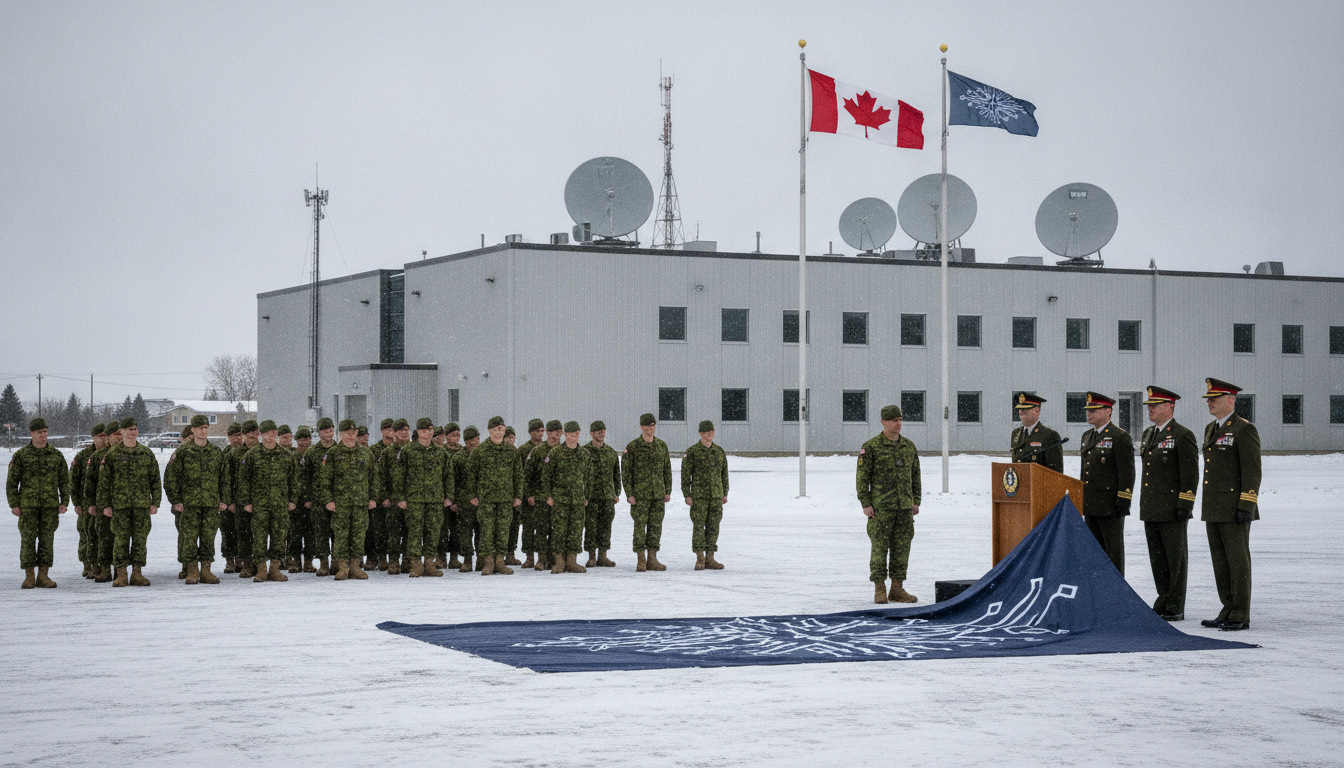
1 Signal Regiment stands up at CFB Edmonton to modernize Canadian Army communications
1 Signal Regiment officially stood up at CFB Edmonton on June 19, 2026, to strengthen Canadian Army communications, cyber readiness and brigade command-and-control systems.
The Canadian Army formally elevated 1 Signal Regiment from squadron to regiment status at CFB Edmonton on June 19, 2026, marking a shift toward prioritizing digital and cyber-enabled warfare.
The ceremony recognized the unit’s new responsibility for brigade-level command, control and communications across Western Canada and the North.
About 200 service members now fall under the regiment as it prepares for expanded operational duties and international testing of new capabilities.
Historic stand-up at CFB Edmonton
The change-of-command parade on June 19 was the first stand-up of a new regiment at the Edmonton garrison since 1968, a milestone leaders described as historically significant.
Mounted troopers and ceremonial formations were on display as military and local officials observed the transfer of authority to incoming commanding officer Lt.-Col. Jason Chor.
Organizers said the parade combined tradition with an explicit message: communications and information systems are now central to operational readiness.
Unit growth and command responsibilities
1 Signal Regiment has been expanded with additional senior leadership positions, including two extra majors and two additional sergeant majors to manage its broader remit.
The unit will handle everything from radios and vehicle-borne networks to internet-protocol systems that link sensors, platforms and commanders in real time.
Officials emphasized the regiment’s role is to ensure disparate systems can interoperate securely so brigade commanders receive timely, actionable information.
Modernizing battlefield communications
Military planners framed the stand-up as a response to a changing battlespace that increasingly unfolds in digital and cyber domains rather than on physical front lines.
Satellites, cloud architectures and mobile command systems now sit alongside traditional tactical radios, and the regiment must integrate those technologies into a coherent, resilient architecture.
Commanders noted adversaries are employing sophisticated cyber techniques, making layered, adaptive communications and rapid response capabilities essential to mission success.
Leadership and technical expertise of Lt.-Col. Jason Chor
Lt.-Col. Jason Chor, who assumed command at the parade, brings a background in computer engineering and extensive experience in operational communications planning.
Chor rose to the role following assignments that included oversight of communication systems for global Canadian Armed Forces operations and NATO exercises, and deployments to Kuwait and Iraq.
His civilian work in mainframe support and a technical education were cited by colleagues as assets for moving mobile command posts into urban, austere or remote environments.
Operational reach: Western Canada to the Arctic
The regiment is attached to 1 Canadian Mechanized Brigade Group and will support operations across Western Canada while providing capabilities for Joint Task Force North in the Arctic.
Officials said the unit’s area of responsibility includes integration with national Arctic defence efforts, where communications challenges are magnified by geography and limited infrastructure.
That regional remit means the regiment will design systems that are transportable, survivable and interoperable with other Canadian and allied platforms.
Training, testing and overseas deployment
The first increment of the regiment’s expanded capabilities will be exercised during a deployment to Latvia scheduled for next year, where interoperability with NATO allies will be tested.
Planners described the Latvia mission as an opportunity to evaluate new networks and command tools under operational conditions and to refine tactics, techniques and procedures.
Success in multinational exercises is expected to shape procurement and training priorities as the regiment scales up.
Investment and infrastructure supporting the growth
The stand-up aligns with a broader national investment in defence infrastructure, including a multi-billion-dollar industrial strategy and approved housing expansion at the Edmonton garrison.
Base officials have already greenlit roughly 1,000 new residences to support personnel growth tied to reinvigorated defence commitments and expanded units.
Commanders said infrastructure improvements are critical to sustainment, morale and the long-term development of high-tech communications capabilities.
Ceremony, tradition and the future of signals work
Veteran senior non-commissioned officers at the parade framed the transition as a once-in-a-generation event that preserves regimental history while signaling a new operational focus.
Members described the moment as both solemn and forward-looking, blending ceremonial customs with the practical realities of cyber and networked warfare.
Leaders urged continued investment in training and technical recruitment to ensure the regiment can meet evolving threats and support national security objectives.
As 1 Signal Regiment begins operations under Lt.-Col. Chor, the Canadian Army has set a clearer institutional priority on communications, cyber resilience and rapid information flow.
The new regiment will be judged on its ability to bind platforms together, support commanders with timely data and operate in harsh and contested environments.
Officials say the coming year of training, international exercises and infrastructure build-out will determine how effectively the regiment transforms doctrine into operational capability.
