
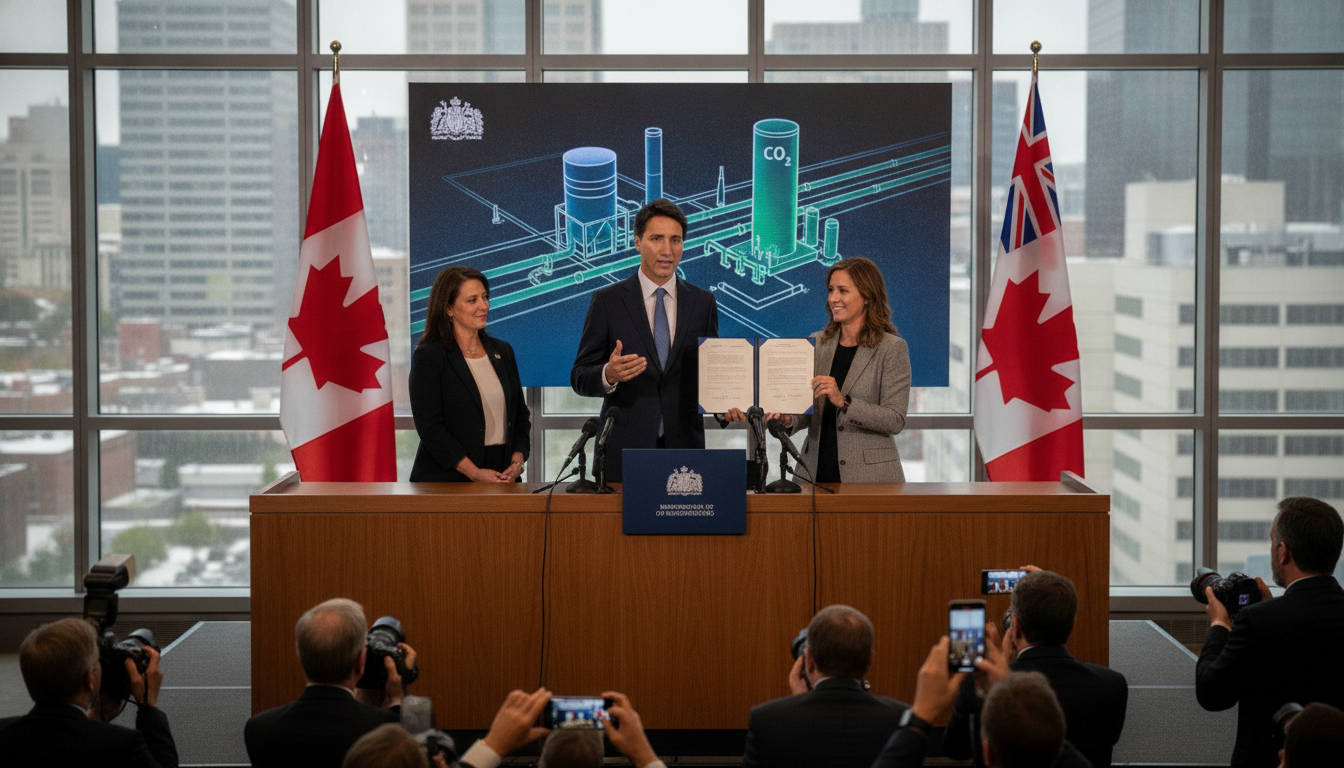
Energy accord advances as Alberta and Ottawa tout pipeline surge at Global Energy Show
Alberta and Ottawa say an energy accord is unlocking pipeline growth and carbon-capture talks, federal leaders report at Global Energy Show, June 9, 2026.
Canada’s efforts to fast-track an energy accord between Ottawa and Alberta took center stage at the Global Energy Show on June 9, 2026, as provincial and federal ministers outlined a string of pipeline and carbon-capture developments. The agreement, first formalized in a memorandum of understanding last November, is being framed by officials as the framework for unlocking new export capacity and large-scale emissions-reduction projects. Both Premier Danielle Smith and Natural Resources Minister Tim Hodgson said recent moves signal renewed momentum, though crucial approvals and private-sector commitments remain outstanding.
Officials point to near-term pipeline capacity gains
Alberta and federal officials highlighted several projects now advancing that together could add substantial export capacity before the end of the decade. Enbridge is planning optimizations on its Mainline system that could increase throughput by as much as 400,000 barrels per day, officials said. Trans Mountain Corp. is working on two separate uprates that together would add roughly 300,000 barrels per day to its system.
These capacity increases, combined with proposals to use existing Keystone XL infrastructure for southbound flows, were cited by the provincial government as evidence that the industry is preparing to move more crude to market. Officials stressed the upgrades are a mix of private- and publicly-led steps aimed at easing current transportation constraints.
Alberta’s West Coast pipeline plan and Major Projects Office timeline
Premier Smith reiterated that Alberta intends to submit a single route proposal for a provincially backed West Coast pipeline to the federal Major Projects Office by Canada Day, July 1, 2026. The province has studied potential northern and southern British Columbia routes and plans to present one coherent option to expedite federal review, she said. Smith described the proposed plan as part of a broader “grand bargain” that pairs increased export capacity with a major carbon-capture initiative in the oilsands.
The province has not yet identified private-sector proponents or a final route, and federal clearance from the Major Projects Office will be required before the project can proceed. Officials emphasized the desire for a compressed review timeline, but acknowledged that consultations and regulatory processes will still take time.
Pathways carbon capture remains the hinge for the deal
Central to the energy accord is the proposed Pathways carbon capture and storage project in the oilsands, which Ottawa and Alberta have tied to broader infrastructure support. Federal and provincial negotiators, along with the Oil Sands Alliance of major producers, continue trilateral talks on the scope and financing of the initiative. Minister Hodgson framed the approach as occupying a “practical middle ground” that advances both pipelines and emissions reductions, saying the government’s role is to create conditions for investment while the private sector builds the projects.
Pathways has not yet received a final investment decision, and participants acknowledged the project’s scale — including the roughly 16 megatonnes of annual emissions reduction referenced in the MOU — will require significant capital and clear industry commitments before construction can begin.
Industry voices warn on carbon pricing and financing gaps
Executives at the conference urged clearer financial signals and firmer commitments to make the projects viable. Cenovus Energy CEO Jon McKenzie criticized the industrial carbon price included in the MOU, arguing it will undercut competitiveness unless adjusted or paired with other supports. McKenzie warned that without definitive producer commitments of barrels to underpin the pipeline investment, the projects are unlikely to be financeable in the private market.
Estimates discussed at the event put the likely capital cost to deliver the emissions reductions targeted in the MOU between $20 billion and $30 billion. Oil Sands Alliance members, including Cenovus, Suncor and Canadian Natural, have expressed concern that an increase in Alberta’s industrial carbon price to $130 per tonne by 2040 could impair investment appetite without compensatory measures.
Political and Indigenous opposition to a northern route persists
Delegates acknowledged the political and legal realities that could constrain a northern Pacific Coast route, noting ongoing opposition from the British Columbia government and some coastal First Nations. Officials and industry representatives said those concerns remain a central obstacle, and that resolving them will be necessary for a coast-to-coast export solution. The province’s choice to submit a single route to the Major Projects Office is aimed at simplifying the review, but it does not eliminate the need for consultations, impact assessments and potential legal challenges.
First Nations and provincial governments have made clear that any pipeline proposal must address environmental, cultural and economic impacts, and proponents will need to navigate those issues as part of any approval process.
Next steps: negotiations, approvals and private-sector decisions
Conference speakers described the path forward as a sequence of parallel advances: firming Pathways finance and commitments, securing regulatory approvals for capacity projects, and continuing trilateral negotiations on carbon pricing and project terms. Premier Smith said daily discussions among government and industry participants are ongoing and that participants are focused on achieving a three-way deal that clarifies the direction for capital deployment.
Officials cautioned that even with the MOU and recent policy shifts — including the federal removal of an oilpatch emissions cap — the timeline to bring major pipelines and carbon infrastructure online remains measured and subject to commercial and regulatory realities. Private-sector decisions, final investment approvals and Indigenous engagement will determine whether the momentum expressed at the Global Energy Show translates into concrete construction starts.
Momentum at the Global Energy Show was evident, but speakers stressed the work ahead is substantial and will require coordinated commitments from governments, producers and investors to turn the energy accord’s ambitions into operating infrastructure.
