
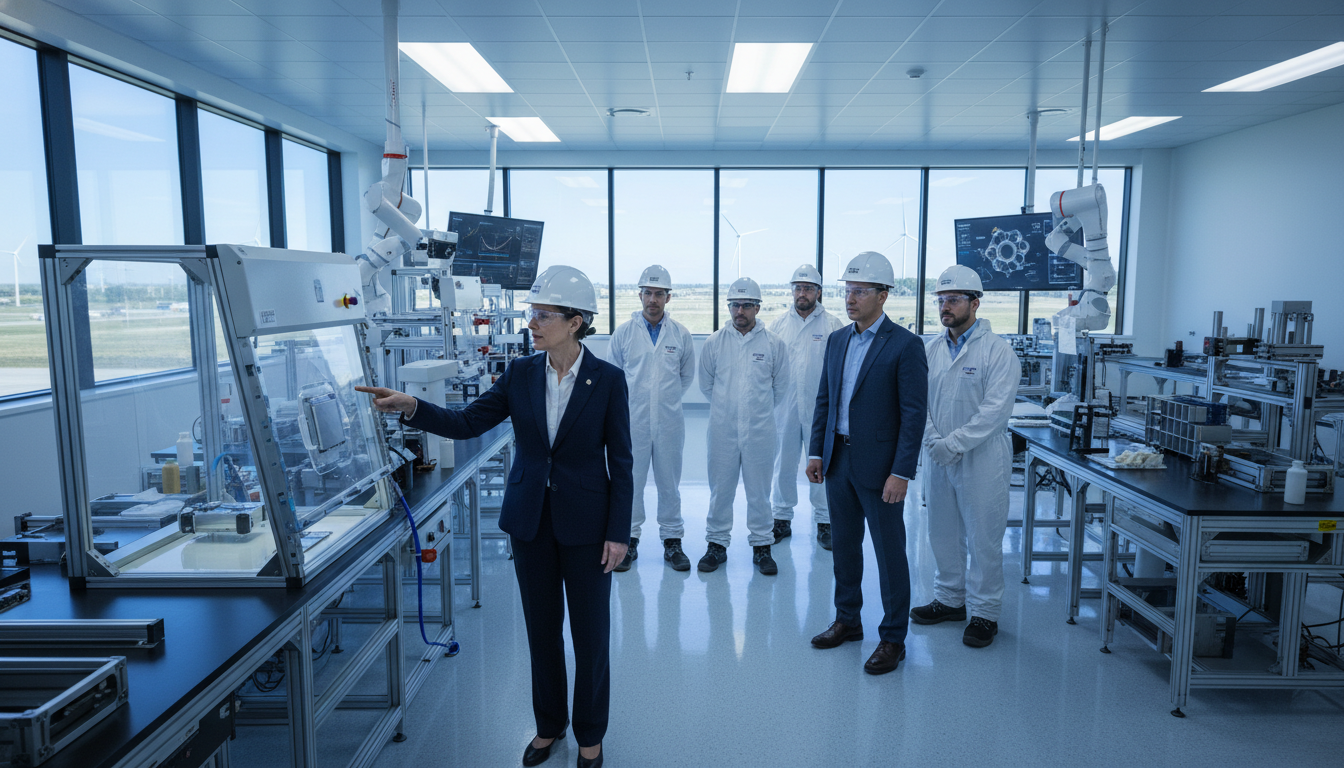
GM opens Battery Cell Development Center to accelerate LMR battery scale-up
GM’s Battery Cell Development Center in Warren will speed LMR battery scale-up, cut EV costs and accelerate production to deliver cheaper EVs by 2028.
The new GM Battery Cell Development Center at the automaker’s Warren Technical Center is stepping into service as a critical link between laboratory breakthroughs and mass production. The 500,000-square-foot facility is designed to compress the timeline for moving LMR (lithium-manganese-rich) chemistry from prototype to factory line, a move GM says could shave nearly 10% off vehicle battery costs. Company executives say the center will help deliver lower-cost, long-range electric vehicles on an accelerated schedule ahead of a planned 2028 rollout.
500,000-square-foot pilot line bridges Wallace research to production
The pair of off-white buildings that make up the Battery Cell Development Center sit adjacent to GM’s Wallace Battery Cell Research Center and are built to handle very different volumes than a full gigafactory. At full tilt the center is expected to produce roughly 2,500 cells per day, equating to about 0.5 gigawatt-hours annually, which positions it as a middle step between coin-cell research and full-scale manufacturing. That intermediate capacity allows engineers to move beyond laboratory demonstrations and validate processes on equipment closer in scale and function to production lines.
The center’s role is not to match the output of GM’s larger Ultium plants but to reduce the risk of costly missteps when a chemistry moves to large-scale production. By testing formulations and manufacturing recipes on similar machinery, GM aims to shorten the handoff time and improve first-pass yields once a factory begins mass output. The smaller batch sizes and pilot runs also limit the financial exposure of early experiments, making each test run materially cheaper than trials at a full-size plant.
LMR chemistry aims to cut costs while preserving range
LMR is central to GM’s cost and range calculus and is the chemistry GM has championed to replace a heavier reliance on nickel-manganese-cobalt (NMC) for mainstream vehicles. GM engineers say LMR can approach the energy density of NMC while moving material costs closer to those of lower-cost chemistries such as LFP (lithium-iron-phosphate). In customer terms, GM projects that LMR could reduce battery pack costs by thousands of dollars in vehicle segments where range remains important, narrowing the price gap with comparable internal-combustion models.
Kurt Kelty, vice president of battery and sustainability, has made LMR a priority since joining GM, describing it as the company’s core product line for the next phase of electrification. While NMC will remain in GM’s high-end models, LMR is being positioned for volume models where the balance of range and cost determines competitiveness in the broader market. The Battery Cell Development Center will be the primary proving ground for whether those projected savings and range trade-offs hold up in a production-like environment.
Pilot testing designed to lower scale-up risk and cost
Scaling a battery recipe from small research cells to large-format automotive cells is notoriously difficult, and GM built the center to reduce that friction. Test runs at the facility are priced in the hundreds of thousands of dollars rather than the multi-million-dollar scale of a full factory dry run, allowing more iterations at lower expense. The similarity of equipment between the pilot center and full plants is intentional; engineers expect a smoother “handoff” when the process has already been validated on nearly identical machines.
Industry analysis has warned that a new chemistry must reach high yields quickly or it risks never becoming commercially viable, and GM’s center is explicitly designed to accelerate that learning curve. The facility’s mixing tanks, coating lines and assembly stations are scaled to reveal issues that coin-cell work cannot, ensuring the company learns the pragmatic details of large-format production before committing vast factory resources. That measured approach is meant to protect capital and shorten ramp times at downstream factories.
Digital twin and AI models accelerate development and debugging
GM has layered digital simulation and artificial intelligence into the development workflow to speed debugging and optimize processes before physical runs are staged. Engineers have created a digital twin of the center — a virtual replica that includes control systems, equipment clearance and machine behaviors — to test operations in VR and detect layout or control problems ahead of real-world assembly. Company officials report extensive compute investment and millions in simulation savings as a result of these virtual validations.
Physics-based models and machine learning have been used to predict how chemistry changes will affect performance and manufacturability, helping the team prioritize experiments that are most likely to scale. GM personnel say cumulative compute hours for LMR research have run into the many millions, enabling rapid iteration on formulations and process parameters. That combination of virtual testing and targeted pilot runs is intended to shave months or more off traditional scale-up cycles.
Market pressure and timing as GM eyes a 2028 commercial rollout
The Battery Cell Development Center arrives as automakers reassess EV plans amid a softer U.S. market but a still-growing global EV demand. GM has retooled operations in recent years and recorded significant charges and workforce changes while seeking a path to profitable electrification at scale. The automaker’s strategy now hinges on delivering a cost-competitive battery option that preserves range in mainstream segments, a condition GM executives say is necessary to broaden consumer adoption.
Company leaders expect initial LMR batches from the center to appear later this year, with validation and ramp activities feeding into assembly plants in Tennessee and Ohio over the next two years. If the chemistry and manufacturing processes clear those milestones, GM plans to field LMR-based vehicles by 2028 that aim to hit a lower price point without sacrificing range. The center is also structured to support future chemistries, meaning LMR will be the first, not the last, test of the facility’s role in GM’s electrification pipeline.
GM’s new center is intended to be more than a building; it is a procedural bridge designed to turn laboratory promise into factory reality. The coming months of pilot production and simulation will determine whether LMR and the Battery Cell Development Center together can tip GM’s EV program toward lower costs, faster launches and broader market competitiveness.
