
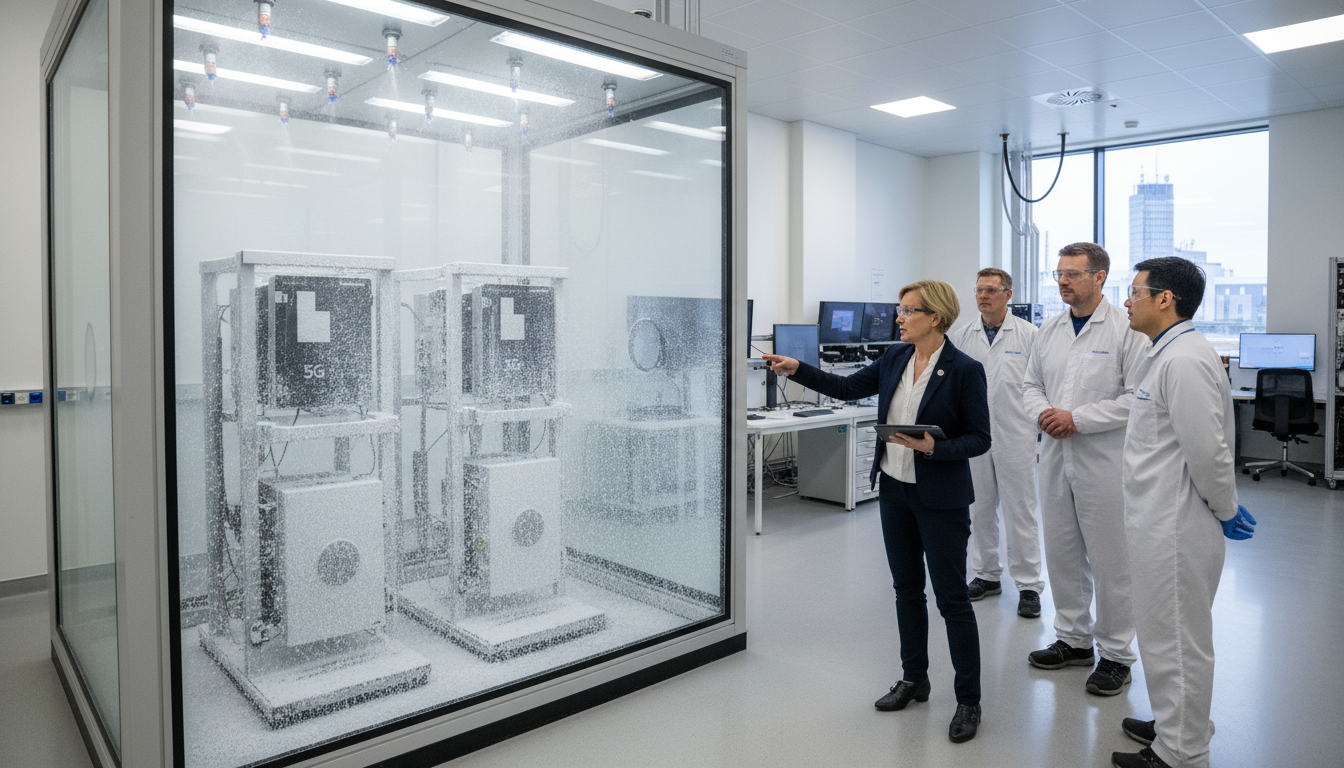
Nokia Oulu Test Chamber Puts 5G Base Stations Through Weeks-Long Salt-Air Coastal Trials
Nokia’s Oulu test chamber subjects 5G base stations to weeks-long salt-air and coastal simulations, advancing resilience testing for maritime and coastal networks.
Nokia’s Oulu test chamber is a sealed, purpose-built facility where the company places 5G base stations and other network equipment into weeks-long salt-air exposure to reproduce the corrosive conditions of coastal deployments. The facility in the Finnish coastal city of Oulu subjects hardware from the former handset maker’s network division to extreme humidity, saline aerosols and other stressors so the products can be certified to operate reliably near shorelines. The program reflects growing operator demand for resilient 5G infrastructure in maritime and coastal environments.
Nokia’s Oulu Salt-Air Test Chamber
The test chamber in Oulu is constructed as an enclosed cube that traps a controlled saline atmosphere around installed devices for extended periods. Engineers monitor corrosion effects, ingress protection and material degradation while collecting performance metrics on radio modules and power systems. These controlled evaluations let Nokia identify weak points before equipment is deployed to towers, ports, vessels or offshore platforms.
Reasons for Coastal Stress Testing
Coastal and maritime deployments present unique risks for telecom hardware, including salt-induced corrosion, rapid temperature swings and elevated humidity that accelerates wear. Operators demand high availability for safety-critical services and commercial applications, making pre-deployment validation essential. By simulating these conditions in Oulu, manufacturers can reduce field failures and lower lifecycle costs for carriers operating near sea routes and harbor infrastructure.
Simulation Methods and Measured Parameters
Inside the chamber, technicians introduce saline mist and cyclic humidity profiles to replicate spray and fog exposure typical of coastal zones. Tests combine environmental stressors with electrical loading and radio traffic patterns so components are assessed under realistic operational strain. Measurements focus on corrosion rates, connector integrity, thermal management and radio throughput to ensure both physical durability and sustained network performance.
Products Tested and Deployment Targets
The program primarily targets 5G base stations and related radio access network modules, but it also covers power electronics, antenna systems and enclosure materials. Equipment that passes Oulu’s conditioning regimen is positioned for deployment on coastal towers, waterfront public networks and enterprise installations that serve ports and marine operations. The testing pipeline helps certify that devices meet industry-grade durability expectations before large-scale rollouts.
Implications for Network Resilience and Operators
Rigorous environmental testing reduces the risk of unplanned outages caused by accelerated corrosion or moisture ingress, improving service continuity for carriers and customers. For mobile operators and critical infrastructure providers, validated equipment lowers operational risk and can simplify maintenance cycles in challenging environments. Manufacturers that can demonstrate such testing capability may gain competitive advantage in markets where coastal coverage is strategic.
Effects on Supply Chains and Product Design
Findings from salt-air testing inform material selection, sealing techniques and long-term maintenance recommendations for deployed gear. Feedback loops between test engineers and product designers enable targeted refinements such as improved gasket compounds, corrosion-resistant coatings and monitoring sensors. This iterative approach shortens the time between lab discovery and field-ready design improvements, reducing warranty claims and enhancing reliability metrics.
Nokia’s investment in dedicated coastal testing facilities underscores a broader industry push to harden networks as 5G extends into new use cases and harsher environments. The ability to reproduce weeks-long saline exposure under controlled conditions gives operators clearer assurance that base stations will meet performance expectations at the water’s edge. As coastal connectivity becomes more central to industrial, public-safety and commercial services, validation like that performed in Oulu will play a growing role in procurement and deployment decisions.
