
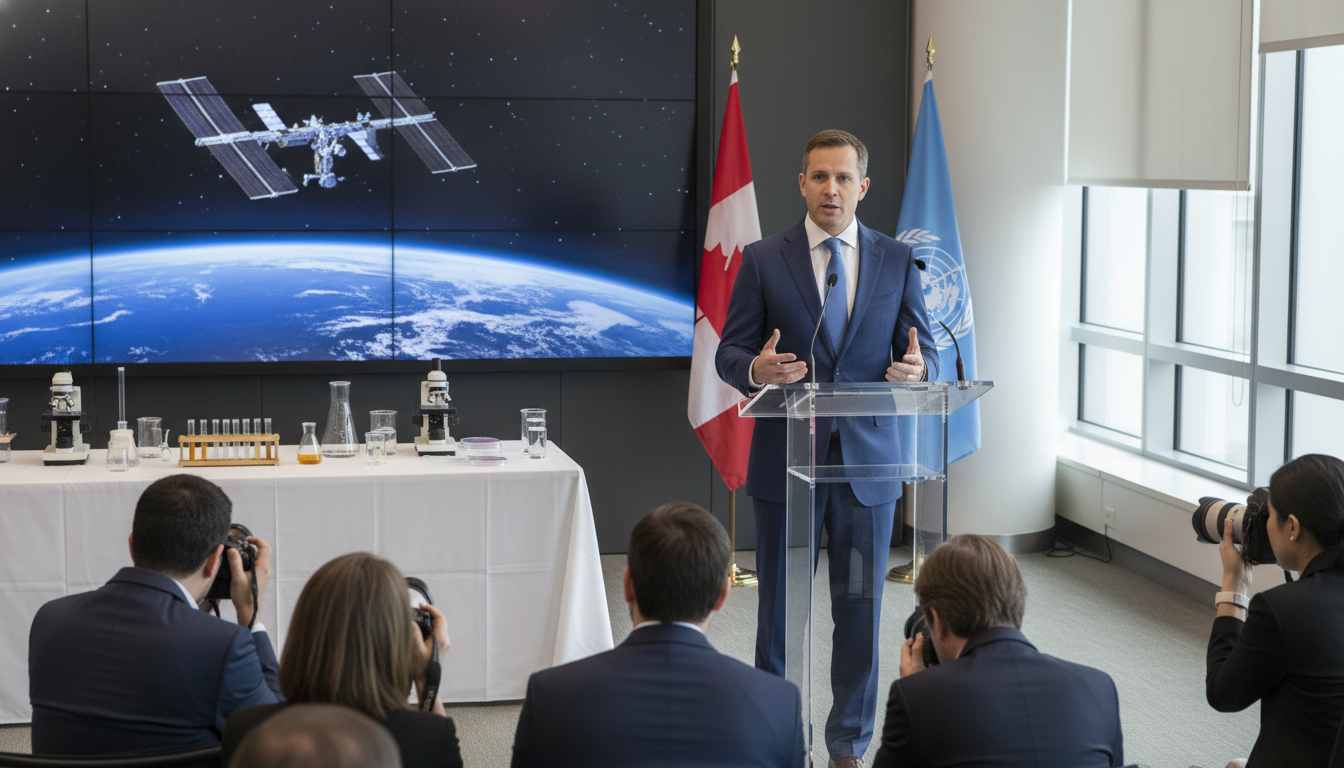
Canada’s Joshua Kutryk highlights dual demands of space station operations and science
Joshua Kutryk outlines responsibility for space station operations, balancing maintenance, repairs and scientific research aboard the orbiting laboratory.
Canada’s astronaut Joshua Kutryk says the primary duty for crew aboard the International Space Station is clear: to take responsibility for the station’s day-to-day operation, upkeep and repair while also carrying out scientific work. He framed “space station operations” as a two-part role requiring technical skill and sustained scientific focus. Kutryk emphasized that years of training prepare astronauts for complex mechanical and systems work as well as for the management of experiments in microgravity. His comments underscore the continuing expectation that orbital crews act as both technicians and researchers.
Kutryk Stresses Operational Responsibility
Kutryk described station stewardship as a hands-on commitment to keeping systems functional and safe. He said operating and maintaining the complex habitat involves monitoring life-support, power and communications systems around the clock. The responsibility extends to diagnosing anomalies and executing hands-on repairs when components fail. That operational dimension remains central to crew training and mission planning.
Years of Training for Complex Repairs
Training for space station operations, Kutryk noted, is intensive and prolonged, covering everything from robotics to extravehicular activity procedures. Astronauts practice hardware removal and replacement, emergency troubleshooting, and coordinated team responses long before launch. Simulators and underwater neutral-buoyancy training recreate the physical and procedural demands of orbit. This preparation is designed to reduce risk and ensure crews can restore essential systems quickly if problems arise.
Robotics and External Maintenance Skills
Robotic systems and external maintenance are a distinctive part of station operations and demand specialized expertise. Canadian robotics hardware has been integral to many maintenance tasks, and crew members train extensively with arms and manipulators in ground facilities. Skills in commanding and supporting remote robotics are essential for moving cargo, installing hardware and assisting with external repairs. These capabilities complement manual crew activities and broaden the options for maintaining the outpost.
Science Agenda Aboard the Station
Kutryk was equally clear that science remains the second pillar of work in orbit, with crews expected to execute experiments across biology, materials science and physical sciences. The station is described as a laboratory in microgravity where investigations produce data that cannot be replicated on Earth. Crew time is allocated to setup, monitoring and troubleshooting experiments, and astronauts often serve as the principal technicians for delicate protocols. Scientific output is a major justification for continued investment in the facility and a key measure of mission success.
Balancing Safety, Maintenance and Research in Orbit
Officials and crew must constantly weigh operational needs against scientific goals, a balance Kutryk said requires discipline and planning. When a critical repair is needed, research schedules are adjusted and scientific staff on the ground re-prioritize experiments. Similarly, preventive maintenance is scheduled to minimize disruption to time-sensitive investigations. This adaptive approach keeps the station safe and productive while allowing scientific objectives to advance.
Implications for Canadian Space Involvement
Kutryk’s comments reflect a broader Canadian role in station stewardship that combines technical support with scientific participation. Canada’s contributions to robotics and crew training have kept Canadian expertise in demand for both operational tasks and research facilitation. The dual focus also shapes domestic training programs and partnerships with international agencies. As the station continues to evolve, Canadian personnel are positioned to play both hands-on and scientific roles.
The twin demands Kutryk outlined — to operate, maintain and repair the station while also delivering scientific results — define the professional identity of today’s astronauts and shape mission planning. Maintaining that balance will remain a test of training regimes, ground-to-orbit coordination and the adaptability of crews working hundreds of kilometres above Earth.
