
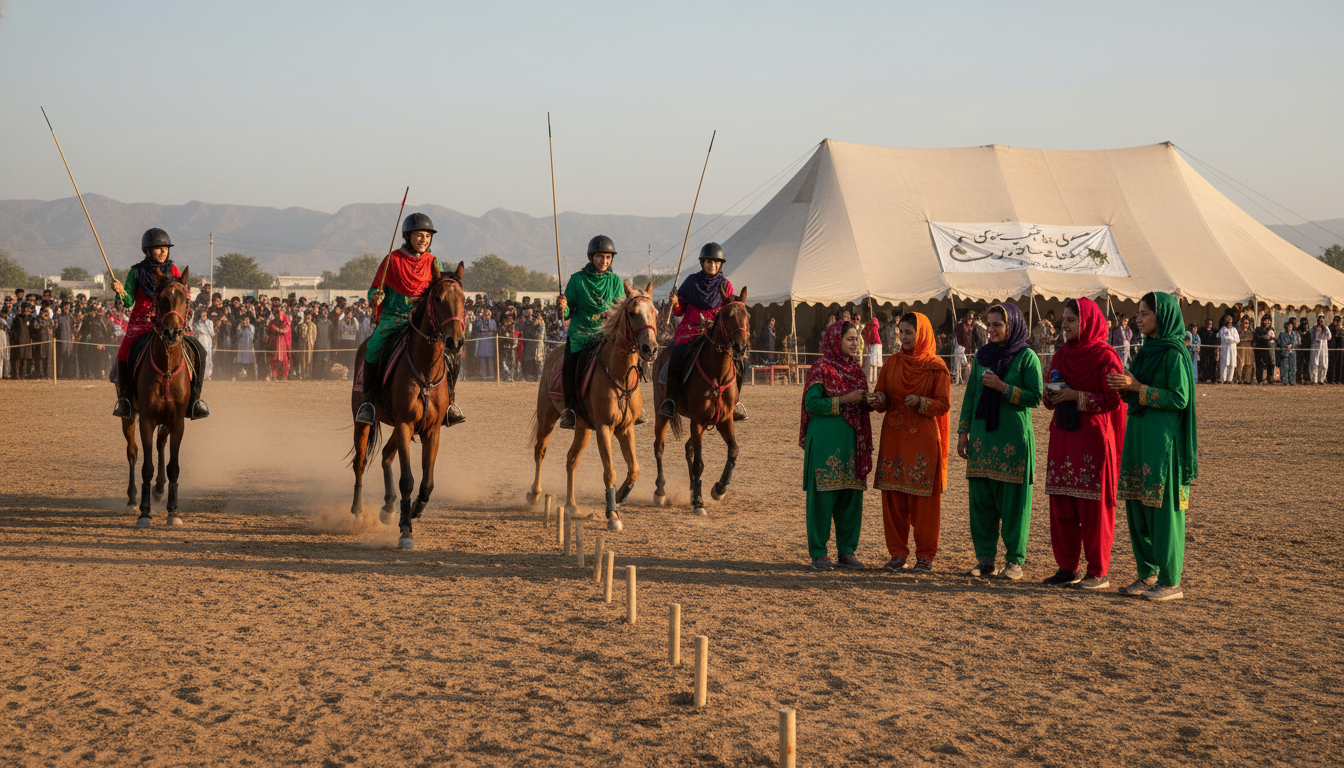
Women tent pegging breaks ground as Pakistan’s first female club competes at Rawalpindi mela
Women tent pegging advances in Pakistan as the first female-only club competes at a mela, exposing cost, access barriers and rising social media visibility.
Female riders made a rare public showing at a winter mela on the outskirts of Rawalpindi, where the newly formed Bint-e-Zahra Club — Pakistan’s first women-only tent-pegging team — ran alongside dozens of male teams. The appearance marked a visible step for women tent pegging in a sport long dominated by men, and it highlighted persistent social, financial and logistical obstacles. Organizers, riders and local spectators watched as the women engaged the crowd and the controversy that sometimes follows challenges to entrenched tradition.
Women’s team debuts at a traditional mela
The Bint-e-Zahra Club entered the carnival-style competition with four riders, including 30-year-old Anum Shakoor and 32-year-old mother Sehrish Awan, drawing immediate attention from photographers and onlookers. The club was formed in 2025 to provide a women-only space for training and competition after many female riders found themselves limited to mixed clubs. Their participation in the mela placed women tent pegging squarely in the public eye, testing social norms at an event attended by thousands.
The team’s runs were met with a mixture of curiosity and scepticism, as the audience—predominantly male—watched closely while drums and shehnai cut through the cold air. While the riders received some applause, they also faced audible surprise and disapproval from sections of the crowd, underscoring the cultural barriers that accompany their entry into the sport.
Tradition, symbolism and resistance
Tent pegging is steeped in history and local identity in northern Punjab, where melas draw competitors from across the region and beyond. For many attendees, the sport is bound up with male lineage and the symbols that accompany it, such as turbans and mounted martial skill. When women wear the same accoutrements or take the field, it can be read by some as a challenge to longstanding social codes.
At the Rawalpindi event, veteran riders and local elites sat alongside men who had ridden for generations, and some reacted negatively when female competitors appeared. Yet the women pushed forward, adopting traditional rider gear and taking visible pride in their roles, a deliberate claim to the sport’s symbols that organisers and supporters say is part of normalizing female participation.
Pathways from training to international competition
Women’s involvement in organized tent pegging in Pakistan has progressed unevenly. The country’s first sustained push to train female riders dates back to initiatives supported by senior figures in the equestrian community, including programs that sent girls abroad for coaching. Riders such as Ayesha Khan emerged from those opportunities, becoming the first Pakistani woman to compete in mixed international events and later captaining an all-women squad.
Despite those milestones, federation selection practices and event logistics have often favoured male riders. Open international tournaments have sometimes gone to male-only delegations even when women could have been included, reflecting assumptions within the sport’s governance that complicate women’s access to higher-level competition.
Costs, infrastructure and unequal access
Financial constraints were repeatedly cited by riders as a primary barrier to participation. Owning and maintaining a horse, transporting animals between cities for multi-day events, and paying caretakers quickly add up, putting the sport out of reach for many would-be competitors. Riders estimate that monthly feed and basic care can approach or exceed local minimum wages, and the cost of a sporting horse remains significant for most families.
Event rules that require each rider to bring their own horse further exclude those without means or networks to arrange transport. Many women also lack family support, which compounds the economic hurdles and narrows the pool of potential riders despite growing interest at the grassroots level.
Social media, visibility and backlash
Short video clips of women tent pegging have found large audiences online, with some posts garnering millions of views and introducing a new public for the sport. Riders use social platforms to document training, competitions and club life, which helps recruit followers and attract informal sponsorship opportunities. That visibility has amplified both admiration and criticism.
Some viral posts have spurred hostile reactions from conservative corners of the equestrian community, including objections when women adopt traditional male attire such as turbans. Riders say the online presence is a double-edged sword: it brings supporters and recruits but also concentrates criticism and threats that can deter participation and complicate families’ willingness to let daughters compete.
Breaking into the sport requires not only skill but also reliable support networks, the riders say. Families that back their daughters provide essential protection at crowded events and help negotiate the cultural unease that sometimes follows female riders into public spaces. Riders acknowledge that without those close allies, many women would be unable to train or travel.
The emergence of a women-only club at a major mela reflects both progress and the work that remains to normalize female participation in tent pegging. The Bint-e-Zahra riders describe their efforts as about gaining equal respect rather than proving superiority, and they point to training opportunities, modest sponsorship and safe facilities as practical next steps.
As the sport adapts, its future will depend on whether governing bodies, event organisers and local communities can reconcile tradition with broader access. For the women on the field, every run, every successful peg and every viral clip represents another small shift in perception — a gradual rewriting of who belongs in a centuries-old arena.
