
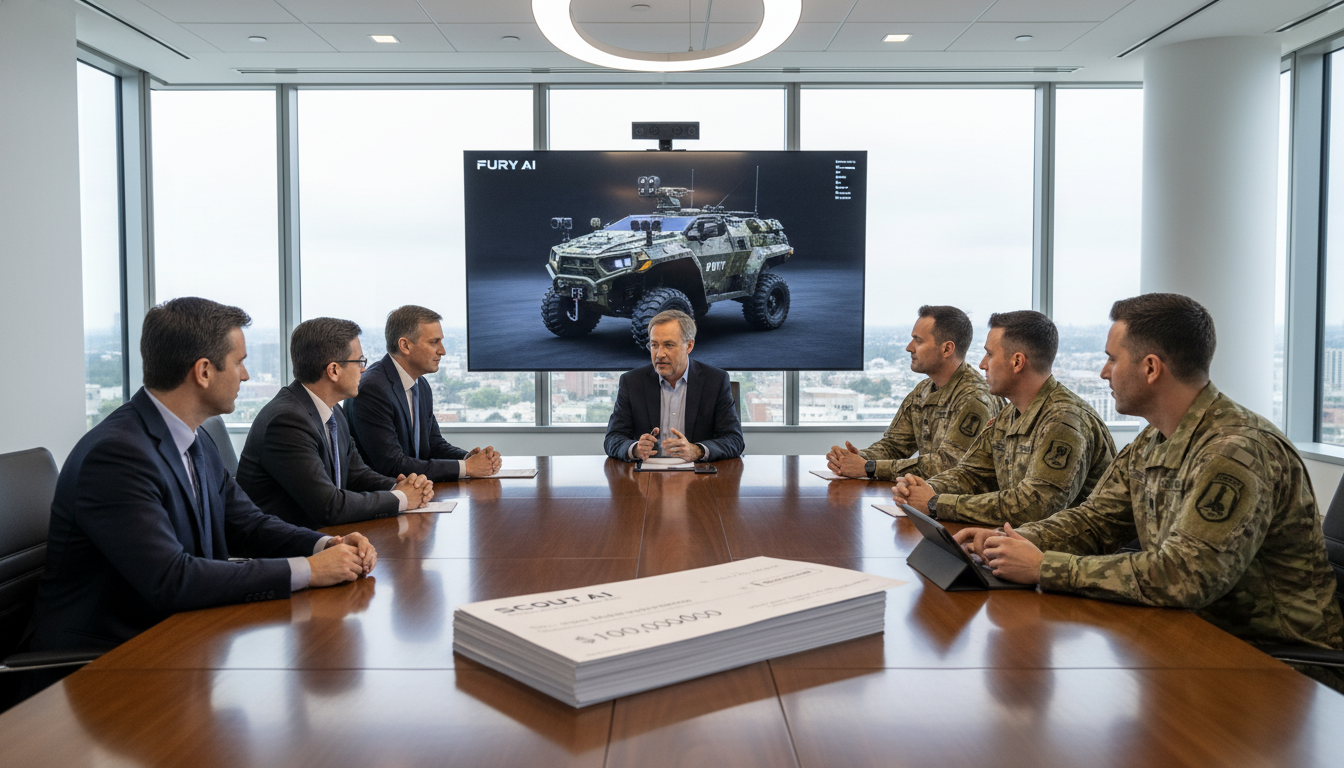
Scout AI raises $100M to train Fury AI on autonomous military ATVs
Scout AI secures $100M Series A to develop Fury, training vision-language-action models on four-seat autonomous ATVs for logistics, reconnaissance and future combat roles.
Scout AI announced a $100 million Series A round on Wednesday as it advances an ambitious program to train its Fury military AI using four-seat autonomous ATVs on a central California training range. The startup, founded in 2024 by Coby Adcock and Collin Otis, is developing vision-language-action models to pilot ground vehicles for resupply, reconnaissance and, eventually, weaponized missions. The company says the funding will accelerate model development, build out its Ox command-and-control product, and expand compute and training operations.
Funding and partnerships
Scout AI’s Series A was led by Align Ventures and Draper Associates, following a $15 million seed round in January 2025. The company also cites roughly $11 million in government technology contracts from organizations including DARPA and the Army Applications Laboratory. Scout’s leaders say the capital will be directed toward training infrastructure, hardware and the longer-term goal of building a proprietary foundation model tailored to military requirements.
Training Fury on a live range
At a restricted military base, Scout is running its “Foundry” training program where engineers and former soldiers put autonomous ATVs through simulated missions on hilly, unmarked trails. Drivers log takeovers and difficult maneuvers during eight-hour shifts; that intervention data feeds reinforcement learning systems used to refine Fury’s behavior. Company personnel describe a mixed stack that includes deterministic control systems alongside the vision-language-action agents to handle edge cases and safety constraints.
How vision-language-action models are being applied
Scout says Fury is built on vision-language-action (VLA) techniques—multimodal models that couple perception with command-oriented reasoning—so vehicles can interpret imagery and execute mission directives. The founders view VLAs as an “unlock” because they allow agents to apply prior knowledge to new tasks without exhaustive task-specific training. In practice, Scout reports its models navigate narrow trail segments, slow when uncertain, and hold lane-like behavior on wider tracks, behaviors the company compares to trained human drivers.
Immediate mission focus: resupply and reconnaissance
Executives and military technologists foresee early operational uses in automated resupply convoys and reconnaissance support. Scout envisions uncrewed ground vehicles carrying supplies to remote outposts or following a crewed truck as part of convoy formations, reducing risk to personnel. The startup is also testing drone orchestration for scouting and potential strike roles, including concepts where a higher-capacity “quarterback” platform would coordinate lighter munitions drones across an area of interest.
Autonomy, targeting and oversight concerns
Scout’s roadmap touches on politically sensitive territory: autonomy in weapons systems. Company spokespeople emphasize constrained use cases and rules-based limits—geofencing, human-in-the-loop confirmation, and mission envelopes—to reduce unintended engagements. Military partners supervising the work acknowledge automated targeting is technically difficult and likely to be limited to highly controlled scenarios in the near term, but they argue VLAs’ reasoning ability makes them worthy of field experimentations with clear guardrails.
Product strategy and scale
Positioning itself primarily as a software and model developer, Scout plans to sell an integrated command-and-control offering called Ox bundled with hardened compute, sensors and communications. Ox is designed to let small teams direct multiple unmanned assets using concise, prompt-like commands for waypoints and threat monitoring. The founders stress they will not manufacture chassis, instead integrating their intelligence layer atop existing vehicle platforms to leverage the Pentagon’s asset base and accelerate fielding.
Scout’s participation in Army experimental cycles extends to a selection of autonomy companies whose systems are being evaluated by units like the 1st Cavalry Division, with expectations that proven technologies may accompany deployments as units rotate in 2027. Company leaders also point to pedigree in autonomy—one founder came from autonomous trucking—and to board and advisory connections in robotics as contributors to their approach.
The field tests at the base reveal both progress and limits: autonomous ATVs completed a 6.5 km loop with cautious behavior on ambiguous terrain, yet engineers acknowledge full off-road autonomy remains out of reach. Scout says the combination of real-world driving data, simulation, and pretrained military datasets will be necessary to close that gap and deliver reliable agents for the tasks the Defense Department prioritizes.
The company’s public stance is unabashedly pro-defense, and its executives contrast their willingness to accept military work with tech firms that have resisted defense contracts. They also concede the long-term plan includes building their own foundation model rather than depending indefinitely on external pretrained weights, a move intended to reduce cost and retain control over how agents interact with the physical world.
As funding flows and field experiments continue, Scout AI aims to refine Fury and Ox through tighter integration with soldier workflows and iterative testing on training ranges. The coming months will show whether the company can translate its range performance into durable, deployable capabilities that meet both operational needs and regulatory and ethical expectations.
