
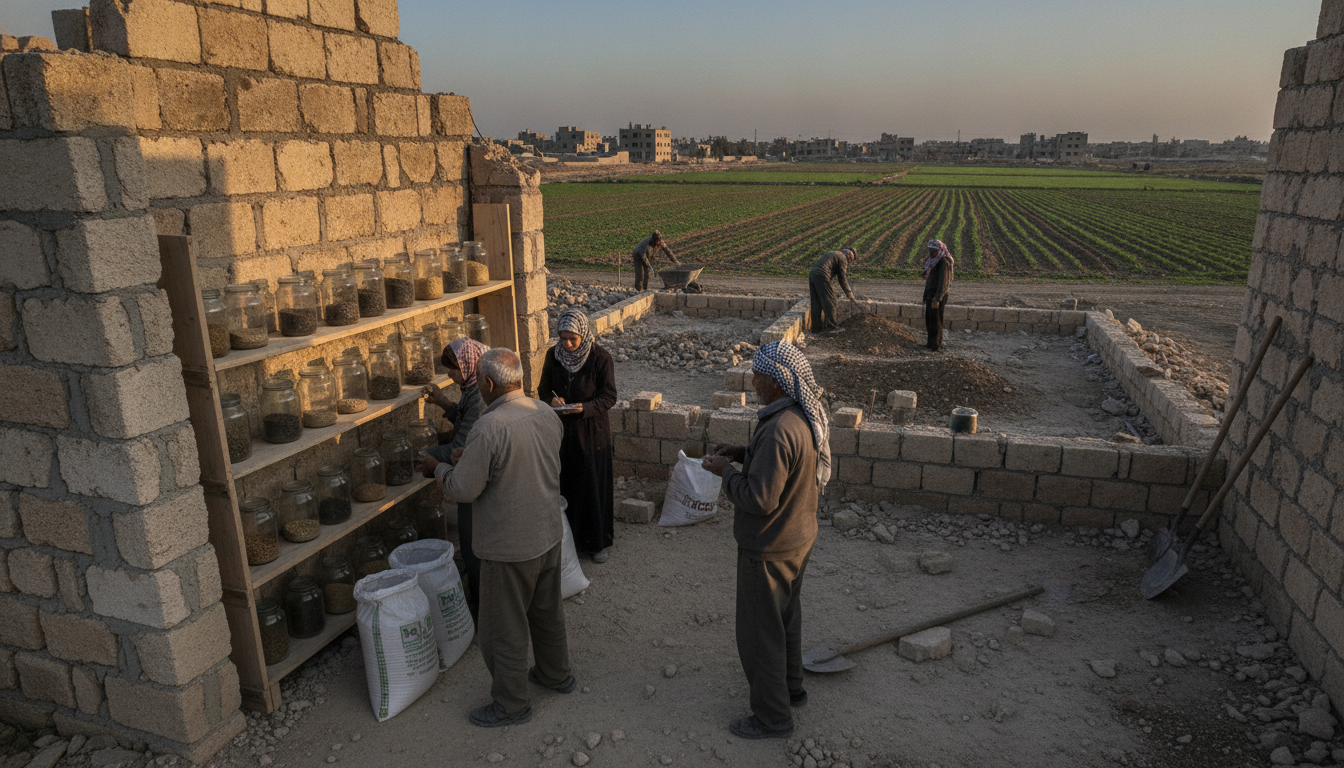
Gaza seed bank rebuilt by farmers to preserve 32 local crop varieties
Farmers in Gaza are rebuilding a seed bank destroyed during the war to preserve local crop varieties, collecting roughly 32 types to help restart cultivation amid widespread damage to farmland.
Farmers rebuild seed bank after destruction
A small group of Gaza farmers and local agronomists have quietly reassembled a community seed bank after the original collection was lost in the conflict. The initiative aims to protect heirloom and locally adapted seeds so remaining plots can be replanted when conditions allow.
Organizers say the project began with household seed donations and small-scale exchanges between farming families and community gardens. The effort seeks to restore genetic diversity that farmers say was severely eroded when the earlier facility was destroyed during the war on Gaza.
Collection now includes about 32 local varieties
The rebuilt collection has reached roughly 32 distinct crop varieties, including staple grains, legumes and vegetables adapted to Gaza’s coastal and inland soils. Farmers describe the selection as a starting point rather than a comprehensive repository for the territory’s agricultural needs.
Local growers emphasize that many important landraces remain missing and that the current stock is not sufficient to meet population demand. They are prioritizing varieties that are drought-tolerant, salt-resistant and quick-maturing to better withstand the region’s degraded growing conditions.
Seed-saving techniques and simple storage
Community volunteers are relying on traditional seed-saving techniques — careful selection, drying and small-scale hermetic storage — combined with basic documentation of variety names and traits. Without advanced cold-storage facilities, custodians focus on low-cost, low-technology methods that can be maintained locally.
Training sessions conducted by farmers and local ngos have covered seed cleaning, pest control and record-keeping to reduce loss and maintain purity of lines. These grassroots practices aim to keep the collection viable until larger-scale support and secure facilities become available.
Scale and access remain major constraints
Despite progress, farmers acknowledge the project is far smaller than Gaza’s agricultural requirements and faces significant logistical barriers. Limited access to farmland, scarcity of inputs such as fertilizer and fuel, and damaged irrigation systems all restrict the ability to scale seed multiplication programs.
Ongoing restrictions on movement and imports have also made it difficult to obtain equipment and materials for proper seed storage and testing. Women and smallholder farmers, who manage a significant share of household food production, report particular difficulty accessing training and seed distributions.
Community networks and external support
The recovery effort has depended largely on informal community networks, agricultural cooperatives and small ngos working inside Gaza. These groups have facilitated seed exchanges, organized field trials and provided workshops on crop management under crisis conditions.
Some international humanitarian agencies have signaled interest in supporting seed preservation and multiplication, though delivery of larger-scale assistance remains subject to complex clearance and logistical hurdles. Local organizers stress that aid designed in coordination with farmers will be most effective.
Potential impact on planting seasons and food supplies
A functioning seed bank could enable more households to plant productive plots during the coming seasons and reduce reliance on imported seed and commercial packages. Conserving locally adapted varieties would also help maintain traits critical to Gaza’s food security, such as resilience to salinity and short growing windows.
However, farmers caution that seed alone will not restore production without concurrent repairs to wells, irrigation networks and roads, plus renewed access to fuel and agricultural inputs. They call for coordinated responses that combine seed preservation with investments in the broader farming infrastructure.
Gaza’s nascent seed bank is an early sign of local resilience, but custodians say its future depends on expanded community participation and secure, sustained support to translate preserved varieties into food on the table.
