
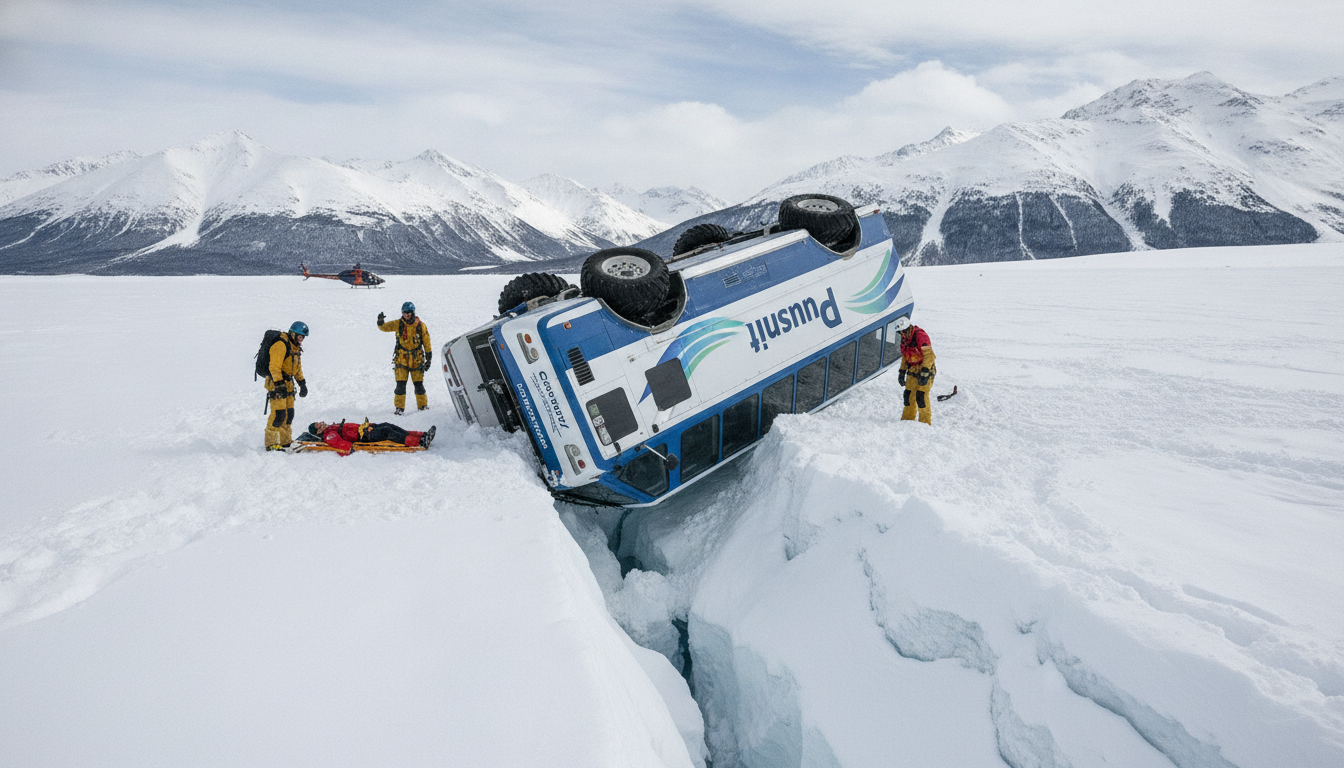
Columbia Icefield rollover injures Pursuit employee during maintenance on Athabasca Glacier
Columbia Icefield rollover injures a Pursuit employee during an operational check; Ice Odyssey vehicle rolled. Tours paused and Alberta OHS investigating.
A worker was injured after an Ice Odyssey all-terrain tour vehicle rolled down an embankment on the Columbia Icefield during an operational maintenance check, police and the tour operator confirmed. The Columbia Icefield rollover occurred at about 11 a.m. on Tuesday, roughly 120 kilometres south of Jasper, and involved a single Pursuit team member who was alone in the vehicle at the time. Emergency responders transported the employee to hospital, and Pursuit later said the person has been released and is recovering, though further care may be required. The incident prompted an immediate suspension of glacier tours while officials and the company review the circumstances.
Single worker injured in Columbia Icefield rollover
RCMP officers who attended the scene described the incident as a workplace injury rather than a multi-passenger crash, noting the injured person was the only occupant of the all-terrain vehicle. Pursuit, the company that operates the Ice Odyssey glacier tours, confirmed the vehicle rolled backwards and down off the road during a maintenance check. The employee was taken to hospital with injuries that were not initially detailed, and Pursuit’s Canadian chief operating officer described the early medical update as encouraging. Local authorities and company representatives emphasized that there were no tourists involved and no additional injuries reported.
Medical and rescue resources were dispatched from nearby Jasper and park services to secure the site and transport the injured worker. Officials said the terrain at the Columbia Icefield is remote and subject to rapidly changing conditions, complicating on-scene response and extraction efforts. Pursuit representatives worked with police and park authorities to stabilize the scene and to ensure the safety of staff and any nearby visitors. The company confirmed it would fully cooperate with investigators and provide any necessary assistance to the worker and their family.
Pursuit suspends Ice Odyssey glacier tours and offers refunds
Following the rollover, Pursuit announced a temporary suspension of Ice Odyssey glacier tours through at least Thursday to allow for internal reviews and coordination with investigators. The company is offering affected customers the choice of refunds or the opportunity to rebook, and it said it is actively contacting those with reservations. Pursuit’s statement framed the pause as a precaution while facts are gathered and the circumstances reviewed with the applicable authorities. Officials stressed that they would not speculate publicly on causes until investigators complete their initial work.
The suspension affects operations on the Athabasca Glacier, where the fat-tire Ice Odyssey vehicles normally carry paying customers across the ice surface as part of a guided experience. Pursuit operates several attractions and transportation services in the region, and the temporary halt is likely to affect nearby visitor schedules and travel itineraries. The company indicated it was working to minimize disruption while also prioritizing safety and the integrity of the investigation. Staff were reallocated to assist with customer communications, refunds, and rebooking logistics.
Vehicle details: Ice Odyssey ‘Fat Truck’ involved in operational check
The vehicle involved in the rollover is one of Pursuit’s Ice Odyssey all-terrain units, commonly referred to as “Fat Trucks.” These purpose-built, high-clearance vehicles are designed to traverse glacial ice and carry passengers safely across the Athabasca Glacier’s irregular surface. Pursuit said the unit was undergoing an operational maintenance check by a trained team member when the vehicle rolled, and that no tourists were aboard at that time. Company officials described the procedure as part of routine equipment checks intended to verify vehicle readiness for public tours.
Fat Trucks feature oversized tires, reinforced frames, and engineering adaptations for travel on ice; however, the unique demands of glacier travel pose operational risks that require specialized training and precautions. Pursuit emphasized that its maintenance protocols include pre-tour inspections and regular servicing, and that staff who perform operational checks are trained to industry standards. After the rollover, the vehicle was secured and removed from service pending a technical assessment, and Pursuit said it will assess any mechanical or human factors as part of the review. The company declined to speculate on the precise cause until the formal inquiry is complete.
Alberta Occupational Health and Safety opens investigation
Alberta’s Occupational Health and Safety department has assumed responsibility for the formal investigation into the incident, a jurisdictional step common for workplace injuries that occur in the province. The transfer of the inquiry to Alberta OHS indicates the matter will be examined under provincial workplace safety legislation and regulations governing employer responsibilities and equipment safety. Investigators are expected to review maintenance logs, training records, vehicle condition, and witness statements as part of their fact-gathering. RCMP will continue to provide scene information and support as required.
Alberta OHS investigations typically seek to determine whether workplace safety standards were met and whether any regulatory breaches occurred that could lead to administrative or enforcement action. The agency has authority to inspect equipment, interview staff, and require documentation from the operator. Pursuit said it welcomed the involvement of provincial investigators and was prepared to provide full cooperation. The company also noted that internal reviews and immediate corrective actions would continue in parallel to ensure staff safety and operational integrity while the formal process proceeds.
Safety history recalled after 2020 Ice Explorer fatal crash
The Columbia Icefield site carries a recent history of high-profile incidents that will inform public attention to the current rollover, including a deadly 2020 crash involving an Ice Explorer bus. In that earlier incident, three people died and 14 were seriously injured when an Ice Explorer lost control and rolled, an event later tied to a catastrophic braking failure according to judicial findings. That crash prompted regulatory scrutiny, legal action, and renewed emphasis on mechanical integrity and operator training across glacier tour fleets. The memory of the fatal rollover continues to shape expectations for safety and oversight in the region.
Industry observers and regional authorities have since emphasized rigorous maintenance regimens, enhanced inspection protocols, and clearer lines of accountability for operators working in glacial environments. Pursuit and other companies that run glacier attractions have publicly outlined investments in fleet upgrades and staff training following the past tragedy. That background is likely to influence both the scope of the Alberta OHS investigation and public reaction to the latest rollover, particularly because it again involves a specialized vehicle operating on the Athabasca Glacier. Officials on both sides of the industry have said they will prioritize transparency as investigations proceed.
Regional tourism and visitor safety implications
The suspension of glacier tours and the investigation that follows are likely to have immediate effects on visitor plans and on local businesses that depend on park tourism. Travelers who had booked Ice Odyssey excursions are being offered refunds or rebookings, and several travel operators in Jasper and the surrounding area said they were monitoring the situation for further developments. The Columbia Icefield remains a major draw for national park visitors, and attractions such as the Skywalk, which operates separately, continued to welcome guests even as glacier vehicle operations were paused. Park managers and tourism officials are coordinating communications to keep visitors informed.
Longer-term implications may include increased scrutiny on tour operator practices, potential regulatory changes, and demand for clearer public information about safety measures on glacier tours. Travel advisors told local outlets that many visitors plan excursions months in advance, and sudden operational pauses can cascade into lodging and transportation changes across the region. Officials encouraged visitors to check directly with tour operators before travelling and to allow additional time for itinerary adjustments. For residents and businesses that rely on park visitors, the priority remains ensuring safe operations while minimizing unnecessary disruption.
Investigators from Alberta OHS and Pursuit will work to establish a clear timeline of events leading up to the rollover, including the specific maintenance actions under way and any environmental or mechanical factors at play. That analysis will form the basis for recommendations or potential enforcement steps and will guide any revisions to operational protocols. Authorities and the company have indicated they will share findings with the public to the extent permitted by investigative rules and privacy considerations. Meanwhile, the injured employee’s recovery and support for staff affected by the incident are central concerns for both the operator and regional safety officials.
Public confidence in glacier attractions depends on visible adherence to safety standards, thorough incident reporting, and timely corrective action when problems occur. The Columbia Icefield rollover, while involving a single worker rather than tourists, will nonetheless prompt review by regulators, industry peers, and visitor advocacy groups. Pursuit’s cooperation with authorities and the decisions made during the coming days on vehicle servicing, staff training, and tour resumption will be closely watched. For now, park officials and the tour operator are emphasizing caution as investigators complete their initial work and as injured parties receive care and support.
Investigators will likely examine weather and surface conditions on the Athabasca Glacier at the time of the rollover, given how sensitive ice travel can be to microclimatic changes and melt patterns. Glacier surfaces can hide crevasses, soft spots, or uneven ice ridges that affect vehicle stability even at low speeds. Maintenance checks are intended to identify potential hazards and ensure vehicles are mechanically sound before carrying passengers, so the fact that the rollover occurred during such a check raises questions for safety auditors. Detailed forensic examination of the vehicle and site will be necessary to determine whether the incident resulted primarily from operator error, mechanical failure, environmental factors, or a combination.
In the short term, Pursuit has communicated to affected customers and the broader public that it will not resume Ice Odyssey tours until it is satisfied that safety has been reestablished and that authorities have concluded their initial inquiries. The company has emphasized its commitment to employee welfare and to transparent cooperation with investigators. Local tourism bodies have expressed support for a thorough review and for measures that restore confidence in glacier attractions. Park officials reiterated that the Columbia Icefield Skywalk — a separate experience offering a walkway and viewing platform over the Sunwapta Valley — remains open for visitors.
As the Alberta OHS investigation proceeds, stakeholders from industry, government, and visitor advocacy groups will be watching for both factual findings and policy implications. If mechanical faults or gaps in training are identified, those findings could result in directives, fines, or mandatory corrective measures under provincial workplace safety laws. Conversely, if the inquiry concludes the rollover was caused by unforeseeable environmental conditions, recommendations may focus on procedural changes and risk communication. Either way, the outcome will shape operational norms for glacier excursions in a region where tourism and safety intersect.
The injured worker’s release from hospital was welcomed by Pursuit officials as an initial positive sign, while company spokespeople acknowledged that recovery may require ongoing medical attention. Pursuit said it would support the employee and review its internal welfare and incident-response procedures to ensure staff receive appropriate care after workplace incidents. The company also reinforced that it would not speculate about the cause while the Alberta OHS review is underway, committing instead to provide factual updates as they become available. For customers, staff, and regional partners, the priority remains ensuring safe conditions before any resumption of full tour operations.
The Columbia Icefield rollover is a reminder of the operational challenges inherent in adventure and wilderness tourism, where specialized vehicles and unpredictable terrain converge. Authorities have underscored that investigations are not only about assigning fault but also about preventing future harm through evidence-based recommendations. As Alberta OHS gathers records and examines the vehicle and site, the public can expect interim updates from both the agency and Pursuit on procedural measures and on any changes to scheduled tours. For now, the company’s immediate focus is on staff care, customer service, and cooperation with the formal inquiry.
Officials from the Royal Canadian Mounted Police and Pursuit have pledged to continue sharing information as appropriate, while acknowledging that investigative protocols and privacy rights may limit what can be disclosed in the short term. The balance between transparency and the integrity of the investigation will determine the pace of public updates. Regional authorities and tourism stakeholders said they would work together to manage communications and to advise visitors about alternative activities while glacier vehicle operations remain suspended.
The coming days will reveal whether the Columbia Icefield rollover was an isolated workplace accident or an event that exposes broader safety concerns requiring systemic change. Alberta OHS’s findings will be central to that determination, and stakeholders across industry and government will look to those conclusions to guide next steps. In the meantime, visitors are advised to confirm the status of glacier tours with operators before travelling, and to heed guidance from park authorities about safety and access. The region’s tourism economy and its visitors rely on careful management of risks in challenging mountain environments.
For now, the injured employee’s recovery and the outcome of the Alberta Occupational Health and Safety investigation are the immediate priorities for authorities and the operator. The Columbia Icefield rollover has prompted a swift operational pause, a commitment to cooperation with regulators, and renewed attention to the safety protocols governing glacier travel. As investigators collect evidence and review maintenance procedures, regional partners will monitor developments closely and prepare to implement any recommended changes to protect workers and visitors alike.
The incident underscores the need for rigorous safety culture where specialized vehicles operate in dynamic natural environments, and it will likely inform how glacier tour operators balance access to iconic landscapes with the imperative of protecting human life.
