
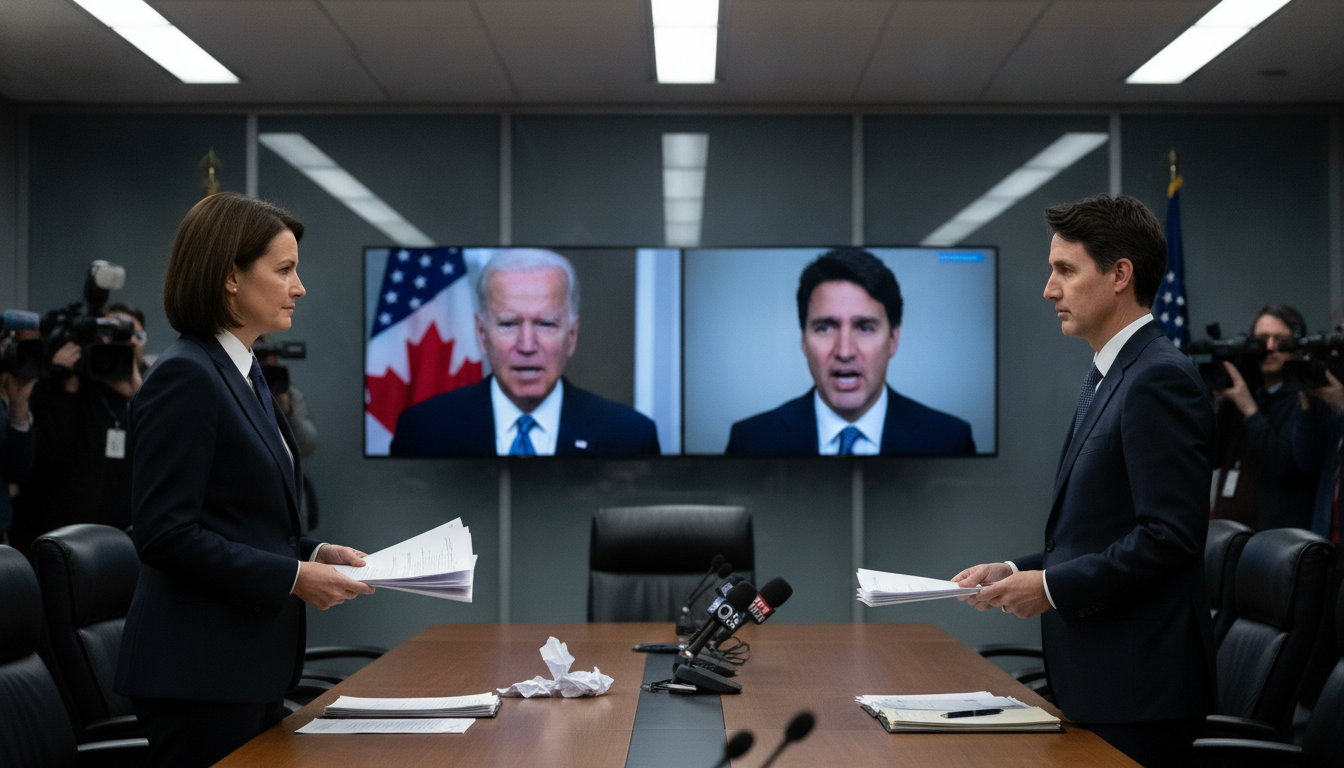
Canada–U.S. trade talks turn personal as leaders trade barbs while negotiators keep a professional front
Canada–U.S. trade talks have grown overtly tense this week as political leaders traded personal insults across the border, even as negotiation teams publicly maintained a professional working relationship amid tariffs and stalled bargaining.
The escalation of rhetoric has coincided with the imposition of heavy retaliatory duties on tens of billions in cross‑border goods, complicating economic ties and raising concerns about the broader costs to producers and consumers on both sides. Negotiators leading the technical and legal talks have largely avoided public acrimony, saying they are focused on economic detail rather than political theatre. Observers say that separation of roles — combative political messaging paired with a measured negotiating corps — appears deliberate and designed to preserve a pathway back to the table.
Leaders’ rhetoric turns personal
Over the past week, exchanges between senior political figures have become increasingly personal, with descriptions ranging from “weak” and “nasty” to “ridiculous,” and at least one crude invitation directed at a Canadian official.
Those public barbs arrived as both capitals announced or defended punitive tariffs, turning what might have been a narrow trade disagreement into a high‑profile diplomatic feud.
Political scientists and communications advisers say the blunt language from front‑line politicians is intended for domestic audiences and to signal resolve abroad, even if it escalates tensions in the short term.
Negotiators keep distance from public insults
Despite the high‑volume rhetoric from heads of government and other senior politicians, the officials responsible for hammering out the technical terms of a deal have largely refrained from trading insults in public.
Canada’s trade minister and the U.S. trade representative have described their interactions as professional and narrowly focused on economic issues, repeatedly framing their work as technical rather than political.
Experts note that negotiators who burn bridges at public events risk making private conversations and future compromise more difficult, which would undercut each country’s ability to secure favourable terms.
Tariffs, stalled bargaining and economic stakes
The dispute has already produced substantial tariffs on a range of goods moving between the two countries, imposing immediate costs on exporters, importers and supply chains that span border communities.
Businesses reliant on integrated North American production have warned that prolonged tariffs raise prices, depress investment and complicate planning for manufacturers and agricultural producers.
With bargaining presently stalled, officials on both sides face pressure to demonstrate results while also justifying domestic political positions to taxpayers and constituencies affected by higher costs.
Political incentives behind public messaging
Analysts say leaders are pursuing different public goals that help explain the contrast between bombastic political rhetoric and the quieter demeanour of negotiators.
From the perspective of elected officials, tough language can be a tool to rally domestic support, project strength to allies, or gain leverage in public opinion that may translate into negotiating advantage.
At the same time, negotiators are tasked with the narrower objective of translating those political signals into concrete changes on tariffs, quotas or regulatory alignment — a task that requires trust and working access to counterparts.
Historical examples of cordial bargaining amid tension
The current dynamic — rough political words and careful negotiators — is not new in North American trade history.
Previous negotiations have seen leaders publicly spar while their representatives continued to trade drafts, attachments and concessions behind closed doors, ultimately producing durable agreements.
Officials cite episodes from past rounds of continental trade talks to justify separating political theatre from the painstaking work of drafting enforceable text and legal schedules.
What negotiators and advisers say about the path forward
Those directly involved in the talks stress that public statements do not necessarily reflect private temperament or the prospects for a deal, and that confidentiality around proposed texts is standard practice.
Public‑relations specialists and political scientists argue that a disciplined negotiating team benefits from the ability to speak and bargain without bearing the full weight of political theatre.
Observers say the path back to substantive talks depends on whether leaders can calibrate domestic messaging while permitting their negotiators to reengage on technical solutions that address tariffs and market access.
Canada–U.S. trade talks: precedent and present strategies
Several former negotiators and trade scholars recall episodes when heated public exchanges eventually gave way to formal agreements, noting that interpersonal rapport among negotiating teams often proved decisive.
Those accounts highlight informal moments — shared meals, sporting events, and private conversations — that helped defuse tensions and create openings for compromise on complex legal and economic issues.
Current participants and analysts say reviving negotiations will likely require a mix of careful diplomacy, technical clarification on outstanding issues, and political cover for leaders to accept concessions perceived as compromising.
The role of domestic politics in cross‑border negotiations
Domestic political pressures are shaping the way leaders communicate about the dispute, with each side mindful of constituencies, electoral calendars, and media narratives.
For governments facing rising public concern about inflation and higher prices, demonstrating toughness on trade can be a salient political message even if it complicates immediate negotiation dynamics.
Conversely, governments that emphasize the long‑term damage of sustained tariffs may be incentivized to provide their negotiators with the time and leverage necessary to pursue a pragmatic agreement.
Legal and technical sticking points that prolong talks
Trade officials say the hardest work in any stalled negotiation is converting political commitments into precise legal text that both sides can administer and enforce.
Issues that commonly slow progress include tariff schedules, rules of origin, dispute‑resolution mechanisms, and regulatory alignment across sectors from agriculture to manufacturing.
When those technical elements are left vague, they can become sources of renewed dispute at later stages, which is why negotiators often insist on confidentiality while ironing out final language.
Economic ripple effects for border communities
Communities and firms that rely on cross‑border supply chains are among the most immediately affected by the dispute, facing decisions about retooling, stockpiling or rerouting shipments.
Farmers, processors, and small manufacturers report heightened uncertainty about input costs and market access, which can depress investment and hiring decisions at the local level.
Economists warn that if tariffs persist, the cumulative effect will be felt in slower growth and higher consumer prices on both sides of the border.
International attention and diplomatic signals
The flare‑up has drawn notice from global media and foreign governments, who are watching closely because the Canada‑U.S. relationship underpins broader trade and security cooperation.
Diplomatic signalling matters: how each capital handles this dispute may influence third‑party assessments about negotiating credibility and reliability in other forums.
Some allies and trading partners express concern that a prolonged bilateral fight could complicate coalition building on other pressing issues, from climate policy to regional security.
Pathways back to negotiations and potential outcomes
Analysts say a credible route back to formal talks will require senior leaders to provide negotiators with a clear mandate and enough political space to explore technical tradeoffs.
Possible outcomes range from a limited, sector‑specific agreement that addresses the most damaging tariffs to a broader framework that reestablishes rules and dispute mechanisms across a wider set of goods.
The timeline for any resolution will depend on domestic political calculations, the legal complexity of outstanding issues, and whether both sides judge the short‑term pain of tariffs worth longer‑term gains.
Private exchanges versus public theatre
A recurring lesson from past North American negotiations is that private channels and personal relationships among officials can outlast public rancour.
Negotiators often rely on discretion, back channels and lapse‑time between public statements to make incremental progress without inviting immediate political backlash.
Public relations experts note that keeping the negotiation process distinct from headline‑driven political messaging preserves the credibility of both institutions and negotiators.
Conclusion
As Canada–U.S. trade talks remain stalled and political leaders continue to exchange sharp rhetoric, the negotiators charged with resolving the dispute have upheld a markedly different tone in public.
That separation appears intentional, serving both as protection for the technical work that remains and as insurance against the immediate consequences of personal animus.
Whether those teams can translate professional restraint into a concrete agreement will depend on political leaders’ willingness to grant them room to maneuver and on both sides’ appetite for compromise in the face of mounting economic costs.
