
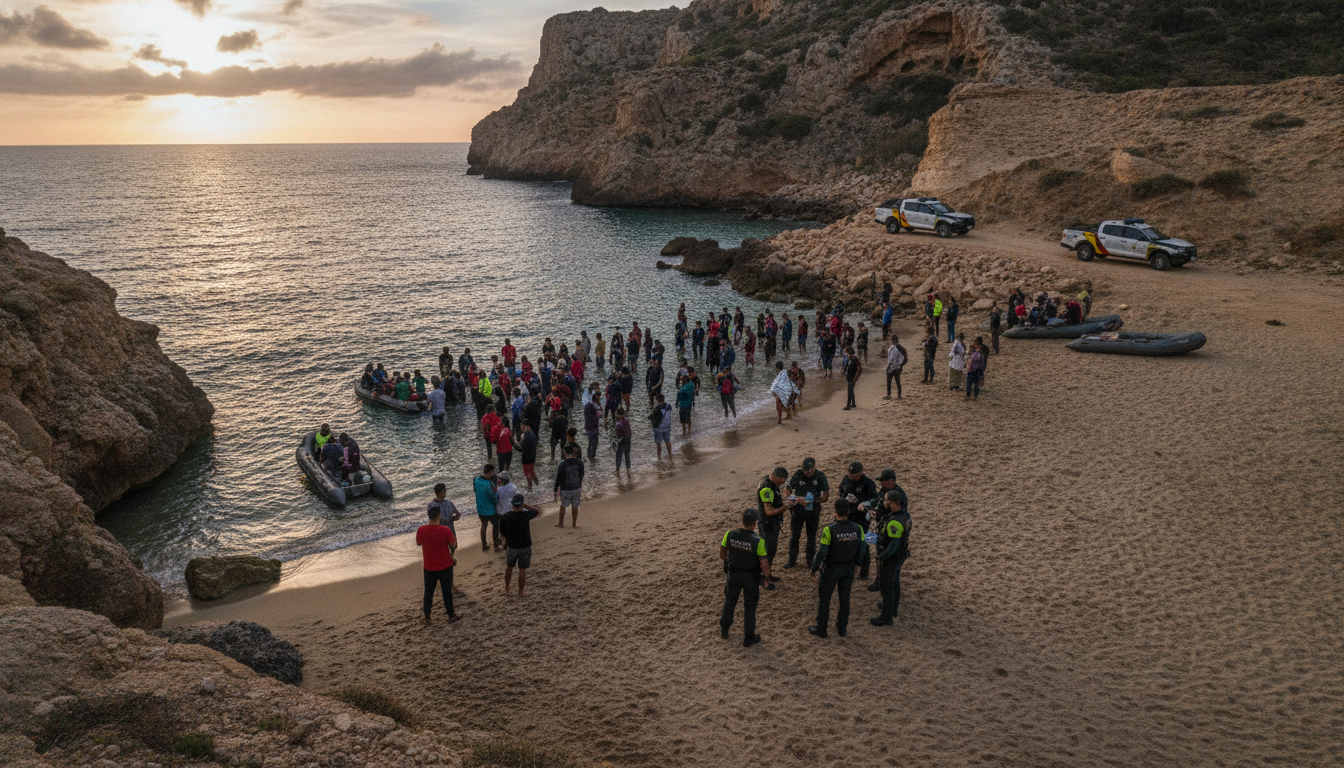
62 Migrants Land at Cala Del Barco Beach on Spain’s Southeast Coast
Dozens of migrants land at Cala Del Barco after a boat crossing on Aug. 21, 2026, as Spain’s Civil Guard reports locating 62 people shown in circulating footage.
A group of migrants arrived by boat on Spain’s southeastern shore on Aug. 21, 2026, with social media footage capturing dozens stepping onto Cala Del Barco beach. Spanish authorities said the Civil Guard located 62 people who had been on the vessel, prompting an immediate response from local emergency and border services. The episode adds to ongoing migration movements across the Mediterranean that Spanish officials continue to monitor.
Boat arrival and immediate response
Footage that circulated online showed a frail-looking craft approaching the sand before people disembarked on the small beach at Cala Del Barco. Local lifeguards and municipal personnel were among the first on scene, offering water and basic assistance while awaiting Civil Guard teams. Emergency services worked to secure the area and ensure no one required urgent medical attention before handing the group over to border authorities.
Civil Guard locating 62 people
Spanish officials confirmed the Civil Guard had identified 62 individuals who had been aboard the boat, though authorities did not immediately release further details about ages, genders or nationalities. The Civil Guard undertook standard procedures, including identity checks and preliminary health assessments, as part of its border control responsibilities. Investigators said they were also collecting testimony and evidence to determine the precise route and circumstances of the crossing.
Social media footage and public reaction
Video of the landing spread quickly across social platforms, prompting both concern and debate among viewers about migration and coastal security. The clip showed a compact landing and the rapid arrival of uniformed personnel, images that were widely shared by users and local community pages. Authorities cautioned the public that footage on social media can be incomplete or misleading and asked people not to approach the scene to allow emergency workers to operate safely.
Coordination with local services
Municipal health and social services were activated to support those located on the beach, providing basic medical screening and assistance where needed. Local reception centres and aid organisations were notified to prepare for possible transfers, and regional authorities said they would coordinate any longer-term humanitarian or administrative measures. Officials emphasized that the priority on arrival was to establish the health and safety of the people before any decisions on accommodation or processing were taken.
Investigation into origin and smuggling concerns
The Civil Guard indicated an inquiry would follow to establish the boat’s origin, the identity of any facilitators and whether criminal smuggling networks were involved. Spanish law enforcement has in recent years pursued trafficking and smuggling rings tied to maritime crossings, and every landing prompts forensic and intelligence work. Authorities said those findings would inform both criminal proceedings and preventive measures along the regional coastline.
The landing at Cala Del Barco comes amid recurring Mediterranean crossings that challenge border management and humanitarian response systems across Spain and neighbouring countries. While individual landings can vary in scale and outcome, authorities maintain that coordinated efforts among emergency services, border forces and social agencies are essential to uphold security and meet humanitarian obligations.
Local residents and municipal officials expressed concern about safety and the pressure on small coastal communities when unexpected arrivals happen. At the same time, aid groups reminded the public of the human dimensions of irregular migration and called for measured responses that protect vulnerable people while supporting local capacity. Authorities urged the public to rely on official statements for accurate information as investigations proceed.
Spanish officials said they would release further details as identity checks and investigations advanced, including whether any of the individuals required immediate transfer to medical facilities or longer-term reception. The Civil Guard and regional agencies continue to coordinate the response and to work with national migration authorities to determine next steps. The outcome of those procedures will shape any subsequent legal or humanitarian action regarding the group.
Investigations into the route and circumstances of this crossing are ongoing, and authorities asked anyone with relevant information to come forward to assist inquiries. The case at Cala Del Barco underscores the continuing challenges of irregular sea crossings in the Mediterranean and the interplay between public safety, law enforcement and humanitarian needs.
