
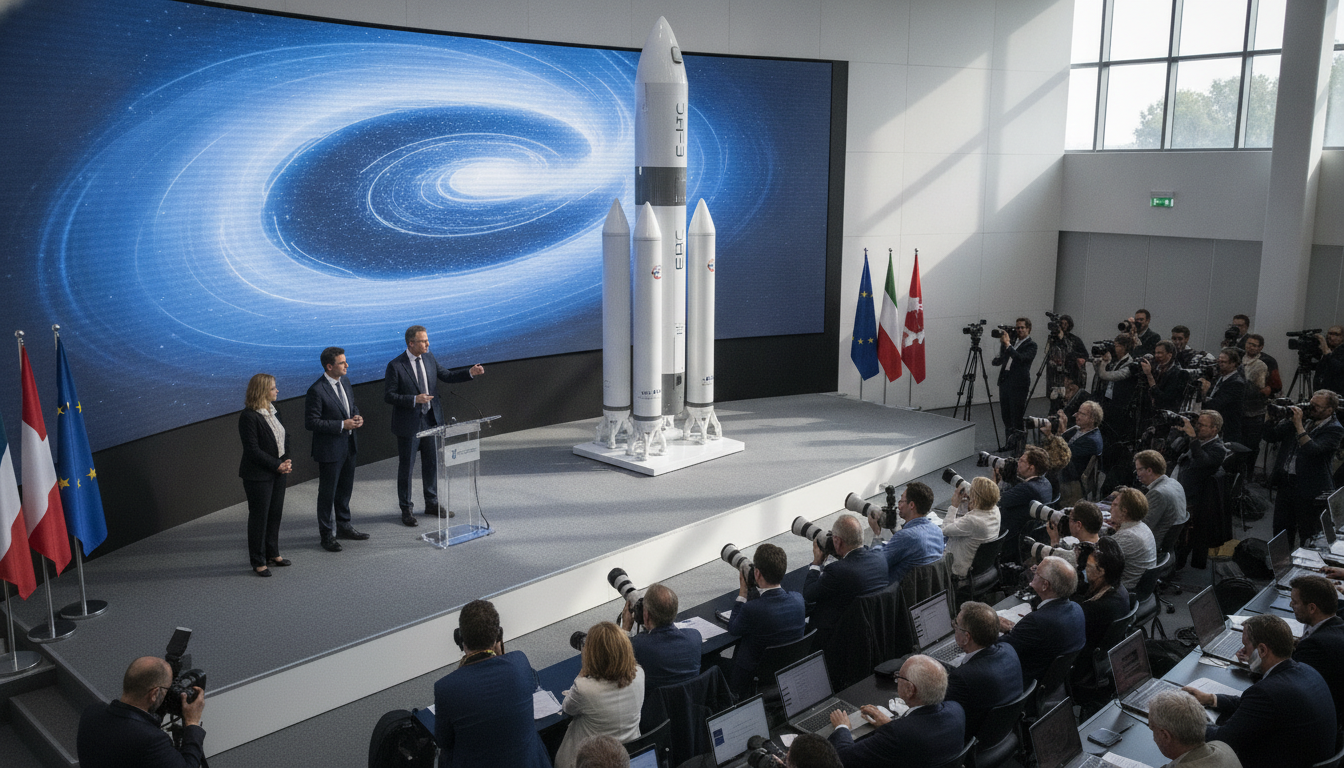
TEC aims to build Europe’s largest reusable heavy rocket as it raises new capital
TEC reusable heavy rocket plans to expand the company’s model and construct Europe’s largest reusable heavy-lift launcher, CEO Hélène Huby says.
Hélène Huby, chief and co-founder of TEC, announced that fresh capital will be directed toward a major expansion of the company’s business model and the development of what she calls Europe’s largest reusable heavy-lift rocket. The move positions TEC to compete beyond the microlauncher segment and to challenge established European players on capacity and reusability. The company intends to leverage the funding to accelerate engineering work and scale its ambitions in a market that is rapidly evolving.
TEC’s funding and strategic shift
Huby described the new financing as a turning point for TEC, enabling a pivot from smaller launch services toward heavy-lift capabilities and larger-scale commercial offerings. The capital will be used to broaden the firm’s technological roadmap and to support the higher development costs associated with reusable large rockets. Company officials framed the shift as necessary to capture emerging demand for heavier payloads and more flexible launch schedules across European and international customers.
Ambition to build Europe’s largest reusable heavy-lift launcher
TEC’s stated goal is to produce a fully or partially reusable heavy-lift rocket that would be the largest of its kind in Europe. Reusability is highlighted as the central technology driver, intended to lower per-launch costs and improve cadence by recovering and reusing primary stages. Developing that capability represents a significant technical and logistical challenge, but TEC views it as a strategic differentiator in a market where cost and reliability increasingly determine market share.
Competition with microlaunchers and established builders
By expanding into heavy-lift, TEC will increasingly overlap with German microlaunchers such as Isar Aerospace, RFA, and HyImpulse on one hand, and established manufacturers like the Arianegroup—producer of the Ariane family—on the other. Huby’s announcement signals that TEC is targeting a broader competitive set, moving from niche small-satellite deployments toward higher-capacity missions that have traditionally been the domain of national or consortium-backed programs. That shift could intensify rivalry across Europe’s launch ecosystem and prompt strategic responses from incumbents.
Business-model implications and market positioning
TEC’s move suggests a recalibration of its commercial positioning from single-mission operators toward integrated launch solutions serving larger payload customers. Expanding the business model may include offering scalable launch services, pursuing institutional and commercial contracts, and leveraging reusability to compete on cost per kilogram. The company’s messaging emphasizes flexibility and ambition, positioning the reusable heavy rocket as a tool to capture market segments that require both lift capacity and competitive economics.
Technical, regulatory and infrastructure challenges
Building a large reusable rocket will require solving complex engineering problems, including thermal protection, landing and refurbishment processes, and systems integration at scale. Beyond technical design, the program must navigate certification, safety approvals, and the development or access to suitable launch and recovery infrastructure. Those hurdles imply substantial timelines and capital expenditure, as well as coordination with regulators and potential partner states to secure range access and environmental approvals.
Potential industry impact and future outlook
If TEC succeeds, the entry of a reusable heavy-lift European launcher could reshape launcher economics and customer choices across the continent. Increased competition may accelerate innovation, push incumbents toward more cost-effective operations, and expand options for institutional and commercial satellite operators. However, the pathway from concept to operational service is long, and success will depend on execution, funding continuity, and alignment with customer needs.
TEC’s announcement frames the new capital as the start of a broader push into the heavy-launch market, with reusability at the core of its bid to become a significant European player. The company will now need to translate ambition into demonstrable engineering milestones and secure the partnerships and approvals required to bring a large reusable launcher from design into flight reality.
