
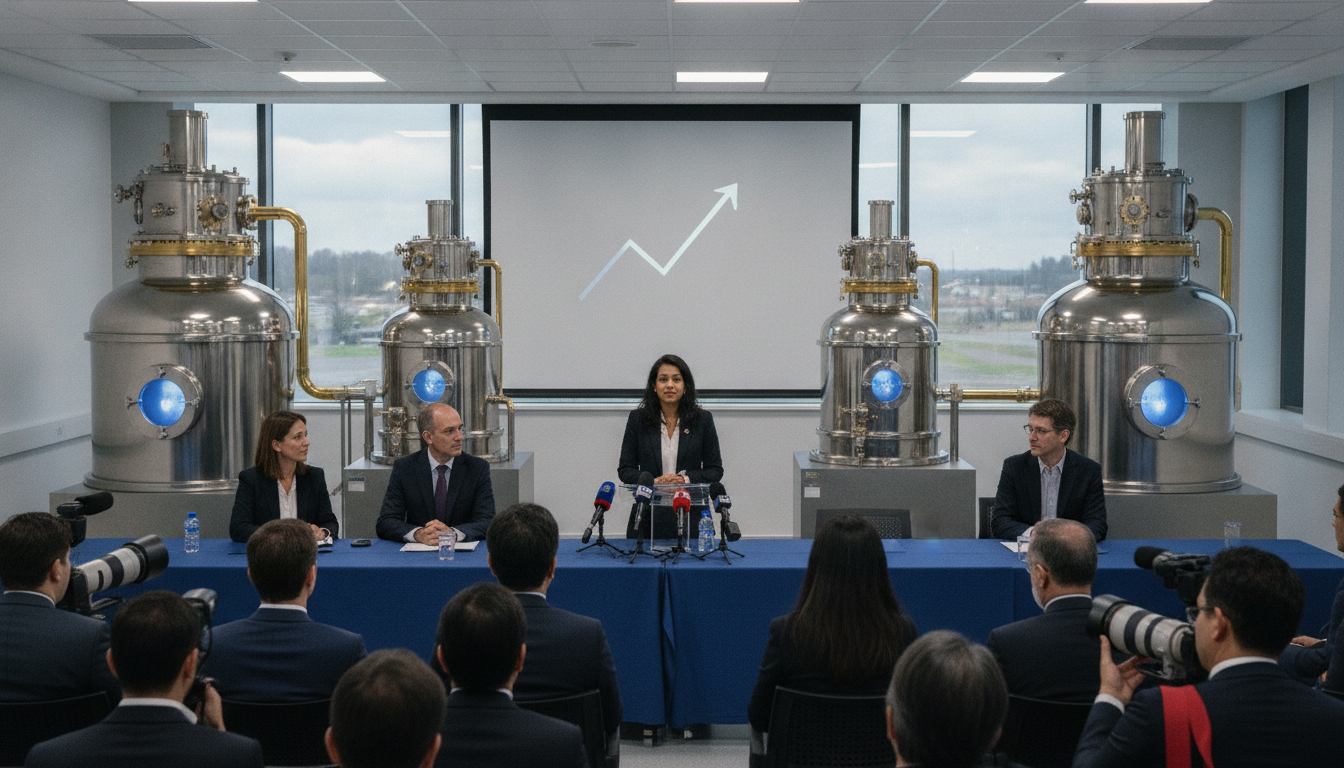
Apollo Atomics shrinks steam generator to cut nuclear costs, targets 3¢/kWh by 2028
Apollo Atomics unveils a compact steam generator approach to cut nuclear plant costs, closing a $26M seed round and targeting commercial deployment in 2028 at about 3¢/kWh.
New funding to prove a factory-built nuclear concept
Apollo Atomics raised $26 million in a seed round that included $5 million in debt to accelerate a demonstration reactor ahead of planned commercial deployment in 2028. The round was led by FCVC and counts Y Combinator, Telesoft Partners, Robinhood Ventures and several university and venture investors among its participants. Company founders Assil Halimi and Drew Walker say the capital will support factory development, testing and regulatory work for a demonstrator based on MIT research.
Shifting focus from reactor design to steam generation
Apollo Atomics is betting that the biggest gains in cost and scale will come from redesigning the steam generator rather than inventing a new core. The startup argues that conventional steam generators are large, hand-built components carried over from fossil-fuel plants and that their size undermines the cost advantages of nuclear fuel. By shrinking that interface between reactor coolant and the turbine cycle, the company aims to unlock reductions in physical footprint, manufacturing labor and onsite construction time.
Compact steam generator architecture and heat transfer innovations
The company’s design replaces tall, tube-based steam generators with a compact metallic block containing dense, needle-thin channels to pass the two fluid loops close together. That configuration increases heat-transfer efficiency and reduces the amount of metal and space required to produce steam at turbine-ready conditions. Because the unit is much smaller, Apollo Atomics plans to mass-produce generators in a factory environment rather than assemble them on site, bringing modular manufacturing practices to a traditionally bespoke component.
Apollo Atomics says the compact approach allows it to shrink the overall reactor package substantially; the firm claims its design can be roughly 40 times smaller than systems using conventional steam generators. That reduced scale creates new options for plant layout, transportation and siting, and it allows the company to offer multiple power-size variants using the same core manufacturing processes.
Factory assembly, schedule compression and cost targets
Factory assembly is central to Apollo’s cost and schedule projections. By shifting construction to controlled manufacturing lines, the company expects to lower onsite labor, shorten licensing and installation timelines, and reduce variability in quality. Management projects a 300-megawatt plant could be built in under 24 months, and estimates the reactor itself could cost four to five times less to produce than comparable designs that rely on large, field-assembled steam generators.
Those production gains feed into Apollo’s levelized-cost ambitions. The company projects electricity generation around 3 cents per kilowatt-hour, a figure it presents as competitive with, or better than, current natural gas prices in many markets. Apollo frames that target as deliberate and aggressive rather than incremental, saying the goal is to make nuclear economically attractive without long-term subsidy dependence.
Prototype work and product sizing
Apollo Atomics has already constructed a small experimental reactor, a 40-kilowatt unit built at MIT, to validate its heat-exchange concepts and control strategies. The company plans to offer a family of units ranging from approximately 10 megawatts-electric to 300 megawatts, enabling applications from industrial heat and district energy to utility-scale power. Scaling the compact steam generator design across that range will be a technical and regulatory challenge, but Apollo says the modular nature of the unit simplifies replication and testing.
Because the steam generator is intended to be factory-produced, the company anticipates standardizing inspection, testing and quality controls in ways that are difficult with custom, field-built components. That standardization, Apollo argues, will help in regulatory submissions and in establishing repeatable cost and performance baselines for customers and grid operators.
Investor backing and planned milestones toward 2028
The seed round was led by FCVC and included participation from Telesoft Partners, Y Combinator, Alumni Ventures, Robinhood Ventures and a slate of other venture and institutional backers, along with university-affiliated funds. Apollo was part of Y Combinator’s Spring 2026 cohort, giving it access to mentorship and startup resources as it scales engineering and commercial teams. Company leadership says the funds will move the demonstrator into fabrication and testing, with commercial deployment targeted in 2028 pending regulatory approval and successful prototype results.
Investors have signaled interest in companies that can materially lower nuclear costs, and Apollo’s strategy of tackling a single, high-impact component is designed to produce measurable cost and schedule outcomes within a relatively short timeframe. The company will still face licensing, supply-chain and capital-raising hurdles typical of the nuclear sector, but its approach aims to reduce some of the most persistent barriers by industrializing a previously bespoke element.
Apollo Atomics’ compact steam generator approach reframes a longstanding engineering trade-off in nuclear plants by treating thermal-to-electric conversion as the prime lever for cost reduction. If the demonstrator meets its performance and timeline goals, the company could present a new pathway for factory-built nuclear capacity that competes more directly with fossil-fuel generation on price. The coming demonstrations and regulatory steps will determine whether that potential translates into commercially deployed plants on the company’s 2028 timetable.
