
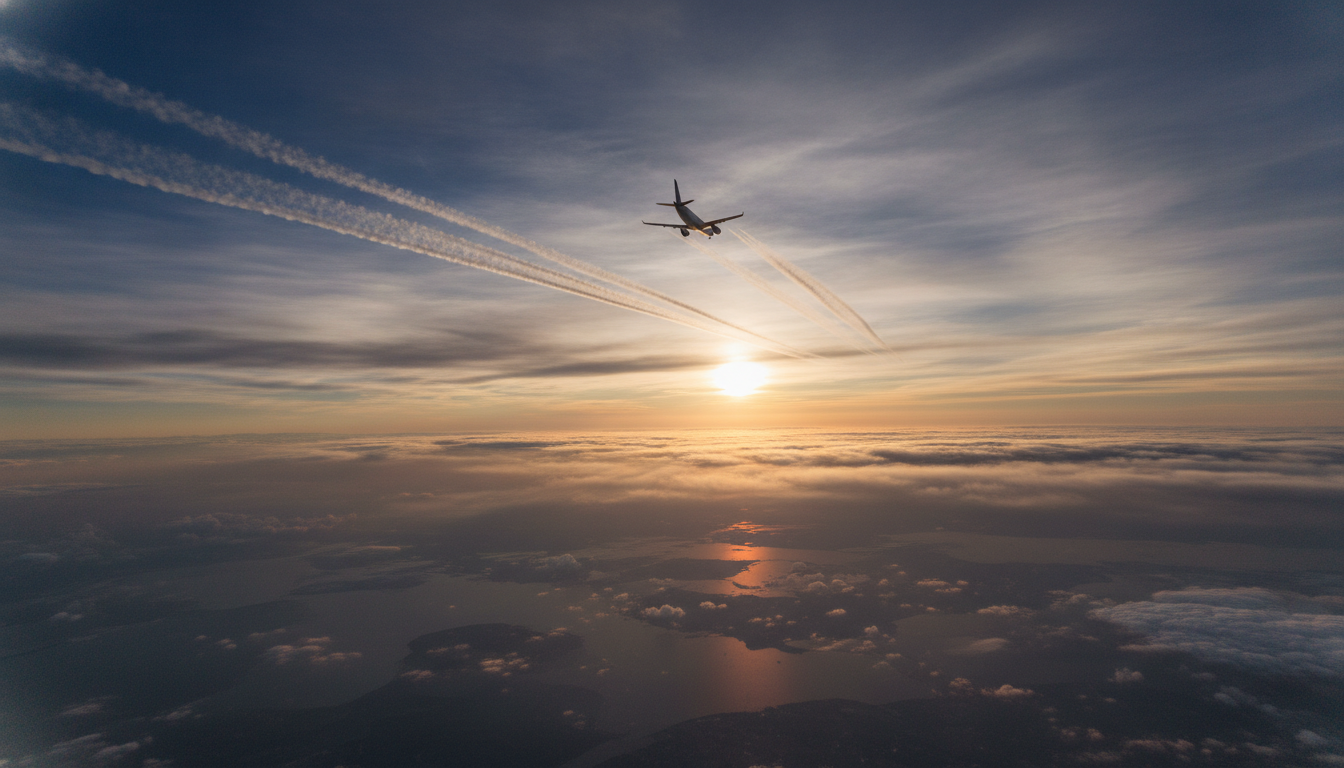
Contrails Climate Impact: Persistent Jet Trails May Account for One-Third of Aviation’s Warming
Contrails climate impact: persistent high-altitude contrails form artificial cirrus that trap outgoing heat and are estimated to cause roughly one-third of aviation’s total warming.
A growing body of research highlights how ordinary jet exhaust can produce contrails that do more than mark the sky; they can alter the atmosphere’s radiative balance. Contrails form when hot, moist exhaust from jet engines meets the cold, humid air of the upper atmosphere, and some evolve into long-lived, cloudlike sheets. Estimates suggest that this contrails climate impact contributes a substantial share of aviation’s overall effect on global warming, comparable in scale to carbon dioxide from flights over short time horizons.
How contrails form in the upper atmosphere
Contrails originate as tiny ice crystals that condense on soot and other particles emitted by aircraft engines when moist exhaust mixes with very cold air. In many cases, these ice trails dissipate quickly as the humidity drops or winds shear them apart. Under conditions of high relative humidity and low temperatures, however, contrails can persist and spread, becoming indistinguishable from natural cirrus clouds.
When short streaks become long-lasting cloud layers
Persistent contrails can broaden and merge into expansive, thin cloud decks that sometimes last for hours. These artificial cirrus layers increase the sky’s overall cloudiness and change how the atmosphere traps and emits thermal radiation. Where they remain extensive, the resulting “blanket” effect can reduce the amount of infrared heat escaping to space during night and day.
Quantifying radiative forcing and the one-third estimate
Scientists quantify contrails’ effect as part of aviation’s non-CO2 radiative forcing, which also includes nitrogen oxides and water vapor effects. While methods and timeframes vary, multiple analyses have suggested that persistent contrails and contrail-induced cirrus may account for roughly one-third of the aviation sector’s current climate forcing. That estimate reflects uncertainties in cloud microphysics, atmospheric humidity mapping, and the transient nature of flight-related cloudiness.
Altitude, weather and operational choices that change impact
The formation and persistence of contrails are highly sensitive to flight altitude and regional weather conditions. Small changes in cruising altitude can move aircraft into air masses with lower humidity, markedly reducing contrail formation on some routes. Airlines and air-traffic managers can therefore reduce contrail climate impact in some regions by adjusting flight levels, although such changes must be weighed against fuel use, emissions, and safety constraints.
Technical and fuel-based mitigation options under review
Reducing soot particle emissions from engines is one pathway to limit contrail formation because fewer condensation nuclei can mean fewer or less-persistent ice crystals. Improvements in combustor design, particulate filters, or the wider use of lower-soot sustainable aviation fuels could change contrail frequency and properties. Policymakers and industry groups are assessing combinations of operational routing, aircraft technology upgrades, and fuel standards to achieve measurable reductions without unduly affecting airline operations.
Research, monitoring and policy steps still needed
Key uncertainties remain around how contrails evolve into broader cloud systems and how that evolution varies by region and season. Enhanced satellite observations, targeted field campaigns, and higher-resolution atmospheric modeling are required to refine estimates of contrail climate impact and to develop reliable forecasting tools. International coordination on flight routing, emissions standards, and research funding would support more effective, evidence-based responses.
Contrails are a clear example of how non-CO2 effects can materially influence the climate footprint of modern aviation, and they represent both a scientific challenge and a potential lever for near-term mitigation. As commercial aviation expands, addressing the contrails climate impact through improved measurement, smarter routing and cleaner combustion may become an essential part of broader efforts to limit warming from the sector.
