
Alberta driver’s licence renewal rules prompt document scramble for residents
Alberta driver’s licence renewal
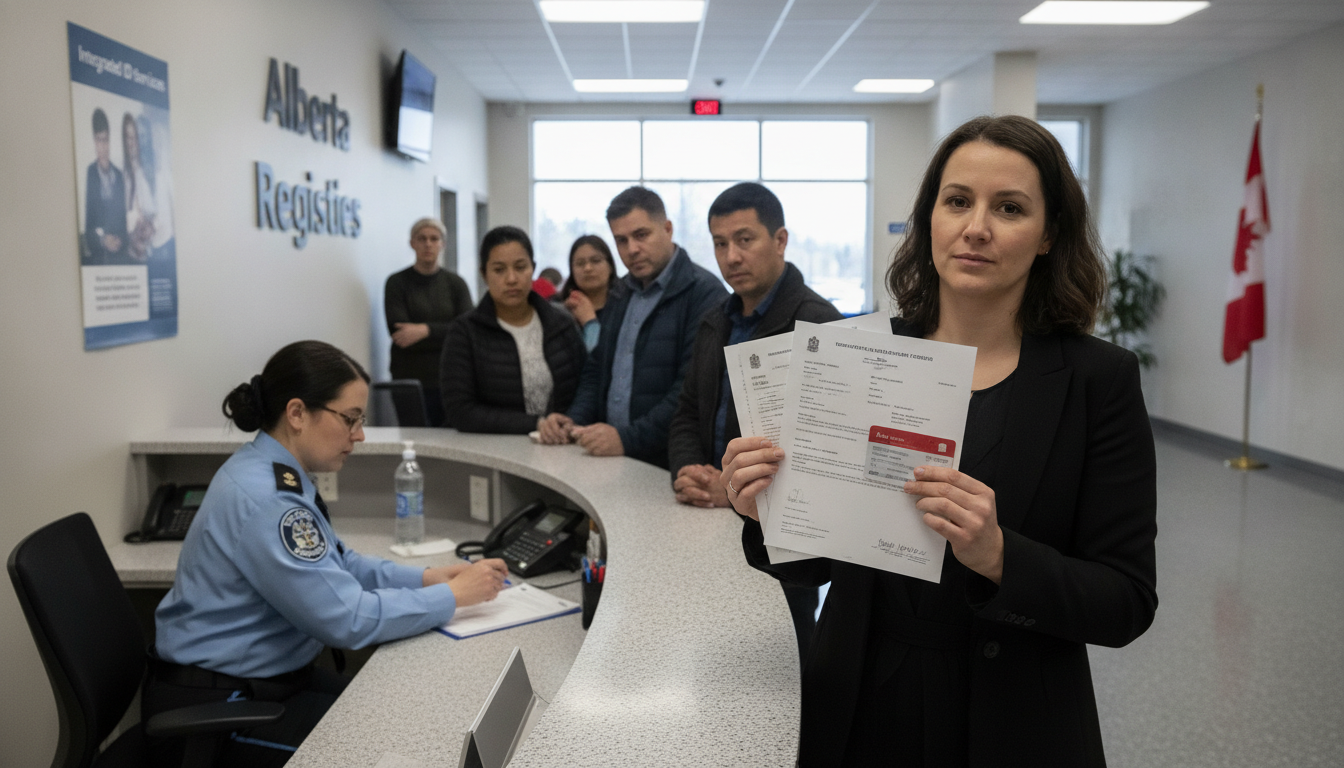
Alberta driver’s licence renewal rules have left some residents scrambling for original documents after the province rolled out a three-in-one identification card that adds health-care and citizenship markers to renewed licences. The change, which took effect July 2, requires proof of citizenship and identity that in some cases must match exactly across records. Dozens of drivers, particularly long-married women, report being turned away from registry offices when their birth certificates and licences carry different surnames.
Three-in-One ID Rollout and New Requirements
The province introduced a consolidated identification card that places a health-care number and citizenship indicator on driver’s licences beginning in July. Officials say the goal is to reduce the number of documents citizens must carry, but the new verification checks are more stringent at the point of renewal. Service Alberta and the Red Tape Reduction ministry have published lists of acceptable documents, including passports, birth certificates, citizenship certificates and NEXUS cards.
Registry offices are now required to verify both identity and citizenship before issuing the updated card, which has led to a tighter review of name consistency across records. If a birth certificate shows a different name than a current licence, staff are asking for supporting legal documents to reconcile the discrepancy. That can include marriage certificates, legal name-change documents or a valid passport, depending on the case.
Officials also report sending automated reminders 60 and 30 days before a card expires, with advice about supporting paperwork residents should bring to avoid delays. The reminders are intended to give drivers time to obtain replacement documents, but for some this window is not long enough. Applicants who lack original records are being directed to apply for replacements through registry services, a process that can take several weeks.
Registry Offices Report Conflicting Documents for Married Women
Registry agents say a common source of delay is mismatched names on government records after marriage, divorce or the adoption of a maiden name later in life. Drivers who changed their surname following marriage decades ago sometimes cannot locate the original marriage certificate used to update a birth registration. That absence becomes a barrier when current identity documents do not align with a birth certificate presented during renewal.
Several Alberta residents described being turned away after presenting a mix of documents that included an expired passport and a health card with a different surname. Staff at the counter asked for the original marriage certificate or other proof linking the names, and applicants were informed they must order replacements if the original cannot be produced. The replacement process can include fees and wait times that complicate matters for people who rely on their licence for work.
Women who married long ago reported particular difficulty locating certificates kept by family members or stored in boxes moved across households over the years. In some instances, expired passports were not accepted as sufficient identification because they do not confirm current citizenship status under the province’s checklist. The cumulative effect is additional appointments, costs and time off work for those trying to comply.
Registry offices themselves have seen increased volumes of requests for replacement certificates since the new criteria were implemented. Staff are balancing the administrative burden of processing these requests with the need to maintain secure identity checks, a tension that has left some applicants frustrated and anxious about losing driving privileges if they cannot meet the requirements in time.
Province Issues Guidance, Drivers Say It’s Insufficient
Service Alberta has issued guidance advising Albertans to check their documents well ahead of renewal dates and to use the reminder notices sent by the ministry. The guidance lists acceptable proofs of citizenship and identity and explains that replacement certificates may be ordered if originals are missing. Officials stress the intent to protect personal information and guard against fraudulent identity claims.
Despite that messaging, affected drivers contend the advice does not address the real costs and practical hurdles of obtaining replacement documents. Many report having to pay fees for certified copies and to wait the standard processing periods, which can be weeks long. Those delays are particularly onerous for people whose licences are close to expiry and who need to drive for employment or caregiving responsibilities.
The province maintains that registry agents are giving clear direction and that the reminders should allow most residents to prepare. However, individuals who lack immediate access to banking information, transportation to registry offices, or who live in remote communities say the system still favors those with easier access to resources. The mismatch between policy intent and on-the-ground experience is prompting calls for additional accommodations.
Some community advocates and municipal officials have asked the provincial government to consider temporary measures, such as short-term extensions or interim letters of authorization, to prevent people from being penalized while waiting for replacement documents. To date, the ministry’s communications have focused on the procedural steps residents must take rather than offering broad exemptions.
Costs, Delays and Work Impacts for Drivers
Drivers facing document shortfalls report both direct and indirect costs tied to the renewal process. Direct expenses include application fees for replacement marriage certificates and expedited shipping where available. Indirect costs include lost wages when applicants must take time off work to appear in person, and transportation or childcare expenses associated with multiple visits to registry offices.
One driver described the sequence of events that creates a compounding financial burden: an expired passport that cannot be used, a missing marriage certificate that must be reordered, and a licence that expires before the replacement arrives. In these cases workers who drive as part of their job risk being unable to legally operate a vehicle until the renewal is complete, which can affect income and employment stability.
The timeline for receiving replacement documents varies by the issuing authority and whether applicants choose expedited options. Standard processing can range from a few weeks to more than a month, depending on backlog and demand. That uncertainty places pressure on families with tight schedules and on self-employed drivers who cannot easily absorb downtime.
Some residents reported paying extra for courier services or premium processing to reduce wait times. Others spoke about the stress and time spent searching through decades of personal records to find a single missing certificate. For older adults and those without digital literacy skills, the process is especially daunting.
Local employers and service providers are also adjusting to the change, as employees seek time off to resolve documentation issues. Human resources departments in certain industries are advising staff about potential impacts, and community organizations are stepping in to help vulnerable residents navigate the replacement process.
What Registry Agents Require and Why
Registry agents are bound by provincial verification standards designed to ensure the integrity of identification documents and to prevent identity fraud. When names differ across records, agents ask for a legal document that establishes the link, such as a marriage certificate or a court order documenting a name change. These safeguards are common in identity verification protocols across Canada.
In practice, agents review a combination of primary and secondary documents to establish identity and citizenship. A valid passport, a provincial birth certificate, a citizenship certificate or a NEXUS card are typically accepted as primary evidence. When only partial or outdated documents are available, agents will request supplementary records that demonstrate continuity between names.
The stricter verification measures are partly a response to technological updates in the new three-in-one cards, which tie together health-care and citizenship information with driving privileges. Integrating multiple personal identifiers increases the need for consistent, reliable source documents at the time of issuance. The tradeoff is that mismatched historical records can trigger additional scrutiny.
Registry staff indicate they are following ministry guidance and are not making arbitrary demands, but consumers say inconsistent application of rules from office to office has contributed to confusion. Differences in interpretation and documentation handling among individual agents have led some applicants to be accepted at one location and refused at another for the same set of papers.
How to Prepare: Steps for Smooth Renewal
Drivers anticipating licence renewal should begin by reviewing the list of acceptable documents provided by Service Alberta and the Red Tape Reduction ministry. Check expiry dates on passports and driver’s licences, and confirm that the names on your birth certificate, health card and other records are consistent. Early preparation reduces the risk of being turned away at a registry office.
If your documents do not match, identify what will legally bridge the difference—typically a marriage certificate, legal name-change document, or a valid passport. If you lack the necessary certificate, order a replacement as soon as possible from the appropriate registry. Keep in mind that standard processing times for replacement certificates can be several weeks, so act immediately upon discovering a discrepancy.
For those with expired passports, consider renewing the passport if it is otherwise valid identity evidence for your needs. Passport processing also has lead times, so check federal timelines and apply early if relying on that document. In the interim, keep records of your application and receipts, as these may help explain the situation to registry staff and employers.
If obtaining replacement documents will be difficult due to mobility, financial or access barriers, contact your local registry office in advance to explain your circumstances and ask about possible accommodations. Community service organizations may be able to help with applications and transportation. Employers and essential service coordinators can also provide letters or temporary verification in some cases to support workers awaiting documentation.
Finally, preserve and digitize important documents once you have them to avoid future loss. Photocopies or scanned files do not replace originals for identity verification at the counter, but maintaining organized records reduces the chance of prolonged disruption the next time you must renew.
A number of Albertans say the new three-in-one licence is a sensible consolidation in principle, but they want clearer transitional measures and greater flexibility for people who cannot quickly produce long-buried certificates.
