
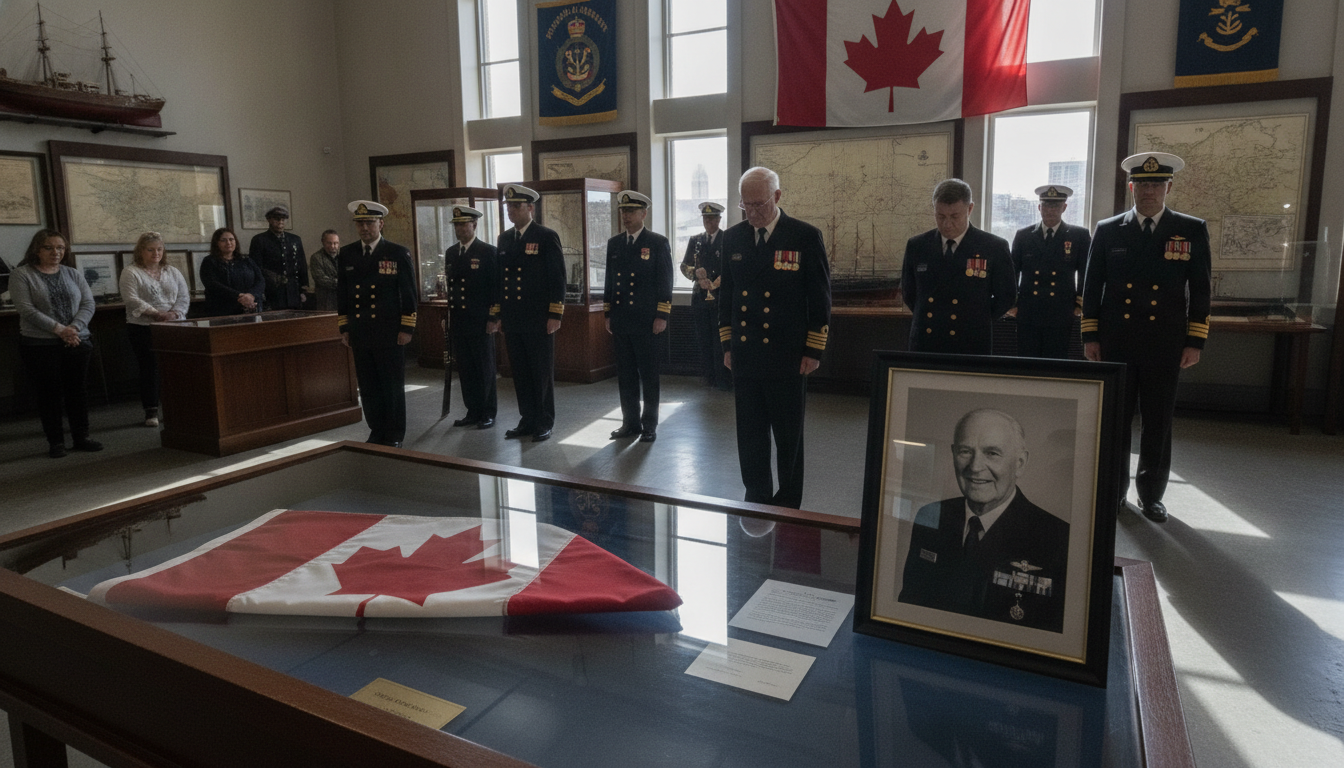
Captain Bill Wilson, Calgary naval leader and D‑Day veteran, dies at 101
Canada mourns a decorated WWII sailor and museum founder who helped preserve naval history and led fundraising for The Military Museums.
Veteran Captain Bill Wilson dies at 101
William “Bill” Wilson, a Second World War veteran and long‑time leader of Calgary’s naval community, has died at the age of 101.
Born in Winnipeg on November 5, 1924, Captain Bill Wilson joined the Royal Canadian Navy in 1942 and went on to serve aboard HMCS Ottawa during the Battle of the Atlantic and the Normandy landings.
Wilson’s death closes a life that combined frontline service in the world’s largest amphibious invasion with decades of civic work to preserve Canada’s naval heritage.
Colleagues and museum leaders in Calgary said his commitment to service and to telling veterans’ stories was central to his public life.
Service aboard HMCS Ottawa and the D‑Day landings
Wilson enlisted in 1942 at the height of the Battle of the Atlantic, joining HMCS Ottawa as a seaman gunner.
His ship escorted convoys across the North Atlantic and later supported operations tied to the June 6, 1944 D‑Day landings on Normandy’s beaches.
He and shipmates faced wartime uncertainty and the chaos of amphibious warfare, experiences Wilson would recall in later interviews and public talks.
On D‑Day, he witnessed landing craft cut down by machine‑gun and artillery fire as Allied forces sought to secure the beaches and pierce German coastal defenses.
The Normandy invasion involved nearly 160,000 Allied personnel and some 14,000 Canadians on the first day, and it marked the beginning of a campaign that ultimately liberated occupied Europe.
Historical records place the D‑Day casualty toll at more than 4,400 Allied deaths on June 6, 1944, with Canadian forces among those who paid a heavy price that day.
From wartime sailor to naval reservist and community leader
After the war, Wilson returned to civilian life in Winnipeg and joined the Royal Canadian Naval Reserve, continuing a lifelong association with maritime service.
He later moved to Calgary in the 1970s and remained engaged with naval units, retiring from active reserve duty in 1979.
Over decades in Calgary, Wilson became a recognizable figure within the city’s military community, attending commemorations, speaking to students, and supporting veterans’ organizations.
Those who worked with him say his presence provided continuity between the Second World War generation and younger volunteers who preserve military history.
Colleagues noted that Wilson’s personal history—enlisting as a teenager and seeing combat at 19—shaped his quiet determination to keep veteran stories alive.
He used his wartime experiences as a platform to educate the public rather than seek attention for himself.
Founding the Naval Museum of Alberta and acquiring artifacts
In 1984 Wilson was a founding member of the Naval Museum of Alberta, an institution created to collect, preserve and display Canada’s naval heritage in the prairie province.
Members of the museum community credit him with persistent fundraising, tireless outreach, and a knack for finding important artifacts for display.
Museum colleagues gave him the nickname “Captain Rabbit” in recognition of his ability to track down objects and persuade owners and authorities to donate or lend them.
That work helped the Naval Museum of Alberta grow into one of the country’s largest collections devoted to maritime history, according to museum representatives.
Wilson’s efforts included contacting senior naval officials and coordinating with institutions across Canada to secure guns, ship models, uniforms, and personal papers.
Those tangible items became core exhibits that give visitors a material connection to Canada’s naval past.
Campaign leadership for The Military Museums and broader impact
Wilson played a central role in a 2001 fundraising campaign that raised $26 million to create The Military Museums complex in Calgary.
The campaign combined pre‑existing regimental collections with new facilities for naval and air force exhibits, forming the largest military museum complex in Canada.
As general manager of the campaign, he helped steward donations from private and public sources, working with elected officials, veterans’ groups, and community leaders.
The campaign’s success expanded exhibition space and visitor programming, enabling larger public outreach and educational initiatives in southern Alberta.
Museum directors and veterans’ advocates say Wilson’s work on the campaign ensured future generations would have access to artifacts and curated interpretation of Canada’s military history.
They emphasize that the expanded museums allow Calgary to host national commemorations and service learning for students and community groups.
Anecdotes, recognition and personal style of service
Friends and associates recount Wilson’s practical, persuasive style and an ability to turn small opportunities into concrete results.
One commonly told anecdote describes how a young Wilson reportedly bought and ate bananas to meet a medical weight requirement at recruitment—an example of his determination to serve.
He was inducted into the Alberta Order of Excellence in 2013, a provincial recognition that highlighted his contributions to military heritage and public service.
That induction followed decades of work in the reserves, in museums, and in community fundraising that together built a lasting public legacy.
Colleagues remember him not only for his organizational skills but for a steady, low‑profile leadership that opened doors for others in the naval and veteran communities.
Whether negotiating for a historic gun or organizing fundraising appeals, he combined personal persistence with an ability to cultivate institutional support.
Tributes, funeral plans and the museum community’s response
Naval Museum of Alberta officials and other veterans’ groups in Calgary expressed condolences and described Wilson as a driving force behind the city’s naval history work.
Scott Hausberg, who served alongside Wilson in museum efforts, said Wilson’s life was defined by service and by building institutions that outlast any one person.
A celebration of life is scheduled for August 10, 2026 at 2 p.m. at HMCS Tecumseh, Calgary’s Naval Reserve unit, where he most recently served.
Organizers asked that those wishing to pay respects check with local naval and museum channels for details about attendance and any livestream arrangements.
Museum leaders said they plan commemorations in the months ahead that will include exhibitions highlighting items Wilson helped acquire and stories he helped preserve.
They described ongoing work to ensure his leadership is remembered within the institutions he helped create.
Final public remembrances are expected to draw veterans, museum volunteers, serving naval reservists and civic officials who worked with him over decades.
Speakers at planned events will recall both his wartime courage and his long‑term commitment to education and remembrance.
William Wilson’s passing closes a chapter on a generation that both fought in the Second World War and spent the postwar decades building memory institutions.
As Calgary prepares to mark his life in early August, museum professionals and veterans’ families will use the occasion to reflect on how one individual’s persistence can preserve national history for future viewers.
His story—enlistment as a determined teenager, combat service at Normandy, decades of reserve duty, and a leadership role in museum building—illustrates a life shaped by public service and historical stewardship.
In galleries where visitors now stand before guns, uniforms and ship models, traces of Wilson’s work remain visible and influential.
The Naval Museum of Alberta and The Military Museums will continue to display and interpret the artifacts he helped secure, carrying his efforts into new generations of programming.
That continuing public work is the practical legacy colleagues say Wilson valued above personal accolades.
For Calgary’s naval community, and for the many Canadians whose families and histories are reflected in museum collections, Captain Bill Wilson’s death is a moment to remember both sacrifice and civic dedication.
Plans for tributes and exhibitions in the months ahead will aim to ensure his contributions to preserving Canada’s naval past are not forgotten.
Wilson is survived by the institutions and collections he helped build, and by a community of volunteers and veterans committed to carrying forward the work he championed.
Those who knew him describe him as a man whose life was consistently oriented toward service to Canada and to telling the nation’s naval story.
As Calgary prepares to gather on August 10, 2026, the city and its museums will mark the passing of a figure who bridged wartime experience and peacetime preservation.
The commemorations will offer a moment to honor a veteran whose actions at sea and at home shaped how Canadians remember their naval history.
