
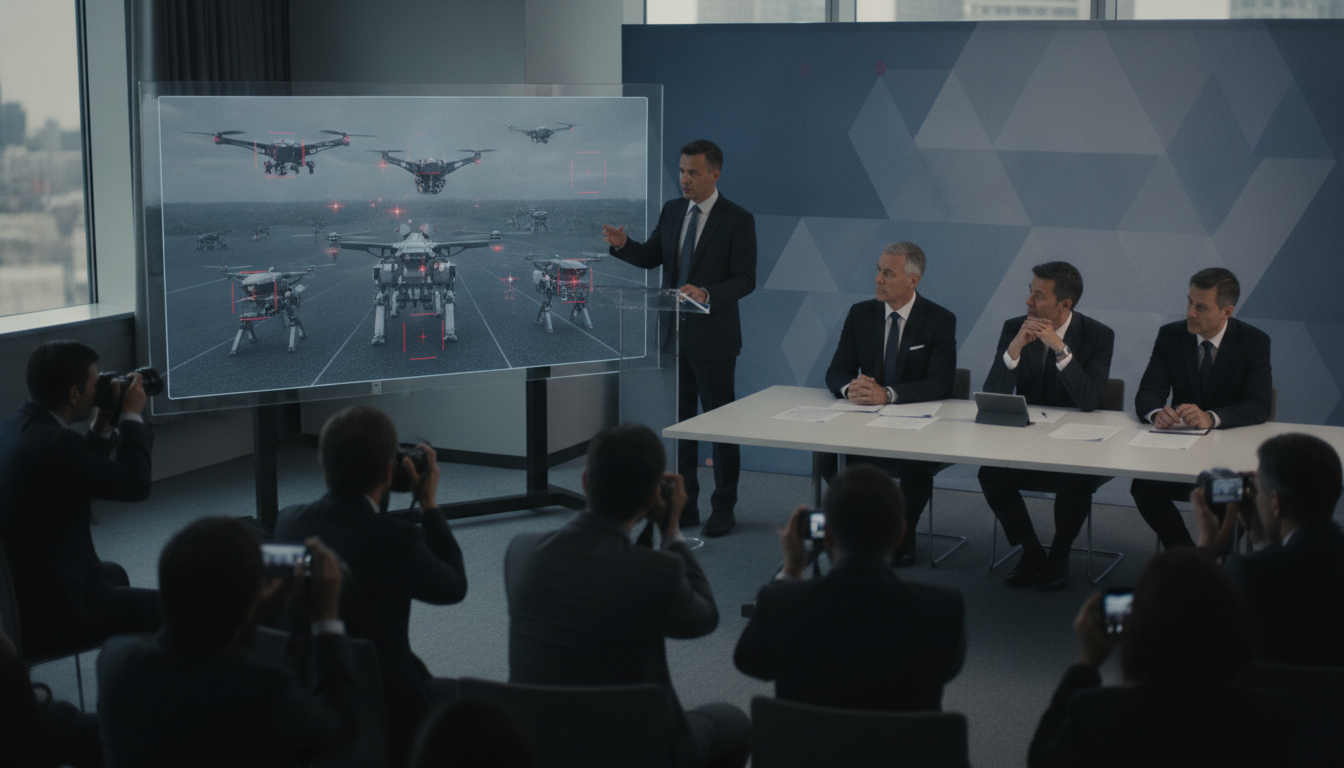
Defense Firm Unveils Autonomous Combat Concept, Spotlighting AI in Warfare
Defense firm reveals an autonomous combat concept that underscores AI in warfare — automated targeting, coordinated drones and implications for defense firms.
The company has publicly presented an autonomous combat concept that industry observers say crystallizes how AI in warfare is reshaping modern battlefields. The concept demonstrates systems that can detect, track and engage targets with limited human direction, and it highlights coordinated behaviour by drones and robots. The unveiling prompted renewed debate over operational risk, export controls and how defense contractors must adapt to faster, software-driven competition.
Company Reveals Autonomous Combat Concept
The firm chose a public demonstration to show off a suite of machine-learning driven subsystems that integrate sensors, decision algorithms and effectors. Officials said the concept is intended to illustrate feasibility rather than announce an immediate fielding plan, but the package makes clear how quickly autonomous capabilities are progressing. Industry analysts noted that even conceptual demonstrations alter procurement conversations by shifting attention from hardware platforms to software and data.
Autonomous Targeting Capabilities Demonstrated
At the core of the concept are algorithms that enable automated target recognition and tracking across multiple sensor types. Developers described how computer vision and sensor fusion allow systems to identify objects of interest under changing conditions and maintain engagement profiles. That technical progress is one of the principal reasons policymakers and military planners are reassessing doctrine for force employment.
Drones and Robots Coordinate More Effectively
The presentation also showcased cooperative behaviors among unmanned air and ground systems, with decision-making distributed across platforms rather than centralized in a single controller. This distributed coordination allows groups of autonomous systems to allocate tasks, avoid collisions and execute complementary maneuvers in real time. Such capabilities expand operational options but also complicate command relationships and raise questions about responsibility when actions are taken autonomously.
Operational Risks and Human Control Questions
Critics stress that greater autonomy increases the risk of misidentification, unintended escalation and loss of meaningful human control during fast-moving engagements. Autonomous systems can be vulnerable to adversary jamming, spoofing and adversarial inputs that produce errant behaviour. Military and civilian ethicists argue that safeguards, rigorous testing and retained human oversight are essential as AI in warfare moves from concept to deployment.
Regulatory Scrutiny and Export Concerns
The demonstration has already drawn attention from regulators and export-control authorities who monitor advanced weapons technologies. Countries debating limits on autonomous weapons point to concepts like this as evidence that new rules or guidelines may be needed to prevent destabilizing proliferation. Defense firms that develop autonomy must navigate an evolving legal and political landscape that affects international sales and partnership arrangements.
Market Shift for Defense Contractors
Commercial and strategic implications for defense contractors are significant: the value proposition is increasingly tied to algorithms, data sets and integration services rather than platform manufacturing alone. Companies that can recruit software talent, secure data pipelines and demonstrate rigorous verification regimes stand to gain an edge in future contracts. At the same time, legacy suppliers face pressure to adapt or partner with technology firms to remain competitive in an environment shaped by AI in warfare.
The concept unveiled by the company underscores a pivotal moment in defense technology where tactical advantage and ethical responsibility intersect. As militaries and governments weigh adoption, procurement decisions will likely hinge on demonstrable controls, interoperability and clear policy frameworks. Continued public scrutiny, regulatory responses and industry adjustments will determine how quickly and in what form these autonomous capabilities enter operational use.
